组成图示
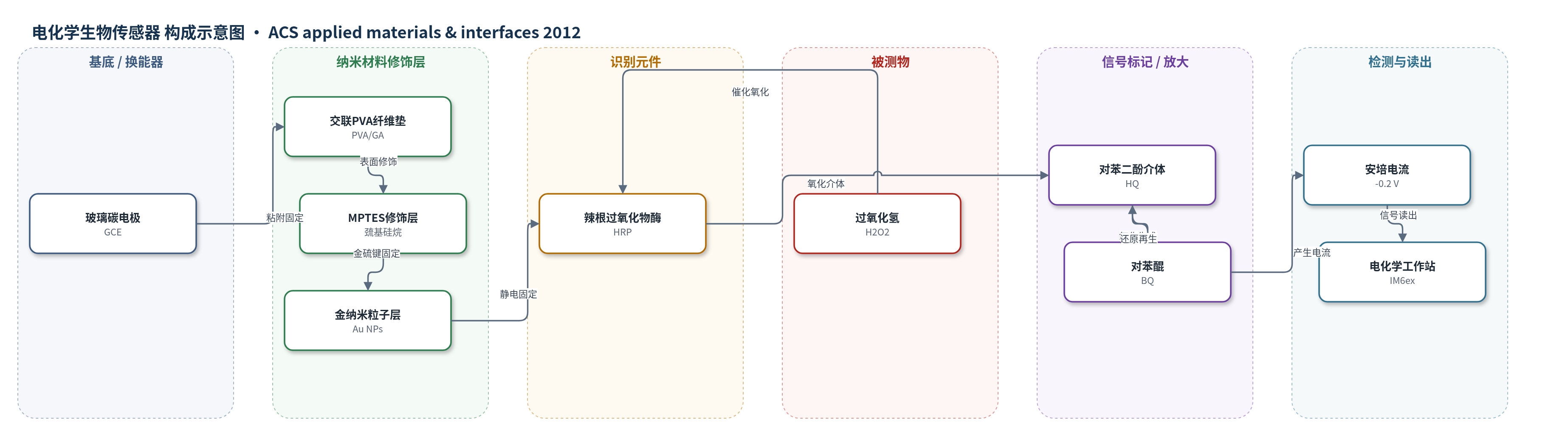
点击图片查看大图 · 依据论文自动绘制
传感器类型
电化学生物传感器
检测对象
过氧化氢(H2O2);样品基质为 0.1 M 磷酸盐缓冲液(PB, pH 6.8,含 1.0 mM 对苯二酚 HQ)
检测原理
HRP 固定在 Au NPs-PVA 纤维垫上,H2O2 进入多孔纤维网络后被 HRP 催化氧化,使 HRP 还原态氧化为氧化态并生成水;氧化态 HRP 氧化电子介体 HQ 为对苯醌 BQ,自身还原;BQ 在电极表面接受电子还原为 HQ,产生安培还原电流。Au NPs 提供导电通路和较大比表面积,促进 HRP 固定与电子传递;PVA 纳米纤维多孔结构加快 H2O2 扩散。H2O2 浓度增加时,HRP 催化循环加快,BQ 还原电流增大,在 -0.2 V 下稳态电流与 H2O2 浓度成正比。
检测灵敏度
LOD: 0.5 μM;线性范围: 1 μM–0.5 mM;R^2 = 0.999
效应效果
该传感器在 -0.2 V 下响应时间约 1 s,可达稳态电流 98%;1 μM–0.5 mM 线性良好(R^2=0.999),LOD 0.5 μM。其线性范围宽于 HRP-Au NP-TiO2 纳米管阵列(5 μM–0.4 mM)和 HRP-介孔二氧化硅空心球-Nafion/GC(3.9 μM–0.14 mM),LOD 与 HRP-Fe3O4/介孔二氧化硅(0.47 μM)、CAT/纳米 Fe3O4/Au(0.5 μM)相当,优于 HRP-DNA/GC(25 μM)。5.0 mM H2O2 下还原电流达 102 μA,高于 HRP/PVA/GCE 的 37 μA。纤维垫浸泡 24 h 仍保持形态,拉伸强度 9–16 MPa;作者认为其柔性、可裁剪、低成本、可重复使用,适合作酶基安培传感器基底。
传感器的构成
- 基底电极:玻璃碳电极(GCE),作为工作电极与信号换能器
- 水稳定纤维基底:交联聚乙烯醇(PVA)纳米纤维垫,提供柔性多孔支撑
- 硅烷修饰层:3-巯基丙基三甲氧基硅烷(MPTES),引入巯基用于固定金纳米粒子
- 纳米材料修饰层:柠檬酸稳定金纳米粒子(Au NPs),通过金-硫键均匀装饰,增强电子传递
- 识别/催化元件:辣根过氧化物酶(HRP),通过静电作用固定,催化 H2O2 氧化
- 粘结固定层:Nafion 水溶液(1 wt%),将纤维垫粘附于 GCE
- 电子介体:对苯二酚(HQ),介导 HRP 与电极间电子传递
- 缓冲介质:0.1 M 磷酸盐缓冲液(PB, pH 6.8),维持反应环境
中文摘要
电纺纳米纤维垫因柔性和多孔性被广泛研究用于组织工程、催化和生物传感器。本文报道一种简便方法制备金纳米粒子-聚乙烯醇(Au NPs-PVA)水稳定杂化纳米纤维垫,并可调节 Au NPs 密度,进一步展示其作为高效生物传感器基底材料的潜力。首先,通过设计的 PVA-戊二醛共电纺纳米纤维中原位交联,成功制备具有合适拉伸强度的水不溶 PVA 纳米纤维垫。随后,在所得 PVA 纳米纤维膜表面修饰 3-巯基丙基三甲氧基硅烷(MPTES),借助金-硫键相互作用实现 Au NPs 的均匀装饰。最后,通过静电作用将辣根过氧化物酶(HRP)嵌入 Au NPs-PVA 纳米纤维垫,用作 H2O2 检测的生物传感器基底材料。所制备的 HRP-Au NPs/PVA 生物传感器对 H2O2 实现高灵敏检测,在信噪比为 3 时检出限为 0.5 μM。通过在 PVA 纳米纤维膜上修饰其他功能纳米粒子或酶,可进一步拓展其作为不同生物传感器基底材料的应用。
英文摘要
Electrospun nanofibrous mats are intensively studied as efficient scaffold materials applied in the fields of tissue engineering, catalysis, and biosensors due to their flexibility and porosity. In this paper, we report a facile route to fabricate gold nanoparticles-poly(vinyl alcohol) (Au NPs-PVA) hybrid water stable nanofibrous mats with tunable densities of Au NPs and further demonstrate the potential application of as-prepared Au NPs-PVA nanofibrous mats as efficient biosensor substrate materials. First, through the designed in situ cross-linkage in coelectrospun PVA-glutaraldehyde nanofibers, water insoluble PVA nanofibrous mats with suitable tensile strength were successfully prepared. Then, 3-mercaptopropyltrimethoxysilane (MPTES) was modified on the surface of obtained PVA nanofibrous films, which triggered successful homogeneous decoration of Au NPs through gold-sulfur bonding interactions. Finally, the Au NPs-PVA nanofibrous mats embedded with horseradish peroxidase (HRP) by electrostatic interactions were used as biosensor substrate materials for H(2)O(2) detection. The fabricated HRP-Au NPs/PVA biosensor showed a highly sensitive detection of H(2)O(2) with a detection limit of 0.5 μM at a signal-to-noise ratio of 3. By modifying other different functional nanaoparticles or enzyme on the PVA nanofibrous film will further expand their potential applications as substrate materials of different biosensors.