组成图示
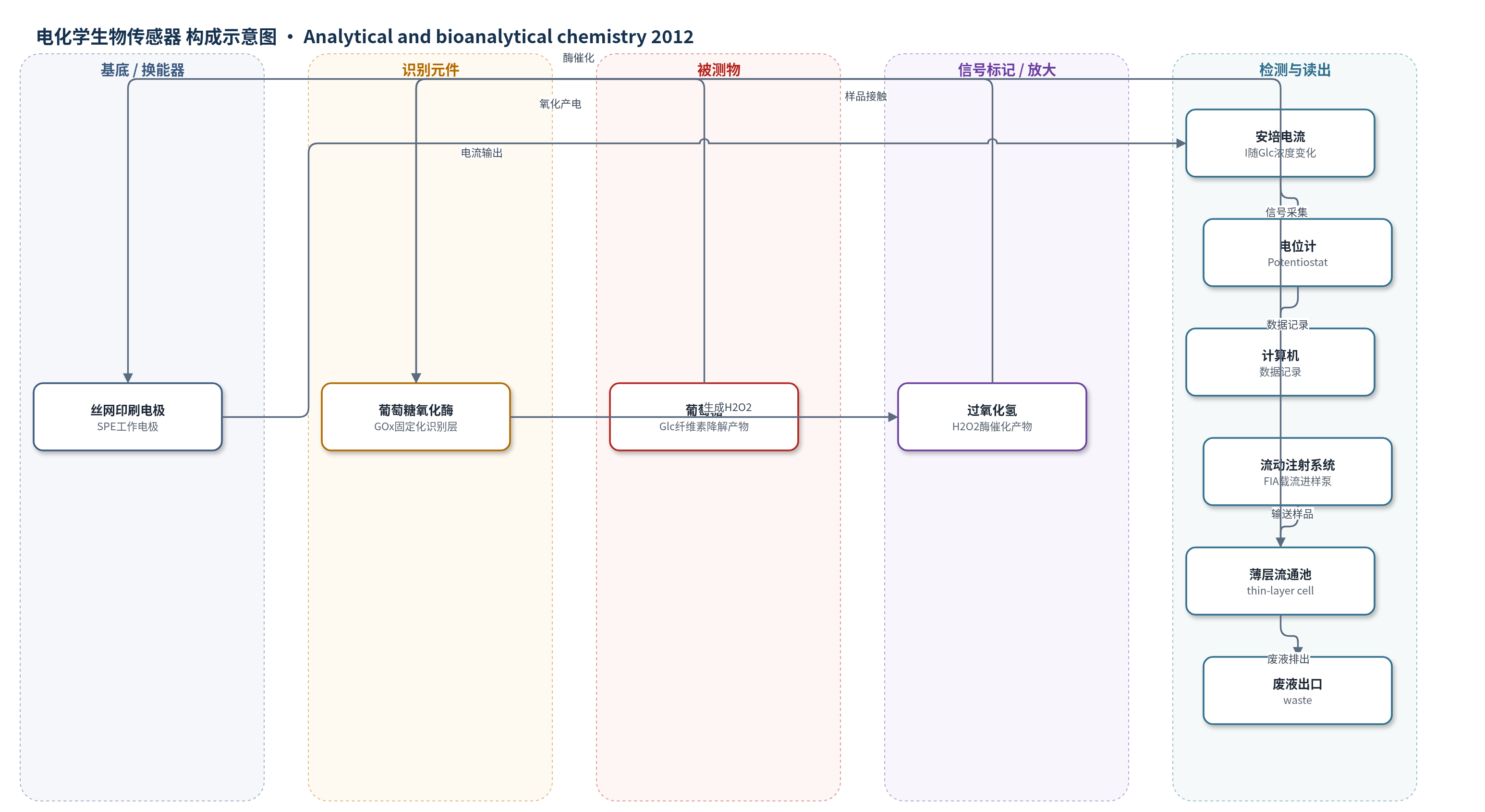
点击图片查看大图 · 依据论文自动绘制
传感器类型
电化学生物传感器
检测对象
葡萄糖(glucose, Glc);样品基质:纤维素/纤维二糖酶解液或纸本艺术品真菌攻击/清洁后的水相样品
检测原理
该检测基于葡萄糖氧化酶(GOx)对葡萄糖的特异性催化。纸本艺术品受真菌纤维素酶攻击后,纤维素/纤维二糖水解产生葡萄糖;样品经流动注射系统进入薄层流通池,葡萄糖扩散至固定化GOx层并被氧化,同时生成过氧化氢(H2O2)。H2O2在丝网印刷电极(SPE)表面发生安培氧化,释放电子形成电流。在固定电位下,电流大小与葡萄糖浓度成正比,因此可定量反映纤维素酶解程度和清洁过程中降解产物的去除量。该方法无额外信号放大,主要依靠酶催化选择性和FIA连续进样实现稳定检测。
检测灵敏度
LOD: 8×10⁻⁴ mol L−1;灵敏度: 30 nA mmol−1 L cm−2;R^2 = 0.995
效应效果
文中系统流速为350 μL min−1,在5×10⁻³ mol L−1葡萄糖下重复性RSD为4%(n=3),表明检测稳定。该方法样品量小,可在线、连续、现场分析,避免了传统破坏性物理力学测试和经验性颜色观察。选择性来自GOx对葡萄糖的酶促反应,文中未报告抗干扰和加标回收率。实际纸样清洁监控中,水凝胶应用1 h、电化学分析约5 min,1 h处理可去除真菌攻击产生的约80%葡萄糖,说明凝胶清洁有效且可确定清洁终点。作者认为该组合可用于纸本艺术品状态评估、清洁过程监控和去除淀粉胶等场景,具有非侵入、操作简便、可重复和可现场应用的价值。
传感器的构成
- 换能器电极:丝网印刷电极(SPE),作为工作电极/换能器,用于安培检测过氧化氢。
- 识别元件:葡萄糖氧化酶(GOx)固定化层,催化葡萄糖氧化并生成过氧化氢,提供选择性识别。
- 流动注射系统:载流缓冲液(carrier buffer)、注射环与进样阀(loop and injection valve)、蠕动泵(peristaltic pump),用于样品定量进样与连续输送。
- 流通池:薄层流通池(thin-layer flow-through cell),容纳SPE/GOx生物传感器,使样品与酶层接触。
- 信号读出:电位计(potentiostat)与计算机(computer),采集安培电流并记录葡萄糖浓度。
- 废液出口:废液(waste),排出反应后的样品流。
中文摘要
纸本艺术品是知识传承中最有价值的资产之一。历史纸张由不同多糖(如纤维素)、黏合剂和胶类组成。在老化过程中,这些组分因外部和内部原因发生多种降解过程,可能损害文件的保存状态。本文报道一种用于纸本艺术品保护的新生物技术策略。通过使用创新且非侵入性的材料(例如适当的水凝胶),并结合选择性电化学生物传感器,可以同时验证纸本艺术品的降解状况,然后对其进行高效清洁,同时监测污染物和降解产物的去除过程。本文聚焦于这些技术应用于纸本艺术品的具体实例,说明与传统纸张清洁方法相比,该生物技术的优势和潜力。
英文摘要
Paper-based artworks are among the most valuable assets for transmission of knowledge. Historical paper is composed of different polysaccharides (e.g. cellulose), binders, and glues. During aging all of these components undergo several degradation processes, as a result of external and intrinsic causes, and these can compromise the state of conservation of the document. In this work, application of a new biotechnological strategy for paper artefact preservation is reported. By making use of innovative and non-invasive materials, for example appropriate hydrogels, in combination with selective electrochemical biosensors, it is possible to simultaneously verify the degradation condition of the paper artwork and then to efficiently clean it, while monitoring the process of removal of both pollution and degradation products. In this paper, we focus on specific examples in which such techniques have been applied to paper artworks and that illustrate the advantages and potential of this biotechnology compared with the traditional paper-cleaning methods currently in use.