组成图示
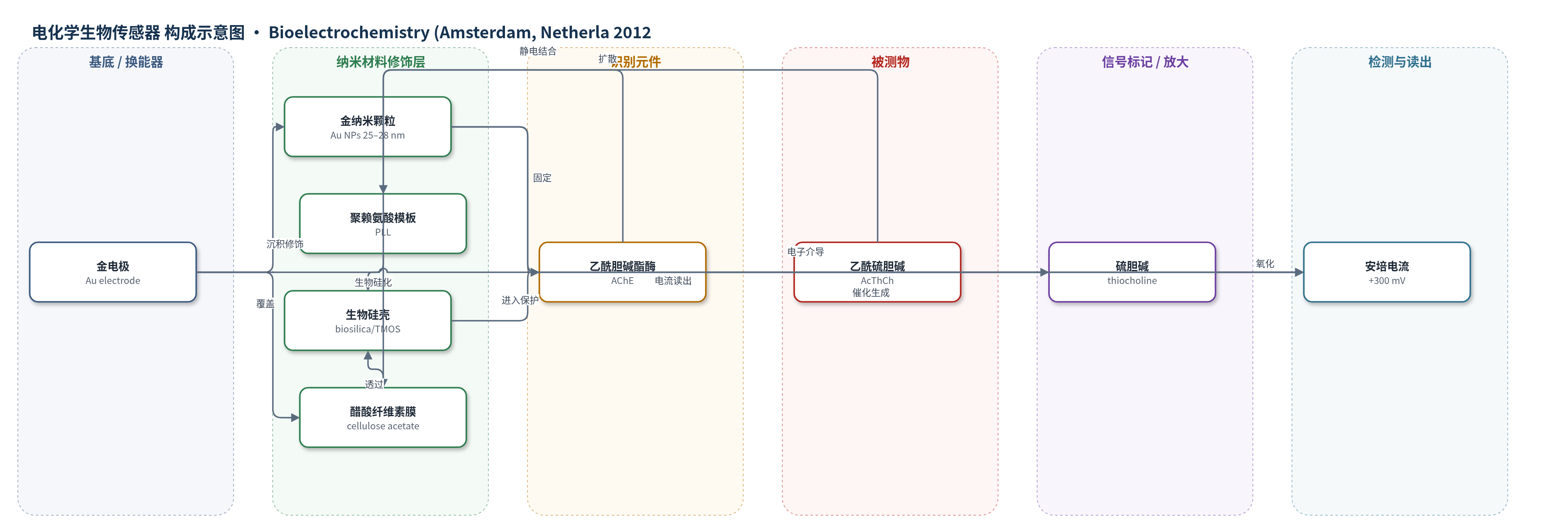
点击图片查看大图 · 依据论文自动绘制
传感器类型
电化学生物传感器
检测对象
乙酰硫胆碱氯化物(acetylthiocholine chloride, AcThCh);样品基质:磷酸盐缓冲液(25 mM, pH 7.0)
检测原理
该传感器以 AChE 为识别元件,以 Au NPs 为电子介体,以生物硅为保护壳。当样品中的乙酰硫胆碱氯化物(AcThCh)扩散穿过醋酸纤维素膜和生物硅孔道到达 AChE 活性位点时,AChE 催化其水解生成硫胆碱(thiocholine)和乙酸。生成的 thiocholine 在 +300 mV 工作电极电位下发生电化学氧化,产生阳极电流。Au NPs 将酶活性中心产生的电子快速传递至金电极,降低电子转移阻力;生物硅多孔结构允许底物和产物自由扩散,同时限制 AChE 流失并防止变性。因此,电流增量 ΔI 随 AcThCh 浓度增加而增大,在 0.04–0.4 mM 范围内呈线性,实现安培检测。
检测灵敏度
线性范围: 0.04–0.4 mM;初始灵敏度: 27.58 nA mM−1;校准方程: ΔI=1.3541+19.603*[acetylcholine chloride] (nA);RSD: ~6% (n=3)
效应效果
该传感器在 25 mM 磷酸盐缓冲液(pH 7.0)中对 AcThCh 的响应时间小于 30 s,明显快于普通 AChE 生物传感器的约 60 s。测量重现性良好,RSD 约 6%(n=3)。稳定性方面,Au NPs–AChE–PLL–biosilica 传感器在 4 个月重复测量后仍保留全部活性,113 天时剩余活性达 155%;而普通 AChE 传感器 42 天后活性降至 50%。ATR-FT-IR 和 HR-TEM 证实 AChE 成功固定于 Au NPs 并被生物硅壳包覆。作者认为该体系兼具信号介导和酶稳定化优势,适合用于 AcThCh 测定,并有望进一步用于 AChE 抑制剂检测。
传感器的构成
- 基底/换能器电极:金电极(Au electrode,1 cm2,抛光),作为工作电极提供电子转导表面
- 纳米材料修饰层:金纳米颗粒(Au NPs,25–28 nm,柠檬酸包覆),作为电子介体和酶固定平台
- 识别元件:乙酰胆碱酯酶(AChE,电鳗来源),共价结合于 Au NPs 表面,催化乙酰硫胆碱水解
- 模板/界面层:聚-L-赖氨酸(PLL,MW 20,000–30,000),带正电,与负电 AChE 静电作用并引导生物硅化
- 保护封装层:生物硅(biosilica,由 TMOS 水解缩聚形成),多孔壳层保护 AChE 免受变性和蛋白酶攻击
- 隔膜层:醋酸纤维素膜(cellulose acetate membrane),覆盖电极表面,用于保护并控制物质扩散
- 信号前体:硫胆碱(thiocholine),由 AChE 催化乙酰硫胆碱氯化物水解产生,在电极表面氧化产生电流
中文摘要
本文报道了一种基于乙酰胆碱酯酶(AChE)与金纳米颗粒(Au NPs)纳米复合物的安培生物传感器。活性 AChE 通过巯基共价结合到 Au NPs 表面,该固定化方式提高了稳定性并增强胶体 Au NPs、催化酶与换能器表面之间的电子转移。为保护酶免受变性和蛋白酶攻击,进一步在 Au NPs–AChE 纳米复合物外生长一层生物硅(biosilica)壳层。酶与金纳米颗粒的偶联以及生物硅包埋过程均通过 ATR-FT-IR 光谱监测和确认。安培法评估了包埋的稳定化效果,并对生物传感器进行了 4 个月的运行监测。生物传感器初始灵敏度为 27.58 nA mM−1,对底物浓度在 0.04–0.4 mM 范围内呈线性响应。结果表明,掺杂 Au NPs–AChE 偶联物的生物硅纳米复合材料兼具信号介导和显著酶稳定化作用,优于普通 AChE 生物传感器;4 个月后仍保留全部活性,而普通 AChE 生物传感器运行 42 天后活性降至 50%。
英文摘要
We report on the construction of an amperometric biosensor based on the immobilization of the enzyme acetylcholinesterase (AChE) onto gold nanoparticles (Au NPs). The active enzyme is covalently bound directly onto the surface of the Au NPs via a thiol bond. This immobilization provides increased stability and high electron-transfer between the colloidal Au NPs, the catalyst and the transducer surface. To further increase the biosensor stability by protecting the enzyme from denaturation and protease attack, a layer of biosilica was grown around the Au NP enzyme nanocomposite. All steps, i.e., the conjugation of the enzyme to the gold nanoparticles and the encapsulation into biosilica, are monitored and confirmed by ATR-FT-IR spectroscopy. The stabilizing effect of the entrapment was evaluated amperometrically, while the operation of the biosensor was monitored over a period of 4 months. The initial sensitivity of the biosensor was calculated to be 27.58 nA mM(-1) with a linear response to the concentration of the substrate in the range from 0.04 to 0.4 mM. It is thus shown that the biosilica nanocomposites doped with Au NPs-AChE conjugates create a system that provides both signal mediation and significant enzyme stabilization over the existing AChE biosensor. The biosensor had retained all its activity at the end of the 4 months, compared with the normal AChE biosensor whose activity reached 50% after only 42 days of operation.