组成图示
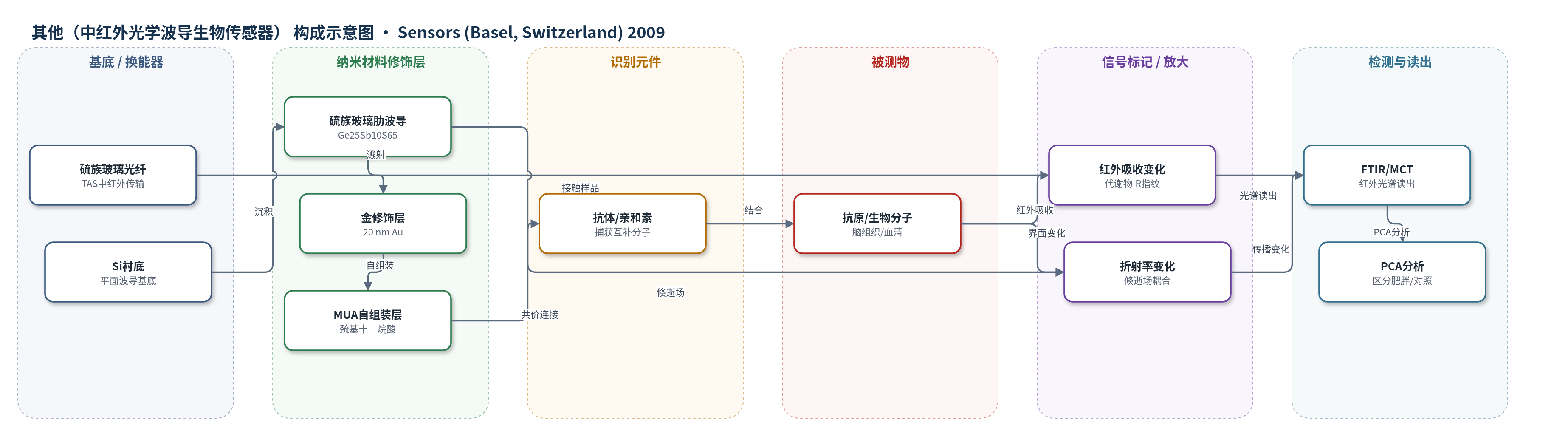
点击图片查看大图 · 依据论文自动绘制
传感器类型
其他(中红外光学波导生物传感器)
检测对象
脑代谢改变(cerebral metabolism alterations,大鼠脑组织切片)、饥饿相关代谢改变(starvation,小鼠肝脏)、肥胖/糖尿病相关血清代谢改变(obese/diabetic mouse serum,小鼠血清)
检测原理
该传感器基于中红外倏逝波光谱。红外光在Te-As-Se硫族玻璃光纤或硫族玻璃平面波导中传播,倏逝场穿透样品表面数微米;样品中蛋白质、脂质、糖类和核酸等生物分子在2–16 μm产生特征振动吸收,吸收光强随代谢物组成与浓度变化,输出端FTIR/MCT记录吸收谱。对平面波导,MUA/NHS/EDC将抗体或亲和素固定于Au表面,抗原结合后改变界面折射率,使倏逝场耦合和波导传播特性变化。锥形光纤增强光与样品相互作用,Y型节点提供参考臂以提高灵敏度与稳定性。
检测灵敏度
原文未报告LOD、线性范围、灵敏度斜率或相关系数。
效应效果
FEWS可无采样、原位实时检测。大鼠脑缺血模型中,右半球与左半球谱差异经二阶导数指认到cerebroside(1049 cm−1)、peptidoglycan(1157/1129 cm−1)、蛋白(约1300 cm−1)、氨基酸(1444 cm−1)等,缺血半球吸收降低。小鼠血清PCA在1100–1000 cm−1区分对照与肥胖,对照血糖10.7±1.1 mmol/L,肥胖32.6±3.7 mmol/L。平面波导刻蚀率300/70 nm·min−1,损耗0.5–1 dB/cm,Y节点附加损耗2–3 dB;Au/MUA/NHS/EDC/avidin功能化经PM-IRRAS确认。作者认为其具医学应用潜力。
传感器的构成
- 基底/换能器:Te-As-Se(TAS)硫族玻璃光纤,中红外传输,锥形区产生倏逝场用于接触样品
- 平面波导基底:Si衬底上Ge25Sb10S65或Ge25Sb10Se65硫族玻璃肋波导,承载光场并支持倏逝场
- 金属修饰层:20 nm Au(RF溅射)覆盖硫族玻璃表面,提供金化学功能化界面
- 自组装单分子层:1,1-巯基十一烷酸(MUA)在金表面形成SAM,提供羧基锚点
- 交联活化层:NHS/EDC活化MUA羧基,形成酰胺键以连接捕获分子
- 识别元件:抗体(antibody)或亲和素(avidin)共价固定于SAM,用于捕获互补抗原/生物分子
- 信号读出:FTIR红外光源与MCT探测器/红外光检测,通过吸收谱或波导传播特性变化读取信号
中文摘要
由于硫族玻璃具有优异的光学性能,硫族玻璃光学波导有望在光学生物传感器发展中发挥重要作用。本文报道了硫族玻璃光纤与平面波导的制备及其性能。利用在中红外波段透明的硫族玻璃光纤,作者开发了一种可快速、原位获取整体代谢改变信息的光学生物传感器。该传感器通过简单接触样品即可进行远程红外光谱检测。研究尝试确定由大鼠脑短暂局灶性缺血引起的脑代谢改变,以及小鼠饥饿状态下肝脏代谢改变所导致的光谱变化,并采用微透析法作为体内脑代谢研究的参考。在集成微传感器方面,采用反应离子刻蚀在硫族非晶薄膜上制备宽度为2至300 μm的肋波导,并用于制作Y型光节点,以实现光学互连,有望提高光学微传感器的灵敏度与稳定性。此外,还开展了硫族玻璃平面波导功能化的初步测试,以探索其作为生物传感器的应用。
英文摘要
Due to the remarkable properties of chalcogenide (Chg) glasses, Chg optical waveguides should play a significant role in the development of optical biosensors. This paper describes the fabrication and properties of chalcogenide fibres and planar waveguides. Using optical fibre transparent in the mid-infrared spectral range we have developed a biosensor that can collect information on whole metabolism alterations, rapidly and in situ. Thanks to this sensor it is possible to collect infrared spectra by remote spectroscopy, by simple contact with the sample. In this way, we tried to determine spectral modifications due, on the one hand, to cerebral metabolism alterations caused by a transient focal ischemia in the rat brain and, in the other hand, starvation in the mouse liver. We also applied a microdialysis method, a well known technique for in vivo brain metabolism studies, as reference. In the field of integrated microsensors, reactive ion etching was used to pattern rib waveguides between 2 and 300 μm wide. This technique was used to fabricate Y optical junctions for optical interconnections on chalcogenide amorphous films, which can potentially increase the sensitivity and stability of an optical micro-sensor. The first tests were also carried out to functionalise the Chg planar waveguides with the aim of using them as (bio)sensors.