组成图示
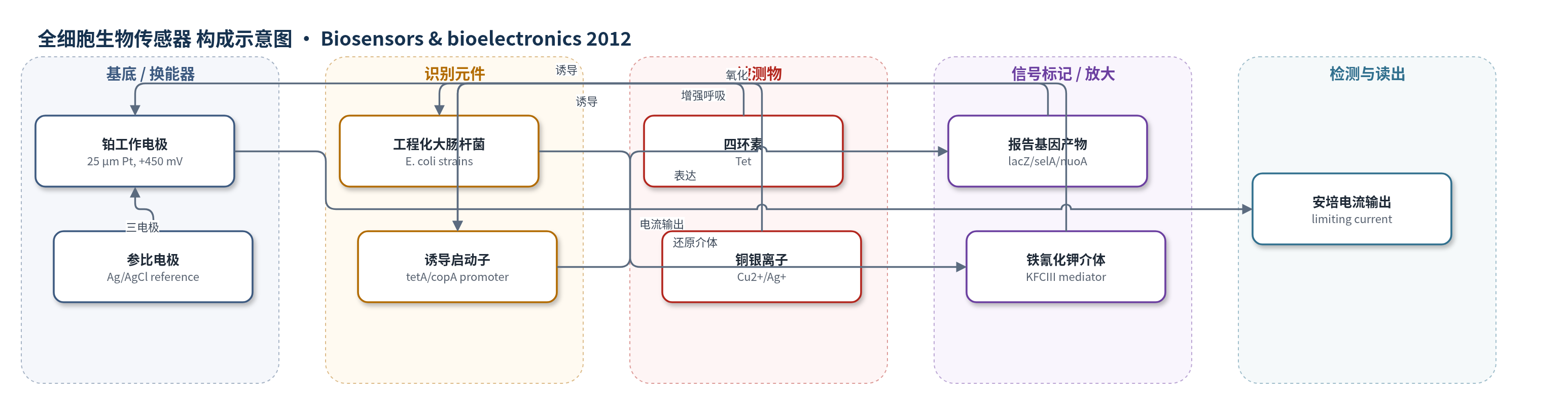
点击图片查看大图 · 依据论文自动绘制
传感器类型
全细胞生物传感器
检测对象
四环素(tetracycline, Tet,水样、牛奶)、铜离子(Cu2+,水样)、银离子(Ag+,水样)
检测原理
该体系以工程化大肠杆菌为全细胞识别元件。当样品中存在四环素(Tet)时,Tn10 tetA启动子去阻遏,诱导lacZ、selA或nuoA表达;当存在Cu2+或Ag+时,copA启动子诱导nuoA表达。lacZ表达β-半乳糖苷酶,使菌利用乳糖获得碳源;nuoA表达NADH脱氢酶I亚基,增强呼吸链电子传递。菌体代谢/呼吸产生的电子经电子传递链转移至外部介体铁氰化钾(KFCIII),将其还原为KFCII。KFCII扩散至+450 mV的Pt工作电极并被氧化,产生与还原介体量成正比的阳极极限电流。因此,亚抑制浓度Tet或Cu/Ag诱导表达量增加,呼吸/代谢增强,电流升高;高浓度Tet可能因过表达形成包涵体导致信号下降。
检测灵敏度
lacZ: LOD: 0.11 μg ml−1;线性范围: 0.1–1 μg ml−1;y = 0.56x + 1.02;R^2 = 0.99。nuoA: LOD: 0.0026 μg ml−1;线性范围: 0–0.01 μg ml−1;y = 45.75x + 1.05;R^2 = 0.96。selA: LOD: 1.45 μg ml−1;线性范围: 0–10 μg ml−1;y = 0.07x + 1.04;R^2 = 0.99。未修饰SciTox: LOD: 4.11 mg ml−1;y = 1.27x + 1.85;R^2 = 0.99。
效应效果
lacZ和nuoA菌株对Tet呈剂量依赖响应,对亚抑制浓度Tet特异灵敏;selA体系灵敏度不足。未修饰SciTox对Tet的LOD为4.11 mg ml−1,文中称其LOD比pSong8高约40倍,pSong8约比未修饰体系灵敏一个数量级;nuoA比lacZ灵敏近两个数量级。选择性方面,nuoA体系对氨苄西林和卡那霉素无响应,并能在牛奶中检测Tet;对Cu/Ag呈剂量依赖响应,未修饰菌在10 μM CuSO4和10 μM AgNO3下无非特异响应,Mg2+无显著差异。菌株-80 ℃保存未见不稳定。作者认为nuoA可作为安培生物传感器呼吸报告基因,使SciTox发展为对Tet、Cu、Ag特异灵敏的检测系统,lacZ与nuoA可互补扩大定量范围。
传感器的构成
- 换能器电极:25 μm platinum working electrode(Pt工作电极,置于+450 mV,氧化还原态介体并输出电流)
- 参比/辅助电极:Ag/AgCl reference electrode与auxiliary electrode(三电极体系,维持电位与电流回路)
- 反应介质:phosphate buffer / phosphate saline buffer supporting electrolyte(提供离子环境,支持微电极安培测量)
- 生物识别元件:genetically modified E. coli strains E. coli(pSong8)、E. coli(pSong9)、E. coli(pSong10)、E. coli(pSong11)(全细胞识别,响应Tet或Cu/Ag)
- 诱导启动子:Tn10 tetA promoter与copper-inducible copA promoter(分别被Tet或Cu/Ag去阻遏/诱导)
- 报告基因/信号放大元件:lacZ(β-galactosidase)、selA(selenocysteine synthase)、nuoA(NADH dehydrogenase I subunit)(诱导后改变碳代谢或呼吸电子传递)
- 电子介体/信号标记物:potassium ferricyanide(KFCIII,250 mM)(替代氧气接受呼吸链电子,被还原为KFCII)
- 碳源/底物:lactose(252 mM,用于E. coli(pSong8))(lacZ诱导后提供可代谢碳源,增强呼吸电流)
中文摘要
本研究比较了三种基于基因诱导表达的工程化大肠杆菌生物传感器菌株,用于在SciTox检测体系中安培法测定抗生素四环素(Tet)。三种策略均利用Tn10 tetA启动子响应Tet,分别诱导表达lacZ、selA和nuoA基因。结果表明,lacZ和nuoA生物传感器对亚抑制浓度Tet具有特异且灵敏的响应,而selA体系灵敏度不足。lacZ和nuoA菌株对Tet的检出限分别为0.11 μg ml−1和0.0026 μg ml−1,线性范围分别为0.1–1 μg ml−1和0–0.01 μg ml−1。与既往作为安培生物检测报告基因的lacZ相比,nuoA是新型且更灵敏的报告基因,也是首次将呼吸基因用作安培生物传感器报告基因。为验证该体系能否检测其他化学物质,作者将nuoA基因改由铜诱导copA启动子驱动,所得菌株可特异检测铜离子和银离子。
英文摘要
Three separate genetic strategies, based upon the induced expression of three different genes (lacZ, selA and nuoA) were tested to provide the SciTox assay with sensitive and specific detection of the antibiotic tetracycline (Tet). All three strategies relied on gene induction from the Tn10 tetA promoter. Both lacZ and nuoA biosensors responded specifically and sensitively to sub-inhibitory concentrations of Tet. However, the selA-based assay was not sensitive enough to detect Tet in the SciTox assay. The detection limits for Tet of the lacZ and nuoA biosensor strains were 0.11 μg ml(-1) and 0.0026 μg ml(-1), respectively, and their linear ranges were 0.1-1 μg ml(-1) and 0-0.01 μg ml(-1), respectively. While lacZ has previously been used as a reporter gene in an amperometric bioassay, nuoA is a novel and more sensitive reporter gene. This is the first report in which a respiratory gene was used as a reporter gene in an amperometric biosensor. The results indicate that this approach can produce a highly sensitive detection system. In order to test whether the new system could be used to detect other chemicals, the nuoA gene was re-engineered to be driven by the copper-inducible copA promoter. Using this strain, the SciTox assay was found to be able to specifically detect copper and silver ions.