组成图示
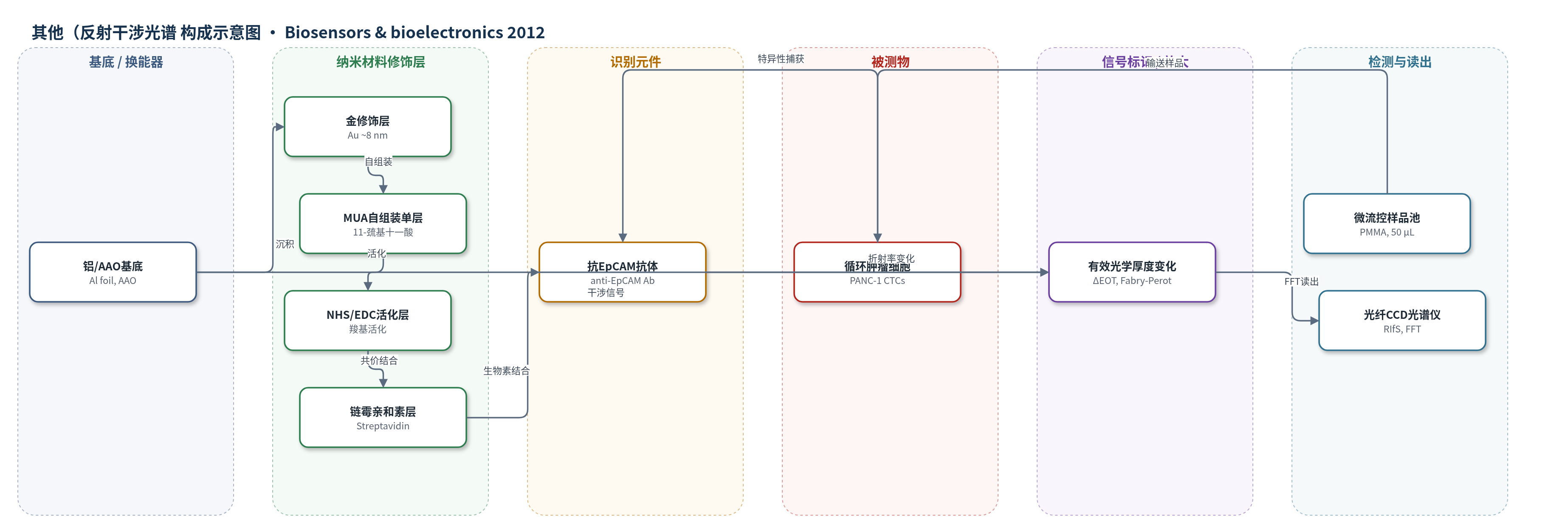
点击图片查看大图 · 依据论文自动绘制
传感器类型
其他(反射干涉光谱(RIfS)微流控生物传感器)
检测对象
循环肿瘤细胞(circulating tumour cells, CTCs;PANC-1胰腺癌细胞);样品基质:PBS、全血(1:10 PBS稀释)
检测原理
该传感器采用无标记反射干涉光谱(RIfS)原理。白光垂直照射AAO多孔层时,在AAO上下表面反射光发生干涉,形成Fabry–Perot条纹;条纹位置取决于有效光学厚度EOT=2neffL。AAO表面经Au、MUA、NHS/EDC、链霉亲和素和生物素化抗EpCAM抗体功能化后,可特异性捕获表达EpCAM的循环肿瘤细胞。细胞结合使AAO表面及孔内介质折射率升高,导致干涉条纹波长红移;经FFT将光谱转换为ΔEOT–时间曲线。随着CTC浓度增加,表面捕获细胞数增加,ΔEOT增大;在1000–10,000 cells/mL呈线性,高于100,000 cells/mL趋于饱和。PBS冲洗去除未结合细胞,保留特异性结合信号。
检测灵敏度
LOD: <1000 cells/mL;线性范围: 1000–10,000 cells/mL;检测范围: 1000–100,000 cells/mL
效应效果
选择性方面,100,000 cells/mL非EpCAM阳性Jurkat细胞仅引起<2 nm EOT变化,PBS冲洗后恢复基线;同型抗体芯片对100,000 cells/mL PANC-1仅产生<1 nm可逆变化,而抗EpCAM芯片对同浓度PANC-1产生>32 nm变化。全血实验中,全血或全血加Jurkat 10,000 cells/mL引起约13 nm EOT变化,全血加PANC-1 10,000 cells/mL引起19 nm变化。响应时间约300±30 s达到90%峰值,总测量<5 min,样品体积50 μL,流速6 μL/min;12 μL/min高流速下信号延迟且冲洗后回基线。未报告RSD、回收率或长期稳定性,但作者认为无需荧光标记和富集,适合快速低成本床旁CTC检测。
传感器的构成
- 基底/换能器:铝片(Al foil)经两步电化学阳极氧化形成纳米多孔阳极氧化铝(AAO),孔径32±3 nm、深度4±0.2 μm,作为RIfS Fabry–Perot干涉传感平台
- 金属修饰层:约8 nm金(Au)薄膜,通过金属蒸气沉积于AAO表面,为硫醇自组装提供锚定基底
- 自组装单层:11-巯基十一酸(MUA)在Au表面形成含羧基末端SAM,提供偶联位点并减少非特异结合
- 偶联激活层:N-羟基琥珀酰亚胺(NHS)与乙基(二甲基氨基丙基)碳二亚胺(EDC)活化MUA羧基,用于共价结合链霉亲和素
- 桥接/封闭层:链霉亲和素(Streptavidin)共价结合于活化SAM,用于结合生物素化抗体;乙醇胺-HCl封闭剩余活化羧基
- 识别元件:生物素化抗EpCAM抗体(biotinylated anti-EpCAM antibody)通过生物素–链霉亲和素作用固定,特异性捕获表达EpCAM的循环肿瘤细胞
- 微流控样品池:聚甲基丙烯酸甲酯(PMMA)热压印微流控芯片与硼硅酸盐玻璃盖片构成样品通道,使50 μL样品以6 μL/min流过AAO表面
中文摘要
本文报道了一种基于反射干涉光谱(RIfS)的无标记微芯片生物传感器,用于检测循环肿瘤细胞(CTCs)。该传感器以铝片经两步电化学阳极氧化制备的高度有序纳米多孔阳极氧化铝(AAO)为传感平台,AAO 的纳米孔结构可产生强 Fabry–Perot 干涉信号。通过多步表面功能化,将生物素化抗 EpCAM 抗体共价固定于 AAO 表面,使其特异性结合上皮来源的胰腺癌细胞 PANC-1 等表达 EpCAM 的肿瘤细胞。所设计的微流控芯片将 AAO RIfS 传感区与样品通道集成,无需荧光标记或预富集即可直接检测 PBS 或全血中低数量胰腺癌细胞。结果表明,该器件可在 1000–100,000 cells/mL 范围内选择性检测肿瘤细胞,检出限低于 1000 cells/mL,响应时间小于 5 min,样品体积仅 50 μL。该方法有望发展为快速、低成本的床旁诊断装置,用于转移性癌症患者 CTCs 的检测。
英文摘要
In this report, a label-free reflectometric interference spectroscopy (RIfS) based microchip biosensor for the detection of circulating tumour cells (CTCs) is demonstrated. Highly ordered nanoporous anodic aluminium oxide (AAO) fabricated by electrochemical anodization of aluminium foil was used as the RIfS sensing platform. Biotinylated anti-EpCAM antibody that specifically binds to human cancer cells of epithelial origin such as pancreatic cancer cells (PANC-1) was covalently attached to the AAO surface through multiple surface functionalization steps. Whole blood or phosphate buffer saline spiked with low numbers of pancreatic cancer cells were successfully detected by specially designed microfluidic device incorporating an AAO RIfS sensor, without labour intensive fluorescence labelling and/or pre-enhancement process. Our results show that the developed device is capable of selectively detecting of cancer cells, within a concentrations range of 1000-100,000 cells/mL, with a detection limit of <1000 cells/mL, a response time of <5 min and sample volume of 50 μL of. The presented RIfS method shows considerable promise for translation to a rapid and cost-effective point-of-care diagnostic device for the detection of CTCs in patients with metastatic cancer.