组成图示
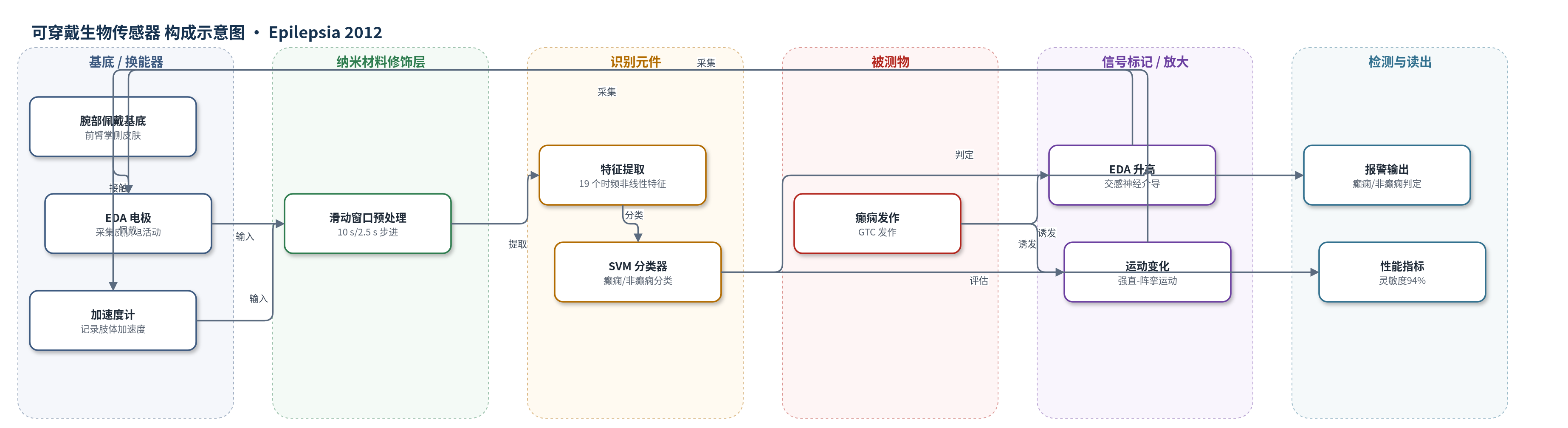
点击图片查看大图 · 依据论文自动绘制
传感器类型
可穿戴生物传感器
检测对象
全身强直-阵挛癫痫发作(generalized tonic-clonic seizures, GTC/GTCS);样品基质:癫痫患者腕部 EDA 与加速度计连续记录(临床长期视频 EEG 监测环境)
检测原理
癫痫发作时,大脑异常放电激活自主神经系统,交感神经介导汗腺活动增强,使皮肤电活动(EDA)升高;同时全身强直-阵挛发作产生节律性肢体运动,使加速度计信号发生特征性变化。腕戴式传感器将皮肤电和加速度转换为连续电信号,算法以 10 秒滑动窗口提取 19 个时域、频域和非线性特征,形成特征向量。支持向量机(SVM)根据这些特征判别癫痫或非癫痫事件。EDA 提供发作相关的自主神经信息,加速度提供运动信息,二者融合相当于对弱运动或早期发作信号进行特征级增强,从而提高检出率并降低误报。
检测灵敏度
原文未报告 LOD、线性范围、灵敏度斜率或相关系数;检测灵敏度: 94%(15/16 GTC 发作);误报率: 0.74 次/24 h。
效应效果
80 名患者 >4213 h 中,半患者特异算法检出 15/16 次 GTC(94%),130 次误报(0.74 次/24 h)。7 名 GTC 患者 688 h 中误报 28 次(0.98 次/24 h),平均 1.05±0.71 次/24 h;非患者特异模式 88%(14/16),约 1 次/24 h。73 名无 GTC 患者 3525 h 中误报 102 次(0.69 次/24 h),63% 无误报,77% <1 次/24 h。中位电生理延迟 42.95 s,临床延迟 31.42 s。仅加速度计误报 1.5 次/24 h,加入 EDA 降至 1 次/24 h。误报多由快速节律运动触发,可作癫痫报警。
传感器的构成
- 佩戴基底:前臂掌侧皮肤(ventral side of forearms),作为腕戴传感器接触界面
- 换能器电极层:EDA 电极(electrode,材料未报告),采集皮肤电活动
- 运动换能层:加速度计(accelerometry sensor),记录肢体运动加速度
- 信号预处理层:滑动窗口(sliding window,10 s 片段、2.5 s 步进),去除非运动和非节律片段
- 特征识别层:19 个时域、频域和非线性特征(features),构成 EDA 与加速度特征向量
- 分类决策层:支持向量机(SVM),将特征向量分类为癫痫或非癫痫
中文摘要
为满足日常使用癫痫发作检测器在成本、舒适性和社会接受度方面的特殊要求,作者开发了一种基于交感神经介导的皮肤电活动(EDA)和加速度计信号的全身强直-阵挛(GTC)癫痫发作自动检测算法,并使用新型腕戴式生物传感器采集信号。检测问题被建模为监督学习任务:对 EDA 和加速度记录中的 10 秒片段,提取 19 个时域、频域和非线性特征,采用支持向量机(SVM)将其分类为癫痫或非癫痫事件。算法采用双重交叉验证评估,并在 80 名癫痫患者的超过 4213 小时记录中测试。半患者特异模式在 7 名患者的 16 次 GTC 发作中检出 15 次(94%),产生 130 次误报(平均 0.74 次/24 小时)。该算法有望为照护者提供癫痫发作报警系统,并客观量化发作频率。
英文摘要
The special requirements for a seizure detector suitable for everyday use in terms of cost, comfort, and social acceptance call for alternatives to electroencephalography (EEG)-based methods. Therefore, we developed an algorithm for automatic detection of generalized tonic-clonic (GTC) seizures based on sympathetically mediated electrodermal activity (EDA) and accelerometry measured using a novel wrist-worn biosensor. The problem of GTC seizure detection was posed as a supervised learning task in which the goal was to classify 10-s epochs as a seizure or nonseizure event based on 19 extracted features from EDA and accelerometry recordings using a Support Vector Machine. Performance was evaluated using a double cross-validation method. The new seizure detection algorithm was tested on >4,213 h of recordings from 80 patients and detected 15 (94%) of 16 of the GTC seizures from seven patients with 130 false alarms (0.74 per 24 h). This algorithm can potentially provide a convulsive seizure alarm system for caregivers and objective quantification of seizure frequency.