组成图示
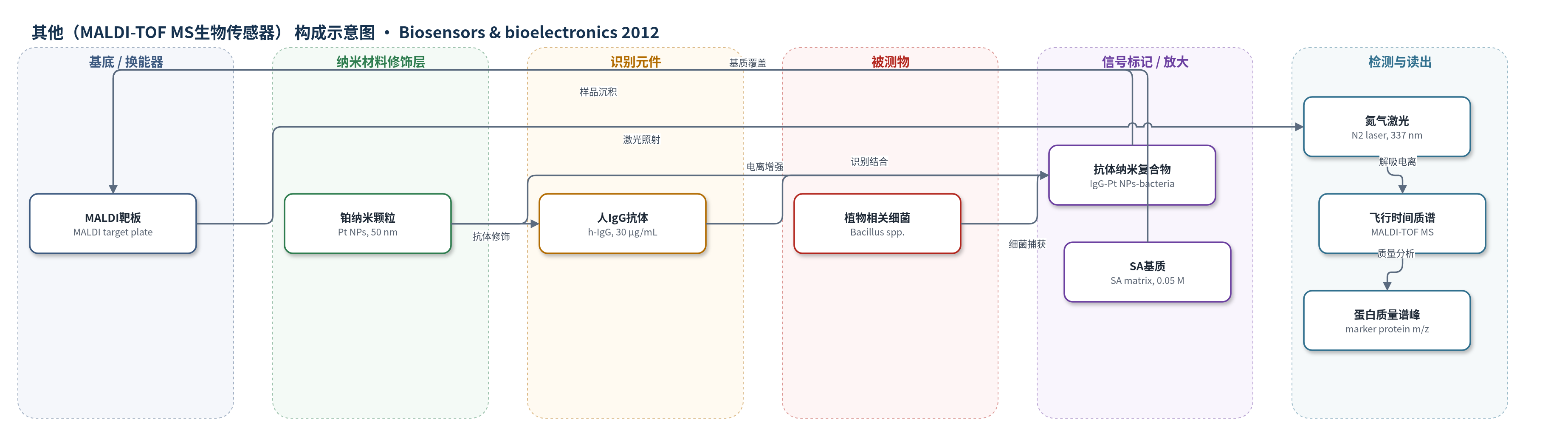
点击图片查看大图 · 依据论文自动绘制
传感器类型
其他(MALDI-TOF MS生物传感器)
检测对象
苏云金芽孢杆菌(Bacillus thuringiensis)、枯草芽孢杆菌(Bacillus subtilis);样品基质:胡萝卜根际土壤(rhizospheric soil)、胡萝卜根(roots)
检测原理
h-IgG在pH 6.0下带净正电荷,与Pt NPs表面阴离子通过离子相互作用结合,形成IgG-Pt NPs。该复合物中的IgG识别并结合细菌细胞表面,将B. thuringiensis或B. subtilis捕获并富集到纳米颗粒上;TEM证实未修饰Pt NPs无附着,而IgG-Pt NPs可附着于菌体。随后样品与SA基质混合干燥,337 nm N2激光照射时,Pt NPs作为亲和探针/电离增强剂提高细菌蛋白的解吸电离效率,使低浓度细菌蛋白产生可检测的MALDI-TOF MS信号。细菌浓度越高,形成的IgG-Pt NPs-细菌复合物越多,特征蛋白峰越强;通过与标准株m/z峰匹配实现鉴定。
检测灵敏度
原文未报告本方法LOD、线性范围、灵敏度斜率或R^2;仅提及直接MALDI-TOF MS细菌检测限>10^7 cfu/mL,目标样品浓度为4×10^5 cfu/mL。
效应效果
在4×10^5 cfu/mL样品中,直接MALDI-TOF MS峰弱,而IgG-Pt NPs辅助后细菌蛋白峰显著增强;未修饰Pt NPs无附着,说明识别依赖IgG。TEM重复至少3次,显示表面附着可重复;蛋白峰在m/z±10内视为可重复。与标准株比对,B. thuringiensis和B. subtilis分别获得多组特征m/z峰,表明能从复杂土壤/根样品中选择性富集目标菌。方法无需形态、分子或生化确认,较传统培养鉴定更快,作者认为可用于环境样品中有益PAB快速检测。
传感器的构成
- 基底/换能器:MALDI靶板(MALDI target plate)与Microflex MALDI-TOF MS离子源,承载样品并接受N2激光(337 nm)解吸电离
- 纳米材料修饰层:铂纳米颗粒(Pt NPs,平均约50 nm),由H2PtCl6经NaBH4还原制备,作为MALDI亲和探针和电离增强剂
- 识别元件:人血清免疫球蛋白G(h-IgG,30 μg/mL),通过离子相互作用结合到Pt NPs表面,形成IgG-Pt NPs用于识别细菌细胞表面
- 信号标记/放大元件:IgG-Pt NPs复合物,结合细菌后富集细菌蛋白并增强MALDI蛋白峰强度
- MALDI基质:3,5-二甲氧基-4-羟基肉桂酸(SA,0.05 M,乙腈:水=3:1 v/v,含0.1% TFA),辅助激光解吸电离
- 样品/被测物:苏云金芽孢杆菌(B. thuringiensis)和枯草芽孢杆菌(B. subtilis)悬液(4×10^5 cfu/mL),来自胡萝卜根际土壤和根
中文摘要
本研究将基质辅助激光解吸电离飞行时间质谱(MALDI-TOF MS)作为生物传感器,用于快速检测胡萝卜根际土壤和根中的植物相关细菌(PAB)。传统细菌鉴定依赖培养、形态、生化或分子方法,耗时长且依赖已知序列;MALDI-TOF MS可通过蛋白谱快速识别,但对低浓度细菌直接检测受限。作者以人血清免疫球蛋白G(h-IgG)功能化铂纳米颗粒(Pt NPs),形成IgG-Pt NPs亲和探针,利用其离子化/富集作用增强细菌蛋白信号。该方法成功从胡萝卜根际土壤和根中检出苏云金芽孢杆菌(Bacillus thuringiensis)和枯草芽孢杆菌(B. subtilis),无需形态、分子和生化测试。结果表明,即使在较低浓度下细菌也可被直接检测,方法简单、快速、灵敏,可用于环境样品中有益PAB的鉴定。
英文摘要
This study is based on the application of matrix-assisted laser desorption/ionization time of flight mass spectrometry (MALDI-TOF MS) as biosensor to detect the plant associated bacteria (PAB) isolates from rhizospheric soil and root. The rapid bacterial detection via on particle ionization/enrichment technique using IgG functionalized Pt NPs (IgG-Pt NPs) assisted MALDI-TOF MS was successfully used to explore two PAB isolates, namely, Bacillus thuringiensis and B. subtilis from rhizospheric soil and roots of carrot plant. When these bacteria are used as bioformulations in agricultural as well as biotechnological applications, the plant growth promotion of economic crops was observed especially when the crops grow in less fertilize soil regions. This study proved that even at low concentrations, bacteria can also be directly detected without morphological, molecular and biochemical test. The current applied technique is simple, rapid and highly sensitive. Besides, it could be widely used for the detection of beneficially important PAB isolates in environmental samples.