组成图示
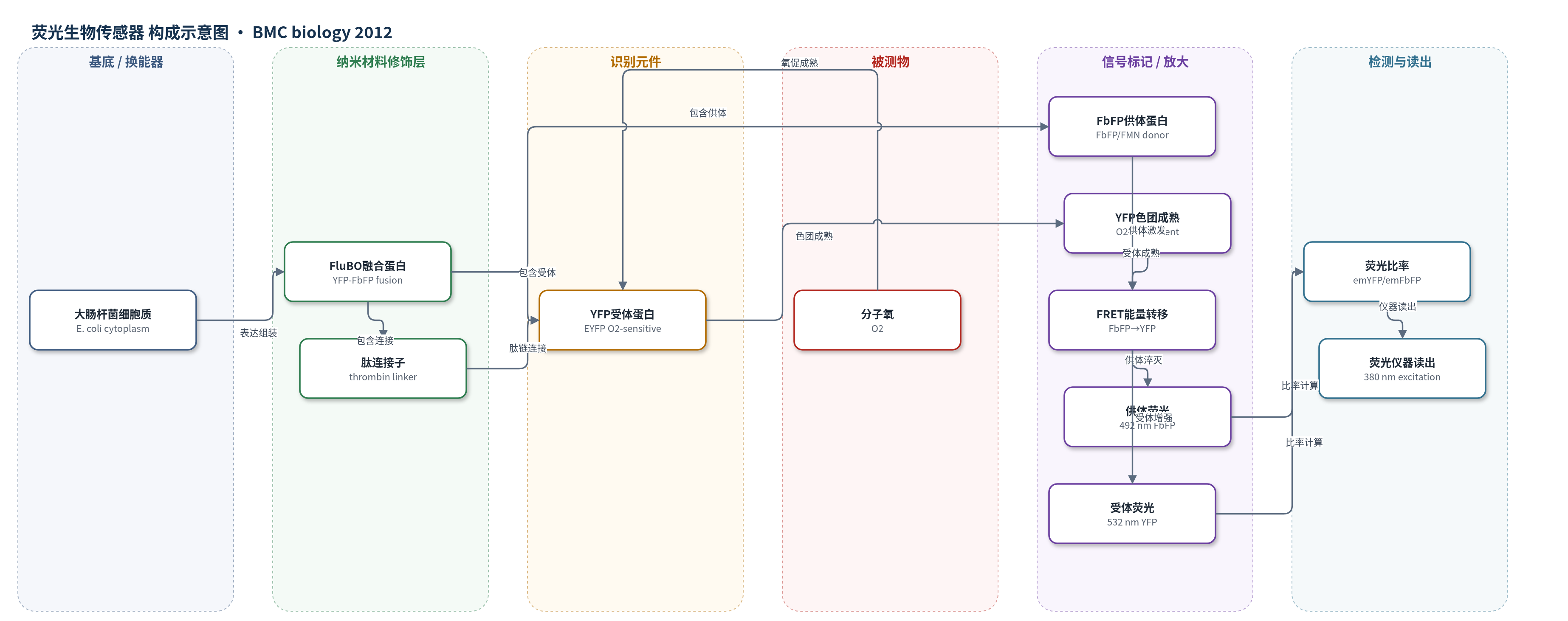
点击图片查看大图 · 依据论文自动绘制
传感器类型
荧光生物传感器
检测对象
分子氧(molecular oxygen, O2);样品基质:大肠杆菌(E. coli)细胞质/批次培养体系
检测原理
FluBO 由 FbFP 供体、肽连接子和 YFP 受体组成。FbFP 含 FMN 色团,其荧光不依赖 O2;YFP 色团形成需要 O2。当细胞内 O2 充足时,YFP 色团成熟,FbFP 发射光谱与 YFP 吸收光谱重叠,发生 FRET,FbFP 荧光被淬灭,YFP 荧光增强;缺氧时 YFP 不能成熟,FRET 效率下降,FbFP 荧光保持而 YFP 荧光较弱。用 380 nm 激发,分别检测 492 nm FbFP 和 532 nm YFP 发射,计算 YFP/FbFP 比率或荧光寿命变化,比率随 O2 升高而升高。由于 YFP 成熟不可逆,氧下降可通过比率随时间变化 d(ratio)/dt 间接反映。
检测灵敏度
线性范围: DOT 0–33%(对应 O2 至 0.08 mmol/l)
效应效果
FluBO 在大肠杆菌批次培养中与溶氧张力(DOT)在线监测呈良好相关,空载体背景荧光比率变化轻微且与 DOT 无关,表明细胞本底干扰低。FLIM 显示 FbFP 平均寿命 2.73 ns,FluBO 为 1.74 ns,Δτ 0.99 ns,表观 FRET 效率 37%;双指数分析中短寿命 τ1=1.03 ns、振幅 67%,对应约 62% 的 FRET 效率,优于 CFP-YFP 的 25.0%。所用 EYFP 的 pKa 为 5.2,生理 pH 范围内稳定;Cl- 至 100 mM 不影响荧光。三次平行发酵结果高度一致,最大时间偏移 10 min。校准曲线覆盖 DOT 0–33%(O2 至 0.08 mmol/l)。作者认为其可非侵入、比率化、高时空分辨率监测活细胞缺氧。
传感器的构成
- 供体荧光蛋白:FbFP(黄素结合荧光蛋白,FMN 色团),氧不敏感,作为 FRET 供体。
- 肽连接子:含凝血酶切割位点的短肽 linker,连接 YFP 与 FbFP,维持 FRET 距离并可切割验证。
- 受体荧光蛋白:YFP(增强型黄色荧光蛋白,EYFP 变体),氧敏感,色团成熟依赖 O2,作为 FRET 受体。
- 融合蛋白:FluBO(YFP-FbFP 融合蛋白),整体遗传编码氧传感器,FRET 效率随 O2 变化。
- 表达载体:pRhotHi-2-FluBO 质粒,携带 FluBO 基因,用于大肠杆菌表达。
- 宿主细胞:E. coli(大肠杆菌),提供细胞质环境并表达 FluBO,作为检测基质。
中文摘要
分子氧(O2)是所有专性和兼性需氧原核及真核生物的关键代谢物,在能量稳态中起核心作用;缺氧则广泛影响多种生理和病理生理过程。因此,实时监测细胞内氧水平是分析活细胞和组织中缺氧诱导过程的基本前提。本研究开发了一种遗传编码的 Förster 共振能量转移(FRET)生物传感器,用于观察活细胞内分子氧浓度的动态变化。该传感器命名为 FluBO(基于荧光蛋白的氧传感器),由对缺氧敏感的黄色荧光蛋白(YFP)和耐缺氧的黄素结合荧光蛋白(FbFP)组成。由于 O2 是 YFP 色团形成所必需的,FbFP 供体结构域向 YFP 受体结构域的有效 FRET 仅在存在氧时发生,而在缺氧时不发生。该氧传感器被用于在大肠杆菌批次培养过程中连续实时监测细胞质中 O2 水平的时间变化。结果表明,FluBO 是一种独特的 FRET 型氧传感器,可实现细胞氧的非侵入性比率读出,可作为研究缺氧发生及其对多种(病理)生理过程影响的新型有力探针。
英文摘要
BACKGROUND: Molecular oxygen (O2) is one of the key metabolites of all obligate and facultative aerobic pro- and eukaryotes. It plays a fundamental role in energy homeostasis whereas oxygen deprivation, in turn, broadly affects various physiological and pathophysiological processes. Therefore, real-time monitoring of cellular oxygen levels is basically a prerequisite for the analysis of hypoxia-induced processes in living cells and tissues.
RESULTS: We developed a genetically encoded Förster resonance energy transfer (FRET)-based biosensor allowing the observation of changing molecular oxygen concentrations inside living cells. This biosensor named FluBO (fluorescent protein-based biosensor for oxygen) consists of the yellow fluorescent protein (YFP) that is sensitive towards oxygen depletion and the hypoxia-tolerant flavin-binding fluorescent protein (FbFP). Since O2 is essential for the formation of the YFP chromophore, efficient FRET from the FbFP donor domain to the YFP acceptor domain only occurs in the presence but not in the absence of oxygen. The oxygen biosensor was used for continuous real-time monitoring of temporal changes of O2 levels in the cytoplasm of Escherichia coli cells during batch cultivation.
CONCLUSIONS: FluBO represents a unique FRET-based oxygen biosensor which allows the non-invasive ratiometric readout of cellular oxygen. Thus, FluBO can serve as a novel and powerful probe for investigating the occurrence of hypoxia and its effects on a variety of (patho)physiological processes in living cells.