组成图示
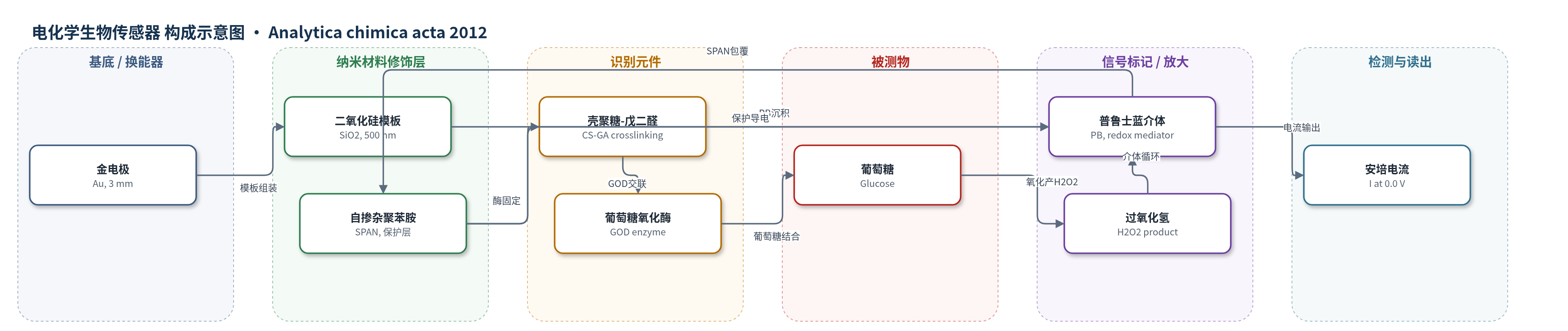
点击图片查看大图 · 依据论文自动绘制
传感器类型
电化学生物传感器
检测对象
葡萄糖(glucose, Glc);样品基质:人血清/血液样品(human serum/blood samples)
检测原理
该传感器采用双酶级联式电化学检测原理。固定于3DOM SPAN/PB膜上的葡萄糖氧化酶(GOD)催化葡萄糖与氧气反应,生成葡萄糖内酯和过氧化氢(H2O2),H2O2浓度与葡萄糖浓度成正比。普鲁士蓝(PB)作为人工过氧化物酶和氧化还原介体,在0.0 V工作电位下发生PB/PW可逆电子转移,并电催化还原H2O2,形成持续电流响应。自掺杂聚苯胺(SPAN)提供酸性微环境、提高导电性并保护PB在中性/弱碱性缓冲液中稳定,3DOM大孔结构增大酶负载量与传质面积,使电流随葡萄糖浓度升高而增大。
检测灵敏度
LOD: 0.4 μM (S/N=3);线性范围: 2–1600 μM;R^2 = 0.99995;灵敏度: 99.4 μA mM^-1 cm^-2;回归方程: I(μA)=0.769+7.02C(mM);Km: 2.09 mM
效应效果
传感器响应迅速,加入葡萄糖后10 s内达到稳态电流的95%。对1.0 mM葡萄糖连续10次进样RSD为2.6%,6个独立电极间RSD为5.3%。4 ℃保存5 d无明显变化,15 d和1个月分别保留95%和85%初始响应。在0.0 V低电位下,抗坏血酸(AA)和尿酸(UA)无明显干扰。人血清加标/实际样品检测与临床生化分析仪结果接近:4.85、7.37、5.76 mM,相对偏差分别为1.04%、−2.70%、−2.37%。与表1中其他PB基葡萄糖传感器相比,其线性范围、检出限和灵敏度更优,可用于实际血糖检测。
传感器的构成
- 基底/换能器电极:金电极(Au),提供导电基底与电子转导
- 牺牲模板层:500 nm单分散二氧化硅微球(SiO2)胶体晶体,形成3DOM孔道,HF处理后去除
- 介体/信号层:普鲁士蓝(PB),电沉积于模板间隙,作为H2O2电催化还原介体
- 导电保护层:自掺杂聚苯胺(SPAN),在PB上方电聚合,提供酸性微环境、导电并保护PB
- 识别元件:葡萄糖氧化酶(GOD),催化葡萄糖氧化生成H2O2
- 固定/交联层:壳聚糖(CS)-戊二醛(GA),共价交联固定GOD并维持酶活性
中文摘要
本文报道了一种基于三维有序大孔自掺杂聚苯胺/普鲁士蓝(3DOM SPAN/PB)双组分膜的葡萄糖生物传感器。该膜采用反晶格模板法,通过分步电沉积制备:先在二氧化硅胶体晶体模板间隙电沉积普鲁士蓝(PB),再电聚合自掺杂聚苯胺(SPAN),最后去除模板。PB不仅作为过氧化氢电催化还原的氧化还原介体,还在SPAN保护下于中性或弱碱性溶液中保持较高稳定性。3DOM结构提供大比表面积和良好导电性,有利于固定葡萄糖氧化酶(GOD)并促进电子传递。优化条件下,传感器对葡萄糖具有2–1600 μM的宽线性范围、0.4 μM的低检出限,响应时间短、选择性好、操作稳定,可用于实际血清样品中血糖检测。
英文摘要
In this paper, a three dimensional ordered macroporous self-doped polyaniline/Prussian blue (3DOM SPAN/PB) bicomponent film was fabricated via the inverted crystal template technique using step-by-step electrodeposition. In this bicomponent film, PB not only acted as a redox mediator, but also presented increased stability in neutral or weak alkaline solution by the protection of SPAN layer on the top. A novel glucose biosensor was fabricated based on the large active surface area and excellent conductivity possessed by the 3DOM SPAN/PB film. The applying experimental conditions of the glucose biosensor have been optimized. Under the optimal conditions, the biosensor showed a wide linear range over three orders of magnitude in glucose concentrations (from 2 to 1600 μM) and a low detection limit of 0.4 μM. Moreover, the biosensor exhibited short response time, high selectivity and excellent operation stability, which can be applied to detect the blood sugar in real samples without any pretreatment.