组成图示
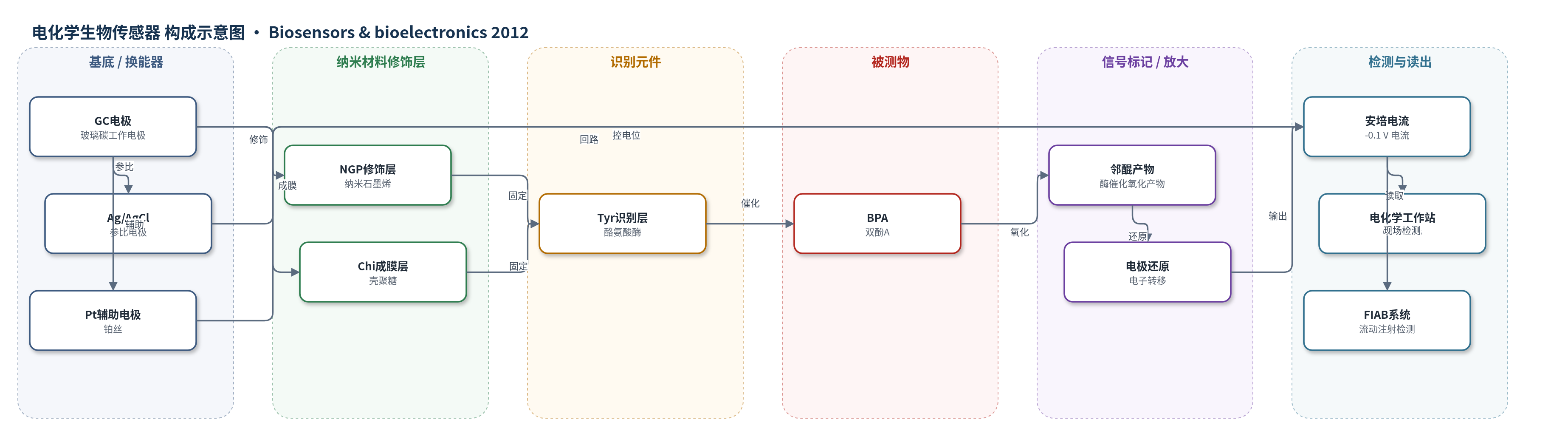
点击图片查看大图 · 依据论文自动绘制
传感器类型
电化学生物传感器
检测对象
双酚A(Bisphenol A, BPA);样品基质:自来水(不同容器浸出液)
检测原理
该传感器以固定于 NGP/Chi 膜中的酪氨酸酶为生物识别与催化元件。BPA 进入电极界面后,在 Tyr 催化下发生羟基化和氧化反应,生成相应的邻醌类产物;邻醌在电极表面被电化学还原为多羟基酚,并可在酶催化下继续循环反应。恒电位 -0.1 V 下,电极记录到与 BPA 浓度成正比的稳态还原电流。NGP 的大比表面积、高导电性和表面羟基/羧基有利于 Tyr 的高负载、稳定固定和快速电子传递,层级 Tyr-NGP 结构促进 BPA 扩散与酶催化,从而降低背景电流并提高灵敏度。
检测灵敏度
LOD: 33 nmol L−1;线性范围: 100 nmol L−1–2000 nmol L−1;灵敏度: 3108.4 mA cm−2 M−1
效应效果
与 MWNTs 基传感器相比,NGP 基传感器响应更快(4 s 对 6 s 达到 95% 稳态),重复性更好(1 μmol/L BPA 下 RSD 为 3.4% 对 9.8%),灵敏度更高(3108.4 对 1557.3 mA cm−2 M−1),LOD 更低(33 对 100 nmol/L)。实际自来水中,PC 奶瓶和 PC 饮水瓶浸出 BPA 分别为 0.66 和 1.42 μg/mL,HPLC 结果为 0.58 和 1.53 μg/mL,相对偏差 12.9% 和 -7.7%;纸杯、PEGT 水瓶和玻璃瓶未检出。100 倍浓度的邻苯二甲酸酯、KNO3、柠檬酸钠、苯、萘等不干扰。作者认为该传感器快速、便携、低成本,适合 PC 产品 BPA 浸出和现场应急污染分析。
传感器的构成
- 基底电极:玻璃碳电极(GC),机械抛光后作为工作电极,提供电子转导基底
- 纳米修饰层:亲水纳米石墨烯(NGP),球磨石墨制备,含羟基/羧基,提供大比表面积、导电通道和酶固定位点
- 成膜固定层:壳聚糖(Chi),线性多糖,成膜固定 NGP 与酪氨酸酶,形成均匀膜
- 识别催化元件:酪氨酸酶(Tyr,蘑菇来源),催化 BPA 羟基化/氧化,是生物识别与催化元件
- 参比电极:Ag/AgCl 电极(3 mol/L KCl),三电极体系电位参考
- 辅助电极:铂丝(Pt wire),完成三电极电化学回路
- 检测介质:磷酸盐缓冲液(PBS,50 mmol/L,pH 7.0),维持酶活性和离子强度
- 读出装置:电化学工作站(CHI 440B)/流动注射安培系统(FIAB),恒电位 -0.1 V 安培检测
中文摘要
本文报道了一种基于亲水纳米石墨烯(NGP)的酪氨酸酶电化学生物传感器,用于快速测定双酚A(BPA)。NGP 由石墨球磨法制备,表面富含羟基和羧基,具有良好的水分散性、较大比表面积和导电性,可作为酶固定平台和电极修饰材料。作者将 NGP、酪氨酸酶(Tyr)和壳聚糖(Chi)混合涂覆于玻璃碳电极(GC)表面,构建 Tyr-NGP-Chi/GC 传感器,并与多壁碳纳米管(MWNTs)基传感器进行系统比较。结果表明,NGP 基传感器具有更快响应、更低背景电流、更好重复性和更低检出限,这归因于其更大比表面积及独特的层级 Tyr-NGP 纳米结构。该传感器在 100 nmol/L 至 2000 nmol/L 范围内呈线性,检出限为 33 nmol/L,灵敏度为 3108.4 mA cm−2 M−1。进一步用于检测自来水中不同容器浸出的 BPA,并用高效液相色谱(HPLC)验证,证明其可用于聚碳酸酯产品 BPA 浸出的快速检测及现场应急污染分析。
英文摘要
Hydrophilic nanographene (NGP) prepared by ball milling of graphite was used as the support to construct a novel tyrosinase biosensor for determination of bisphenol A (BPA). The performances of the nanographene-based tyrosinase biosensor were systematically compared with those of multiwall carbon nanotubes (MWNTs) modified tyrosinase biosensors. The results indicated that the nanographene-based tyrosinase biosensor provided significant advantages over MWNTs-based tyrosinase biosensor in term of response, repeatability, background current and limit of detection (LOD), which could be attributed to its larger specific surface area and unique hierarchical tyrosinase-NGP nanostructures. The nanographene-based tyrosinase biosensor displayed superior analytical performance over a linear range from 100 nmol L(-1) to 2000 nmol L(-1), with LOD of 33 nmol L(-1) and sensitivity of 3108.4 mA cm(-2)M(-1). The biosensor was further used for detecting BPA (leaching from different vessels) in tap water, and the accuracy of the results was validated by high performance liquid chromatography (HPLC). The nanographene-based tyrosinase biosensor proved to be a promising and reliable tool for rapid detection of BPA leached from polycarbonate plastic products and for on-site rapid analysis of emergency pollution affairs of BPA.