组成图示
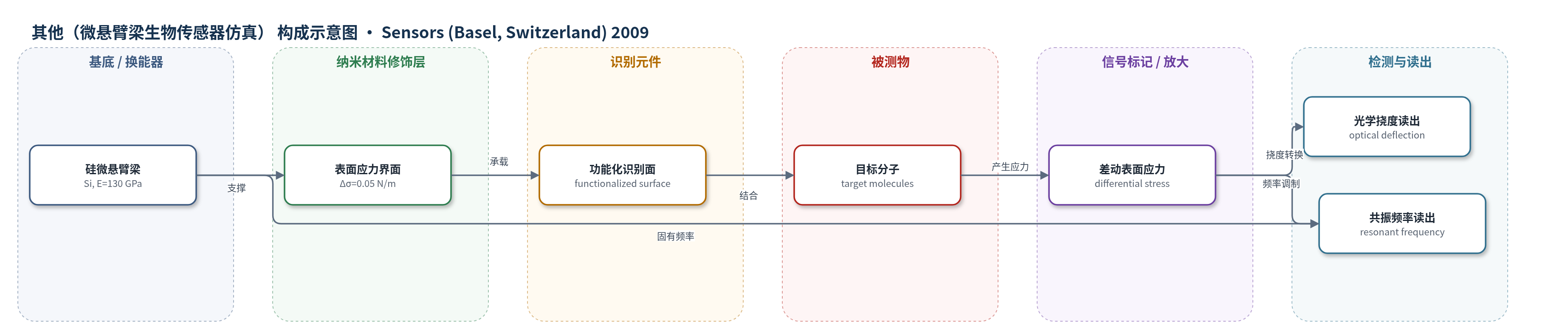
点击图片查看大图 · 依据论文自动绘制
传感器类型
其他(微悬臂梁生物传感器仿真)
检测对象
未指定具体被测物;目标分子(target molecules),样品基质:未指定溶液/介质(media)
检测原理
微悬臂梁生物传感器利用功能化顶面与目标分子结合后产生的表面应力变化实现无标记检测。目标分子吸附或结合会改变表面原子平衡位置、电荷分布或悬挂键饱和状态,使悬臂梁顶面与底面之间形成差动表面应力。该差动应力通过Stoney关系转换为悬臂梁弯曲挠度Δz,挠度大小随表面应力变化而变化,可反映被测物结合量。同时,悬臂梁的基频f0由其刚度、质量和轮廓决定;改变轮廓或截面可调节f0,提高信噪比和测量灵敏度。信号通过光学挠度读出获得,整体灵敏度以Δz·f0评价。
检测灵敏度
原文未报告LOD、线性范围、灵敏度斜率或相关系数。
效应效果
本文未进行实际生物样品检测,未报告选择性、抗干扰、稳定性、RSD、回收率或与ELISA/HPLC/qPCR对比。仿真与解析一致:#R1挠度0.28 μm、频率4.91 kHz;#T1为1.00 μm、6.44 kHz;#S1为0.50 μm、5.84 kHz。相对#R1,#T1挠度提高257%、频率提高31%,Δz·f0提高368%;#S1挠度提高79%、频率提高19%,Δz·f0提高113%。修改截面#R2、#T2、#S2挠度提高89%、11%、50%,频率降低38%、24%、37%。最大应力0.41–3.85 MPa,低于硅极限300 MPa;#T1性能最佳但难制造,#S2更易DRIE加工,更实用。
传感器的构成
- 基底/换能器:硅(Si)微悬臂梁,E=130 GPa、ν=0.28,将表面应力转换为挠度和共振频率变化
- 识别元件:功能化顶面(functionalized top surface),结合目标分子并改变表面应力,原文未给出具体抗体/适配体/酶材料
- 信号读出:光学挠度读出(optical deflection readout)与共振频率测量,用于检测表面应力诱导的纳米级形变
中文摘要
本文研究矩形、三角形和阶梯轮廓微悬臂梁在表面应力下的挠度、共振频率和应力特性,为微悬臂梁生物传感器选择更优传感元件。微悬臂梁生物传感器通过功能化表面结合目标分子产生表面应力,并转换为可测挠度;整体灵敏度取决于设计灵敏度(挠度)和测量灵敏度(共振频率)。作者用ANSYS Multiphysics有限元建立三维模型,对六种设计进行静力与模态分析。悬臂梁为硅,E=130 GPa,ν=0.28,顶面施加0.05 N/m表面应力;模型长500 μm、宽100 μm、固定端厚1 μm,修改设计经50 μm长、20 μm宽条带连接固定端。数值结果与解析公式一致。结果表明,三角形和阶梯轮廓比矩形轮廓挠度更高,三角形还提高频率;减小固定端截面可增大挠度但降低频率。综合灵敏度Δz·f0以三角形最高,但阶梯#S2更易用深反应离子刻蚀制造,更适合作为实用生物传感器元件。
英文摘要
This study presents the deflection, resonant frequency and stress results of rectangular, triangular, and step profile microcantilevers subject to surface stress. These cantilevers can be used as the sensing element in microcantilever biosensors. To increase the overall sensitivity of microcantilever biosensors, both the deflection and the resonant frequency of the cantilever should be increased. The effect of the cantilever profile change and the cantilever cross-section shape change is first investigated separately and then together. A finite element code ANSYS Multiphysics is used and solid finite elements cantilever models are solved. A surface stress of 0.05 N/m was applied to the top surface of the cantilevers. The cantilevers are made of silicon with elastic modulus 130 GPa and Poisson's ratio 0.28. To show the conformity of this study, the numerical results are compared against their analytical ones. Results show that triangular and step cantilevers have better deflection and frequency characteristics than rectangular ones.