组成图示
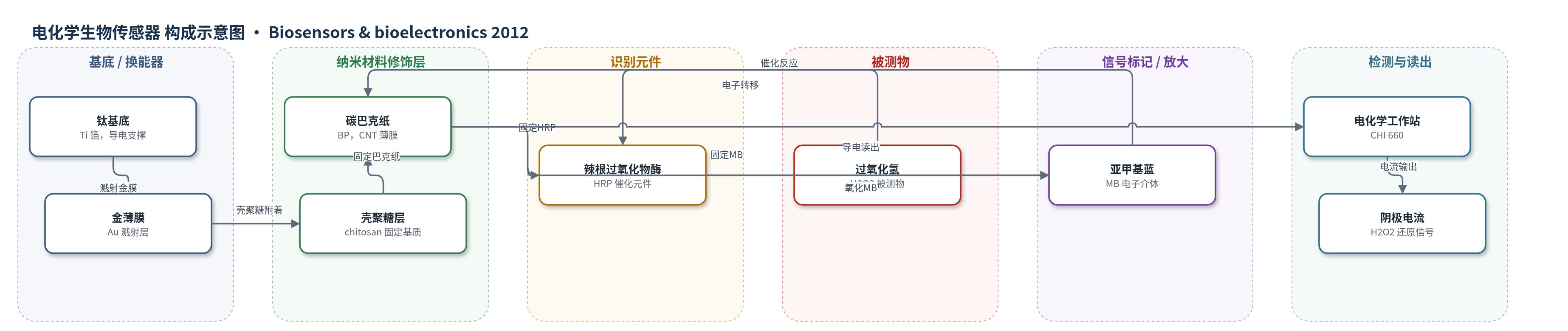
点击图片查看大图 · 依据论文自动绘制
传感器类型
电化学生物传感器
检测对象
过氧化氢(hydrogen peroxide, H2O2);样品基质:人尿(human urine,PBS 稀释)
检测原理
在 pH 7.4 的 PBS 中,H2O2 与固定在功能化碳巴克纸上的 HRP 发生酶促反应:还原态 HRP 被 H2O2 氧化为氧化态 HRP,同时 H2O2 被还原为水。氧化态 HRP 随即被亚甲基蓝(MB)还原态再生为还原态 HRP,MB 被氧化为 MB(ox)。MB(ox) 在电极表面接受电子还原为 MB(red),形成可检测的阴极电流。碳巴克纸的高导电网络和壳聚糖固定层促进电子传递,MB 作为电子介体降低过电位并放大响应。随着 H2O2 浓度增加,酶催化循环加快,MB(ox) 还原电流增大,因此阴极峰电流与 H2O2 浓度呈线性关系。
检测灵敏度
LOD: 7.5 × 10⁻⁸ M (based on S/N = 3);线性范围: 0.1 × 10⁻⁶–5 × 10⁻⁴ M;灵敏度: 54 μA μM−1;R^2 = 0.994
效应效果
该传感器在 10 μM H2O2 下连续 10 次测定相对标准偏差为 2.9%,四个独立制备电极间 RSD 为 3.1%。4 ℃ PBS 中储存 30 天后仍保留约 96% 初始响应,前 3 天下降约 1.6%,两周后下降约 3.5%。人尿样品经 10 倍 PBS 稀释后加标回收率为 95.02%–104.92%。健康志愿者饮用咖啡 60 min 后尿 H2O2 浓度均升高,提示咖啡中羟基氢醌等成分可诱导氧化应激。文中未报告选择性/抗干扰实验。作者认为该传感器制备简便、催化活性高、稳定性好,可用于人尿 H2O2 定量,作为体内氧化应激生物标志物。
传感器的构成
- 基底电极:钛箔(Ti),提供导电、生物相容和耐腐蚀支撑
- 导电增强层:金薄膜(Au),溅射于 Ti 表面,提高界面导电性并为巴克纸提供机械支撑
- 附着基质层:壳聚糖(chitosan),将碳巴克纸附着于 Au/Ti 表面
- 纳米修饰层:碳巴克纸(BP,碳纳米管宏观薄膜),经电化学活化引入羧基,提供高比表面积导电网络
- 生物固定层:壳聚糖(chitosan)复合膜,共固定 HRP 与 MB,提供生物相容微环境
- 识别/催化元件:辣根过氧化物酶(HRP),催化 H2O2 还原并维持生物催化活性
- 电子介体/信号元件:亚甲基蓝(MB),介导 HRP 与电极间电子转移并产生可检测电化学信号
中文摘要
本文报道了一种基于功能化碳巴克纸的电化学过氧化氢检测方法。将辣根过氧化物酶(HRP)与亚甲基蓝(MB)共同固定在钛基底上经金薄膜修饰的碳巴克纸(BP)表面,利用壳聚糖作为成膜与固定基质,构建 Ti/Au/BP/HRP-MB 电化学生物传感器。循环伏安法用于研究和优化传感器性能。该传感器在生理 pH 7.4 条件下对 H2O2 定量表现出良好分析性能,优化条件下线性响应范围为 0.1×10⁻⁶ 至 5×10⁻⁴ mol/L,检出限为 7.5×10⁻⁸ mol/L(S/N=3)。所制备传感器的重现性和稳定性均令人满意。进一步通过检测健康志愿者饮用咖啡前后人尿中 H2O2 水平,验证其生物学相关性;尿 H2O2 升高提示咖啡摄入可诱导人体氧化应激。该方法有望作为评估体内氧化应激水平的有价值生物标志物。
英文摘要
Here we report on a new approach for the electrochemical detection of hydrogen peroxide (H(2)O(2)) based on the co-immobilization of horseradish peroxidase and methylene blue on the functionalized carbon buckypaper supported by a titanium substrate. Cyclic voltammetry was used to study and optimize the performance of the resulting electrochemical biosensor. The proposed biosensor exhibited high analytical performance towards the quantification of H(2)O(2) at the physiological pH 7.4. Under optimized conditions, the biosensor shows a wide linear response range from 0.1 × 10(-6) to 5 × 10(-4)M concentrations of H(2)O(2). The detection limit was determined to be 7.5 × 10(-8)M (based on S/N=3). Reproducibility and stability of the fabricated biosensor were examined with satisfactory results. The biological relevance of the developed electrochemical biosensor has been further studied by the determination of H(2)O(2) in human urine samples of normal volunteers prior to and following the ingestion of coffee. Increased levels of urinary H(2)O(2) concentration suggest that oxidative stress is induced by coffee drinking in humans. There is considerable interest in oxidative stress as relates to human physiology. The sensitive determination of H(2)O(2) in human urine may serve as a valuable biomarker to effectively elucidate specific levels of oxidative stress in vivo.