组成图示
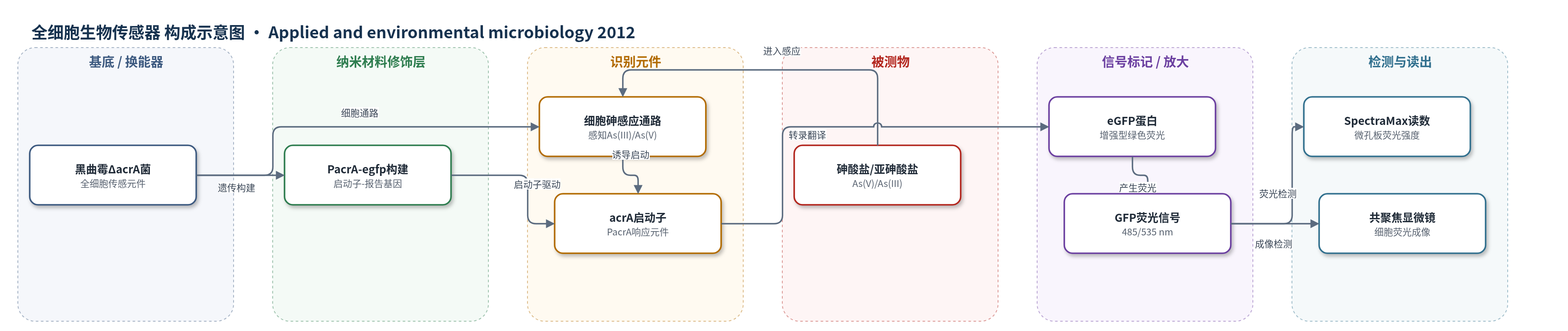
点击图片查看大图 · 依据论文自动绘制
传感器类型
全细胞生物传感器
检测对象
亚砷酸盐(arsenite, As(III))、砷酸盐(arsenate, As(V));样品基质:YPD 肉汤、RPMI 1640/MOPS 培养基(面向饮用水/地下水样品)
检测原理
该传感器为全细胞荧光生物传感器。工程菌ΔacrA::PacrA-egfp中,样品中的As(III)/As(V)进入黑曲霉细胞后,触发细胞内砷感应与转运/代谢通路,使acrA天然启动子PacrA被激活。PacrA驱动egfp转录和翻译,产生增强型绿色荧光蛋白eGFP。eGFP在485 nm激发、535 nm发射,荧光强度随砷浓度升高呈剂量依赖性增加;孢子在12 h即可产生可检测荧光,48 h信号明显增强。ΔacrA菌株用于扣除自荧光背景。信号放大主要来自基因转录—翻译级联,而非化学或纳米材料放大。
检测灵敏度
检测范围: 1.8–180 µg/L;12 h 可检出,48 h 信号增强;WHO 限值: 10 和 50 µg/L
效应效果
该菌株对亚砷酸盐和砷酸盐均产生剂量依赖荧光,检测范围1.8–180 µg/L,覆盖WHO限值10和50 µg/L;12 h可检出,48 h信号增强。特异性测试中,镉、锑(III)、钴(II)、铜(II)、铁(III)等金属/类金属未引起显著荧光,ΔacrA菌株作为自荧光对照。预培养菌丝总体荧光更高,但背景自荧光同步升高,与孢子相比无显著差异。论文未报告RSD、实际水样加标回收率或与ICP-MS/AAS等方法的定量对比。作者认为相比实验室仪器和产生有毒副产物的现场比色法,黑曲霉孢子稳定、耐环境波动、GRAS,适合作为低成本现场砷检测基础,但仍需比色读出和现场验证。
传感器的构成
- 基底/换能器:黑曲霉 Aspergillus niger ΔacrA::PacrA-GFP 工程菌株,作为全细胞传感元件,在砷存在下诱导报告基因表达。
- 修饰层:PacrA-egfp 遗传构建,将 acrA 天然启动子与 egfp 报告基因融合,提供砷响应表达元件。
- 识别/响应元件:细胞内砷感应/转运通路及 acrA 天然启动子(PacrA),感知亚砷酸盐/砷酸盐并启动转录。
- 信号标记物:egfp 基因编码增强型绿色荧光蛋白(eGFP),表达后产生可测荧光。
- 样品介质:YPD 肉汤或 RPMI 1640/MOPS,提供孢子萌发与菌丝生长环境。
- 读出装置:SpectraMax 微孔板荧光读数仪(激发 485 nm、发射 535 nm)或共聚焦显微镜,用于荧光强度与成像读出。
- 阴性对照:ΔacrA 菌株,用于扣除自荧光背景。
中文摘要
砷污染地下水是全球重大公共卫生问题,亟需安全、快速的现场检测方法。为开发真菌砷生物传感器,作者基于基因组同源性在黑曲霉(Aspergillus niger)中鉴定出7个候选砷代谢与转运基因。实时RT-PCR显示,在砷酸盐诱导下,编码质膜亚砷酸盐外排泵的acrA基因表达上调超过200倍,且低浓度砷酸盐即可显著诱导。通过基因敲除、互补实验和AcrA-eGFP融合蛋白定位,证实AcrA定位于质膜并参与砷外排;ΔacrA突变株对砷酸盐敏感且细胞内砷积累增加。进一步构建ΔacrA::PacrA-egfp报告菌株,以acrA天然启动子驱动增强型绿色荧光蛋白(eGFP)表达,并用共聚焦显微镜和荧光分光光度法检测。该菌株可在1.8–180 µg/L范围内可靠检测亚砷酸盐和砷酸盐,覆盖世界卫生组织饮用水砷限值10和50 µg/L。
英文摘要
Arsenic contamination of groundwater sources is a major issue worldwide, since exposure to high levels of arsenic has been linked to a variety of health problems. Effective methods of detection are thus greatly needed as preventive measures. In an effort to develop a fungal biosensor for arsenic, we first identified seven putative arsenic metabolism and transport genes in Aspergillus niger, a widely used industrial organism that is generally regarded as safe (GRAS). Among the genes tested for RNA expression in response to arsenate, acrA, encoding a putative plasma membrane arsenite efflux pump, displayed an over 200-fold increase in gene expression in response to arsenate. We characterized the function of this A. niger protein in arsenic efflux by gene knockout and confirmed that AcrA was located at the cell membrane using an enhanced green fluorescent protein (eGFP) fusion construct. Based on our observations, we developed a putative biosensor strain containing a construct of the native promoter of acrA fused with egfp. We analyzed the fluorescence of this biosensor strain in the presence of arsenic using confocal microscopy and spectrofluorimetry. The biosensor strain reliably detected both arsenite and arsenate in the range of 1.8 to 180 μg/liter, which encompasses the threshold concentrations for drinking water set by the World Health Organization (10 and 50 μg/liter).