组成图示
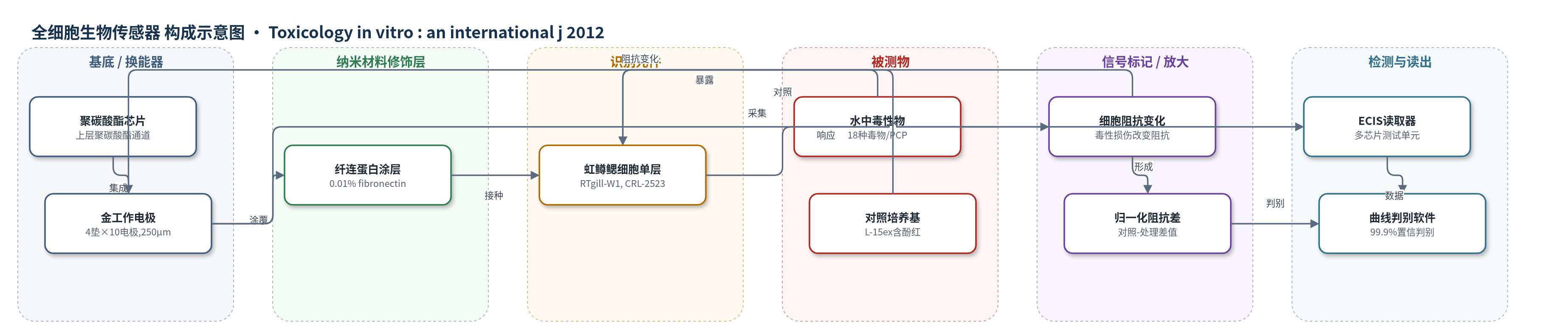
点击图片查看大图 · 依据论文自动绘制
传感器类型
全细胞生物传感器
检测对象
多种饮用水毒性化学物质(toxic chemicals,包括丙烯腈 acrylonitrile、涕灭威 aldicarb、氨 ammonia、亚砷酸钠 sodium arsenite、叠氮化钠 sodium azide、硫酸铜 copper sulfate、氰化钠 sodium cyanide、苯胺磷 fenamiphos、氟乙酸钠 sodium fluoroacetate、氯化汞 mercuric chloride、甲胺磷 methamidophos、对硫磷 methyl parathion、尼古丁 nicotine、百草枯 paraquat、五氯酚钠 sodium pentachlorophenate/PCP、苯酚 phenol、硫酸铊 thallium sulfate、甲苯 toluene);样品基质:饮用水/水样(L-15ex培养基/去离子水)
检测原理
RTgill-W1细胞在纤连蛋白修饰的金电极上形成连续单层,细胞-基底界面阻碍交流电流通过,使芯片呈现较高阻抗(约1200–2000 Ω)。当水样中的毒性化学物质进入测试通道并与细胞接触时,毒物引起细胞膜完整性、形态、附着或信号通路改变,导致单层完整性受损或界面电学特性改变;多数毒物使阻抗下降,个别如铜可致阻抗升高。ECIS测试单元每60 s采集4个电极垫的平均原始阻抗,并以暴露前初始值归一化。软件将处理通道与对照通道的归一化阻抗曲线进行功能数据分析,若连续10个时间点差异显著(p<0.001)则判为阳性。信号大小随毒物浓度和细胞损伤程度变化,最低检测水平按90%检出概率、80%置信度的MDL确定。
检测灵敏度
原文未报告LOD、线性范围、灵敏度斜率或R^2;报告RTgill-W1 1 h检测水平(detection level, μM):acrylonitrile 7627.1、aldicarb 3484.5、ammonia 5872.0、arsenic 60.1、azide 285.6、copper 15.7、cyanide 538.0、fenamiphos 18.5、fluoroacetate 6623.4、mercury 1.2、methamidophos >7100.3、methyl parathion 97.3、nicotine >1615、paraquat 1788.6、pentachlorophenate 9.4、phenol 3910.3、thallium 132.1、toluene 1085.4
效应效果
RTgill-W1芯片对18/18种毒物1 h内显著响应,9/18在MEG–HLC范围内;PCP 9.4 μM在6°C保存2–39周后仍显著(p<0.001)。6°C不换液可维持78周,阻抗约1200–2000 Ω,8/52周升至约2400 Ω;12°C>20周,20°C>16周,25°C<4周,30°C<24 h。与BLMVEC相比,其对氨、铜、氰化物、汞、氟乙酸盐、对硫磷和甲苯更敏感,对丙烯腈、涕灭威、甲胺磷、尼古丁和苯酚较低;BLMVEC需37°C且每周换液3次。实验用酚红监控pH,pH差>0.20时调整。作者认为适合低成本、免维护、现场便携饮用水筛查。
传感器的构成
- 换能器电极层:下层电子层含4个电极垫/通道,每垫10个直径250 μm工作电极,金电极连接用于ECIS阻抗读取
- 流体封装层:上层聚碳酸酯层形成两个独立封闭流体通道,Pharmed Biopharm管路封闭端部,用于容纳培养基和样品
- 细胞附着修饰层:0.01%纤连蛋白(fibronectin)溶于L-15培养基处理通道1 h,促进RTgill-W1附着并形成连续上皮单层
- 识别/响应元件:虹鳟鳃上皮细胞RTgill-W1(ATCC CRL-2523),接种密度2.5×10^5 cells/mL,形成单层并作为毒性响应元件
- 培养/测试介质:L-15完全培养基(10% FBS、1% GlutaMAX-1、青霉素/链霉素)用于培养;L-15ex含酚红培养基用于对照和毒物暴露
- 被测物注入:18种有毒化学物质(如PCP、arsenic、copper、cyanide等)溶于去离子水或缓冲液,注入测试通道
- 读出与验证:ECIS多芯片测试单元每60 s采集平均阻抗并归一化;Calcein AM/ethidium homodimer-1活死染色用于验证细胞活力
中文摘要
本文报道了一种基于虹鳟鳃上皮细胞(RTgill-W1)的细胞基生物传感器,用于快速筛查可能污染饮用水的有毒化学物质。将RTgill-W1细胞接种于封闭流体生物芯片上,并用电细胞-基底阻抗传感(ECIS)技术监测。暴露后1 h内,18种受测有毒化学物质均引起显著阻抗响应,其中9种在美军规定的现场毒性传感器比较浓度范围内。该变温细胞系可在环境CO2、6°C条件下不换培养基保存78周仍保持单层完整性;保存后的芯片用9.4 μM五氯酚钠(PCP)挑战,各保存时间点的阻抗响应均显著(p<0.001)。与需37°C培养且每周换液3次的牛肺微血管内皮细胞(BLMVEC)相比,RTgill-W1具有相当的毒物敏感性,但维护要求更低。其快速响应、长储存期和免维护特性使其成为低成本、现场便携饮用水毒性筛查生物传感器的候选。
英文摘要
Rainbow trout gill epithelial cells (RTgill-W1) are used in a cell-based biosensor that can respond within one hour to toxic chemicals that have the potential to contaminate drinking water supplies. RTgill-W1 cells seeded on enclosed fluidic biochips and monitored using electric cell-substrate impedance sensing (ECIS) technology responded to 18 out of the 18 toxic chemicals tested within one hour of exposure. Nine of these chemical responses were within established concentration ranges specified by the U.S. Army for comparison of toxicity sensors for field application. The RTgill-W1 cells remain viable on the biochips at ambient carbon dioxide levels at 6°C for 78weeks without media changes. RTgill-W1 biochips stored in this manner were challenged with 9.4μM sodium pentachlorophenate (PCP), a benchmark toxicant, and impedance responses were significant (p<0.001) for all storage times tested. This poikilothermic cell line has toxicant sensitivity comparable to a mammalian cell line (bovine lung microvessel endothelial cells (BLMVECs)) that was tested on fluidic biochips with the same chemicals. In order to remain viable, the BLMVEC biochips required media replenishments 3 times per week while being maintained at 37°C. The ability of RTgill-W1 biochips to maintain monolayer integrity without media replenishments for 78weeks, combined with their chemical sensitivity and rapid response time, make them excellent candidates for use in low cost, maintenance-free field-portable biosensors.