组成图示
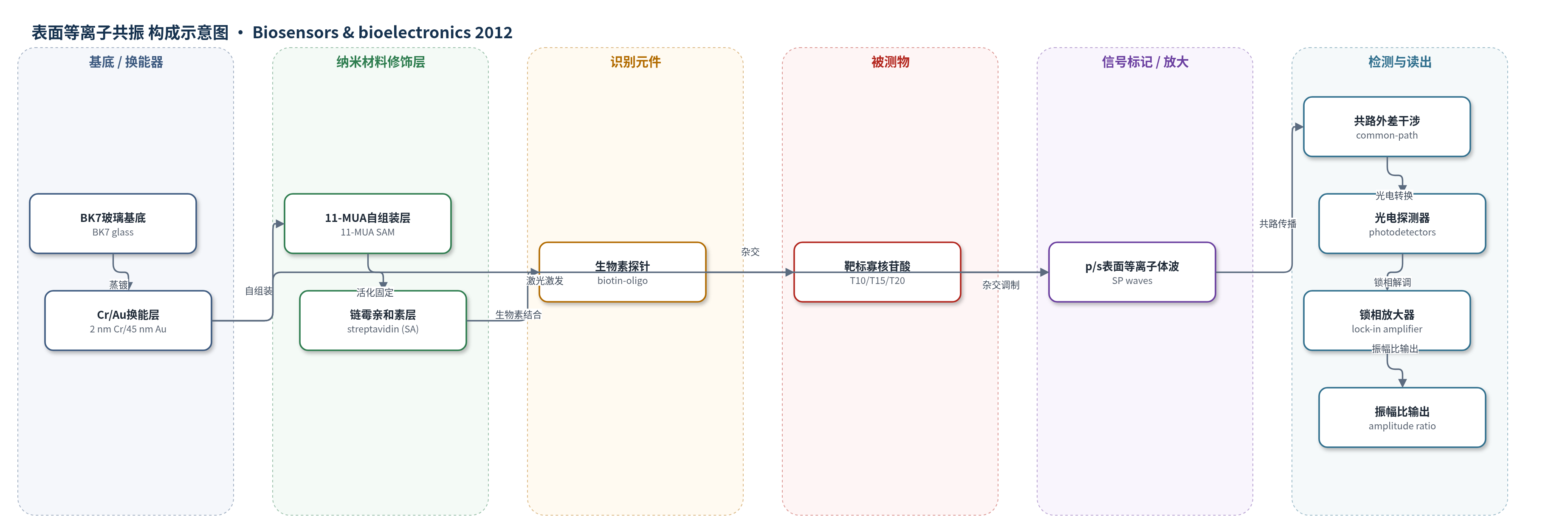
点击图片查看大图 · 依据论文自动绘制
传感器类型
表面等离子共振(SPR)生物传感器
检测对象
未标记寡核苷酸(unlabeled oligonucleotides,T10/T15/T20)、非靶标寡核苷酸(non-target oligonucleotide,NT23);样品基质:PBS缓冲液
检测原理
金膜表面激发表面等离子体激元(SP),p偏振信号波与s偏振参考波共路传播形成外差拍频。固定于芯片的寡核苷酸探针与未标记靶标序列特异性杂交,使金膜近场有效折射率和界面质量增加,改变SP共振条件及p波振幅。PSPWB实时解调p/s外差信号振幅,并用信号/参考振幅比归一化,抑制激光强度波动;共路p/s传播抵消温度引起的公共相位噪声。靶标浓度越高,杂交量越多,振幅比响应越大,在0.5–500 pM内与浓度对数线性相关。
检测灵敏度
LOD: 0.5 pM;线性范围: 0.5–500 pM;R^2 = 0.92950
效应效果
该平台在45 min内信号稳定,变异系数低于0.06%。选择性方面,10 pM和10 nM非靶标寡核苷酸响应仅略高于背景;10 pM靶标与非靶标响应分别为3.37和1.07 a.u.,10 nM为8.93和1.41 a.u.。无探针芯片对2 µM靶标仅0.66 a.u.,而探针芯片在5 pM靶标下达2.88 a.u.,PBS背景0.23 a.u.,信号约为背景10倍。LOD 0.5 pM,优于传统SPR约10 nM,也优于部分物理/光学改进SPR(2 pM、50 pM)。无需标记、酶反应或引物,适用于microRNA等短寡核苷酸检测。
传感器的构成
- 基底/换能器:BK7玻璃片(25.4 mm×25.4 mm×1 mm)蒸镀2 nm Cr粘附层和45 nm Au层,支撑表面等离子体激元(SP)激发。
- 修饰层:11-巯基十一烷酸(11-MUA)自组装单分子层(SAM),提供羧基用于EDC/NHS活化。
- 交联层:EDC/NHS活化后固定链霉亲和素(SA),利用SA-生物素高亲和力固定探针。
- 封闭层:乙醇胺-HCl(ethanolamine-HCl)封闭残余NHS酯,减少非特异性结合。
- 识别元件:生物素标记寡核苷酸探针(biotin probe)或巯基修饰寡核苷酸探针(HS-oligonucleotide)固定于表面,用于序列特异性杂交。
- 封闭层:6-巯基-1-己醇(MCH)封闭巯基探针路线中未结合的金表面。
- 信号/读出:激光激发p偏振信号波与s偏振参考波共路外差,经光电探测和锁相放大器解调为振幅比响应。
中文摘要
利用表面等离子共振(SPR)检测未标记寡核苷酸较困难,因为其分子量通常低于蛋白质。本文报道了一种基于配对表面等离子波生物传感器(PSPWB)的低浓度未标记寡核苷酸检测方法。该传感器芯片上固定寡核苷酸探针,通过序列特异性杂交识别靶标寡核苷酸。PSPWB实时测量外差信号的解调振幅,并利用检测输出信号与参考信号振幅之比抑制激光强度波动带来的噪声;p波与s波共路传播可抵消温度变化引起的公共相位噪声,从而获得高信噪比外差信号。寡核苷酸杂交的序列特异性使平台能准确区分靶标与非靶标。在优化条件下,检测到的外差信号在0.5–500 pM范围内与靶标寡核苷酸浓度的对数呈线性关系,检出限为0.5 pM。10 pM和10 nM非靶标寡核苷酸仅产生略高于背景的响应,表明方法具有高选择性和特异性。10-mer、15-mer和20-mer完全匹配靶标在150 pM浓度下均可被识别。
英文摘要
Detection of unlabeled oligonucleotides using surface plasmon resonance (SPR) is difficult because of the oligonucleotides' relatively lower molecular weight compared with proteins. In this paper, we describe a method for detecting unlabeled oligonucleotides at low concentration using a paired surface plasma waves biosensor (PSPWB). The biosensor uses a sensor chip with an immobilized probe to detect a target oligonucleotide via sequence-specific hybridization. PSPWB measures the demodulated amplitude of the heterodyne signal in real time. In the meantime, the ratio of the amplitudes between the detected output signal and reference can reduce the excess noise from the laser intensity fluctuation. Also, the common-path propagation of p and s waves cancels the common phase noise induced by temperature variation. Thus, a high signal-to-noise ratio (SNR) of the heterodyne signal is detected. The sequence specificity of oligonucleotide hybridization ensures that the platform is precisely discriminating between target and non-target oligonucleotides. Under optimized experimental conditions, the detected heterodyne signal increases linearly with the logarithm of the concentration of target oligonucleotide over the range 0.5-500 pM. The detection limit is 0.5 pM in this experiment. In addition, the non-target oligonucleotide at concentrations of 10 pM and 10nM generated signals only slightly higher than background, indicating the high selectivity and specificity of this method. Different length of perfectly matched oligonucleotide targets at 10-mer, 15-mer and 20-mer were identified at the concentration of 150 pM.