组成图示
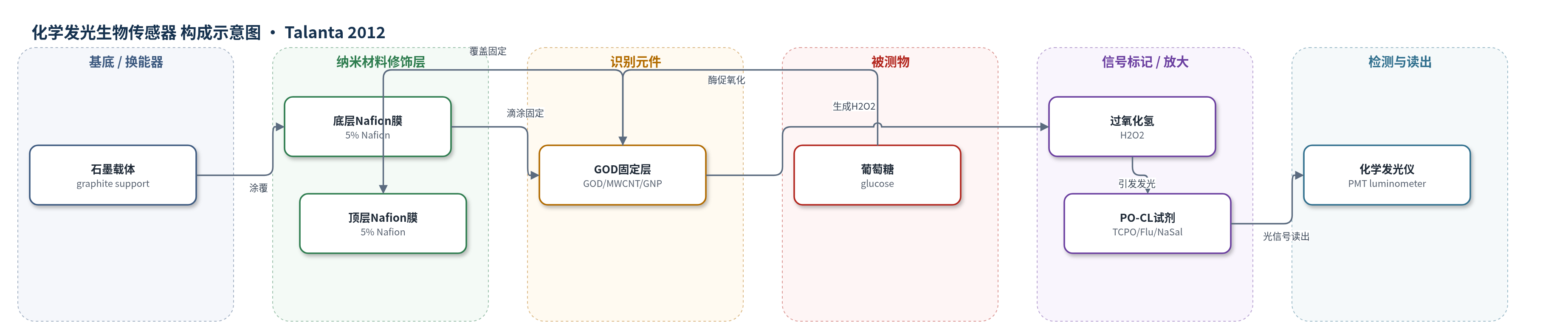
点击图片查看大图 · 依据论文自动绘制
传感器类型
化学发光生物传感器
检测对象
葡萄糖(glucose);样品基质:磷酸缓冲液、人血清、尿液
检测原理
葡萄糖进入反应体系后,被 Nafion/GOD/MWCNTs/GNPs 复合膜中的 GOD 特异性催化氧化,生成 H2O2;MWCNTs 与 GNPs 通过大比表面积、快速传质和导电/催化作用提高 GOD 活性与 H2O2 生成效率。随后取反应液注入含 TCPO、新荧光体 Flu 和水杨酸钠(Na salicylate)的 CL 比色皿,H2O2 氧化 TCPO 形成高能量 1,2-二氧杂环丁烷酮中间体,并通过化学引发电子交换发光(CIEEL)将 Flu 激发,Flu 退激发射光子。CL 强度与 H2O2 浓度成正比,因而随葡萄糖浓度增加而增强。Nafion 膜固定酶并排斥阴离子干扰物,降低背景与干扰。
检测灵敏度
LOD: 1.00 × 10⁻⁶ mol L−1;线性范围: 2.25 × 10⁻⁶–1.75 × 10⁻⁴ mol L−1;灵敏度斜率: 1.9451(y=1.9451x+3.0781);R^2 = 0.9982
效应效果
该传感器抗干扰能力较强:在 1.0×10⁻⁵ mol/L 葡萄糖测定中,蔗糖、果糖、乳糖至少 15 倍,尿酸和抗坏血酸至少 150 倍不干扰;尿酸可耐受 8.50×10⁻³ mol/L,抗坏血酸 3.75×10⁻³ mol/L。重现性良好,2.5×10−5 mol/L 葡萄糖 10 次测定 RSD 为 ±1.2%。稳定性方面,前 8 h 响应基本恒定,10 天后仍保留约 80% 初始响应。实际血清和尿液样品中,CL 生物传感器结果与光度法基本一致,且对低浓度尿液葡萄糖(2.8–5.0 mg/dL)优于光度法(LOD 5 mg/dL)。作者认为其仪器简单、酶可重复使用、样品量可低至 10 μL,适合临床和科研分析。
传感器的构成
- 基底/载体:石墨棒(graphite support),多孔结构用于固定 Nafion 膜
- 底层固定层:5% Nafion 乙醇溶液(100 μL),提供固定与阴离子排斥
- 识别/催化复合层:GOD、MWCNTs、GNPs(v/v=1:1:1,120 μL),GOD 识别葡萄糖,MWCNTs/GNPs 增强酶活性与传质
- 顶层固定层:5% Nafion 乙醇溶液(100 μL),稳定固定 GOD–GNPs–CNTs 并增强选择性
- 发光试剂层:TCPO、Flu、水杨酸钠(Na salicylate,acetonitrile 溶液),与 H2O2 发生 PO-CL 反应产生光信号
- 反应介质:0.001 mol/L 磷酸缓冲液(pH 7.0),用于酶促反应并控制 pH
中文摘要
本文报道了一种基于化学发光(CL)检测酶促生成过氧化氢(H2O2)的新型葡萄糖生物传感器。该传感器通过将葡萄糖氧化酶(GOD)、碳纳米管(CNTs)和金纳米粒子(GNPs)有效固定于 Nafion 膜中,并构建在石墨载体表面。作者系统考察了溶液 pH、酶作用时间、干扰物以及化学发光试剂浓度等实验参数对检测性能的影响。CNTs 和 GNPs 对 GOD 与葡萄糖反应中 H2O2 的生成具有良好催化促进作用,从而提高葡萄糖检测灵敏度。在最优条件下,葡萄糖线性响应范围为 2.25×10⁻⁶ 至 1.75×10⁻⁴ mol/L,检出限(信噪比 3)为 1.00×10⁻⁶ mol/L。该 CL 生物传感器具有良好储存稳定性,在 pH 7.0 下储存 10 天后仍保留约 80% 初始响应。该方法已用于实际血清和尿液样品中葡萄糖浓度的测定,结果令人满意。
英文摘要
A novel glucose biosensor based on the chemiluminescence (CL) detection of enzymatically generated H(2)O(2) was constructed by the effective immobilization of glucose oxidase (GOD)/carbon-nanotubes (CNTs)/gold nanoparticles (GNPs) in nafion film on graphite support. The influences of various experimental parameters such as solution pH, the action time of the enzyme, interferents and the concentration of CL reagents were investigated. Carbon nanotubes and gold nanoparticles offer excellent catalytic activity toward hydrogen peroxide generation in enzymatic reaction between glucose oxidase and glucose, which would enable sensitive determination of glucose. Under the optimum condition, the linear response range of glucose was found to be 2.25 × 10(-6) to 1.75 × 10(-4 ) mol L(-1), and the detection limit (defined as the concentration that could be detected at the signal-to-noise ratio of 3) was 1.00 × 10(-6) mol L(-1). The CL biosensor exhibited good storage stability, i.e., 80% of its initial response was retained after 10 days storage at pH 7.0. The present CL biosensor has been used to determine the glucose concentrations in real serum and urine samples with satisfactory results.