组成图示
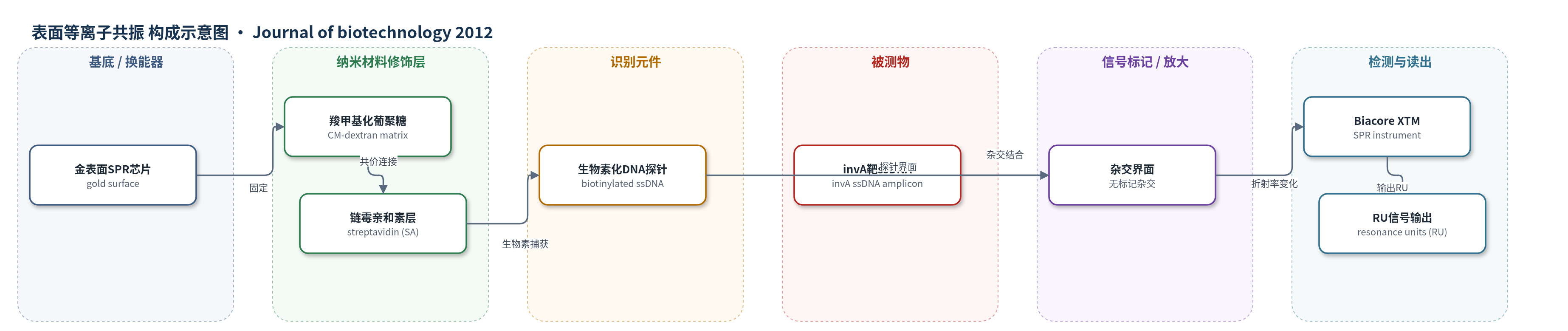
点击图片查看大图 · 依据论文自动绘制
传感器类型
表面等离子共振(SPR)生物传感器
检测对象
沙门氏菌(Salmonella)invA基因单链PCR扩增产物(invA ssDNA amplicon);样品基质:细菌培养物(LB培养基培养,含S. Typhimurium、S. Enterica、S. Derby)
检测原理
该传感器以金表面SPR芯片为换能基底,羧甲基化葡聚糖和链霉亲和素构成固定化界面,生物素化单链寡核苷酸探针通过生物素-链霉亲和素作用固定于表面。检测时,先以煮沸法从沙门氏菌培养物中提取基因组DNA,再用两步改良半巢式不对称PCR扩增invA基因,获得单链扩增产物。靶ssDNA与探针杂交后,传感表面附近质量与折射率发生变化,SPR共振角/共振单位随之改变,实现无标记实时检测。PCR扩增提供信号放大,使低浓度细菌的invA基因可被检出;杂交完成后用Glycine-HCl再生表面。
检测灵敏度
LOD: 0.5 nM;线性范围: 5 nM-1000 nM;灵敏度斜率: 435.51(ΔRU vs lg C);R^2 = 0.9994;回归方程: ΔRU = -145.13 + 435.51 × lg C (nM);细菌浓度响应范围: 10^2-10^10 CFU mL^-1
效应效果
该传感器对合成靶DNA的平均RSD为4.3%,杂交时间仅15 min,全流程约4.5 h。选择性方面,非互补DNA在10 nM和500 nM下ΔRU分别为7.5±20.53和9.9±11.58,无显著信号;大肠杆菌和金黄色葡萄球菌在10^8 CFU/mL下ΔRU分别为7.6±9.29和6.4±13.94,而鼠伤寒沙门氏菌同浓度下ΔRU为655.8±39.25。方法可检测三个沙门氏菌血清型,PCR空白不干扰。传感表面经300次再生后SPR响应下降小于20%。作者认为该方法快速、无标记、灵敏且特异,可用于沙门氏菌监测并扩展至其他病原体。
传感器的构成
- 基底/换能器:金表面SPR芯片(gold surface),提供表面等离子共振换能
- 修饰层1:羧甲基化葡聚糖基质(carboxymethylated dextran matrix),固定于金表面并提供共价连接位点
- 修饰层2:链霉亲和素(streptavidin, SA),共价连接于葡聚糖层,用于捕获生物素化探针
- 识别元件:生物素化单链寡核苷酸探针(biotinylated ssDNA probe),靶向invA基因序列并与靶DNA杂交
- 信号标记物:无标记(label-free),无额外荧光/酶标记物
- 信号读出:Biacore XTM SPR分析仪,监测共振单位(RU)变化
中文摘要
本文报道了一种基于表面等离子共振(SPR)DNA生物传感器的无标记、高灵敏沙门氏菌检测方法。针对沙门氏菌invA基因设计生物素化单链寡核苷酸探针,并将其固定于链霉亲和素包被的羧甲基化葡聚糖传感表面。采用改良半巢式不对称PCR从细菌培养物中扩增invA基因,获得单链扩增产物用于杂交检测。合成靶DNA在5 nM至1000 nM范围内线性良好,检出限为0.5 nM。该方法成功检测了鼠伤寒沙门氏菌、肠沙门氏菌和Derby沙门氏菌三个血清型的invA单链扩增产物,SPR响应与10^2至10^10 CFU/mL的鼠伤寒沙门氏菌浓度相关。对大肠杆菌和金黄色葡萄球菌无显著响应,表明选择性良好。杂交可在15 min内完成,传感表面可再生至少300次且性能无明显损失。
英文摘要
A method based on surface plasmon resonance (SPR) DNA biosensor has been developed for label-free and high-sensitive detection of Salmonella. A biotinylated single-stranded oligonucleotide probe was designed to target a specific sequence in the invA gene of Salmonella and then immobilized onto a streptavidin coated dextran sensor surface. The invA gene was isolated from bacterial cultures and amplified using a modified semi-nested asymmetric polymerase chain reaction (PCR) technique. In order to investigate the hybridization detection, experiments with different concentration of synthetic target DNA sequences have been performed. The calibration curve of synthetic target DNA had good linearity from 5 nM to 1000 nM with a detection limit of 0.5 nM. The proposed method was applied successfully to the detection of single-stranded invA amplicons from three serovars of Salmonella, i.e., Typhimurium, Enterica and Derby, and the responses to PCR products were related to different S. typhimurium concentrations in the range from 10(2) to 10(10) CFU mL(-1). While with this system to detect E. coli and S. aureus, no significant signal was observed, demonstrating good selectivity of the method. In addition, the hybridization can be completed within 15 min, and the excellent sensor surface regeneration allows at least 300 assay cycles without obvious loss of performance.