组成图示
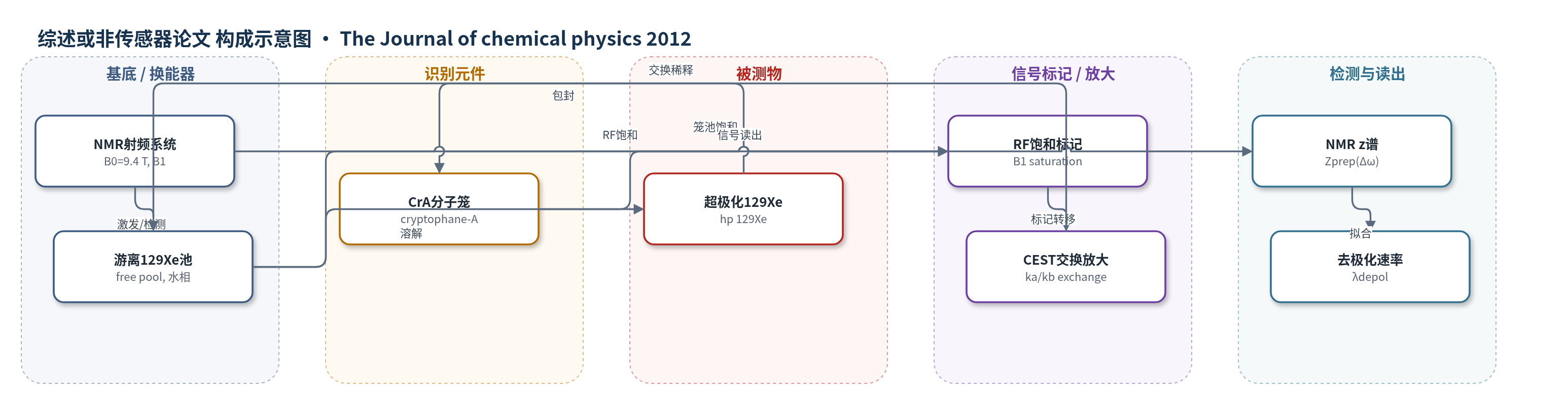
点击图片查看大图 · 依据论文自动绘制
传感器类型
综述或非传感器论文
检测对象
超极化氙-129(hyperpolarized 129Xe)与 cryptophane-A(CrA)笼的宿主–客体交换参数(交换速率 kb、笼浓度分数 fb);样品基质:水溶液/氙气-水相 NMR 样品。
检测原理
超极化 129Xe 经激光光学泵浦(SEOP)获得远高于热平衡的核自旋极化。游离水相 129Xe 与 CrA 笼内包封 129Xe 因化学位移不同形成两个交换池。对 CrA 笼池施加选择性 RF 饱和后,笼内 Xe 的饱和标记通过化学交换转移到数量更大的游离 Xe 池,使游离池纵向磁化强度发生单指数衰减。该衰减率 λdepol 由 Bloch–McConnell 方程模值最小特征值决定,并受交换速率 kb、笼浓度分数 fb、横向弛豫 R2b、RF 场强 B1 和 T1/T2 影响。信号放大来自小笼池标记向大游离池的累积,因此可通过 z 谱定量宿主–客体相互作用。
检测灵敏度
R2 > 99.96%(Lorentzian拟合,除δb外)
效应效果
解析解与数值 Bloch–McConnell 模拟在宽参数范围内高度一致,Lorentzian 拟合相关系数 R2 > 99.96%(除 δb 外)。有效范围包括 tsat > 0.1 s、10 Hz < kb < 2000 Hz、δa–δb > 5 ppm、B1 < 5 μT、全解 fb < 50%、近似解 fb < 10%、超极化 > 100 倍热极化、T1 > 2 s。模型可分离并定量 kb、R2b 与 fb,预测最优交换速率 kb,opt ≈ 35 Hz,FWHM 在 kb ≈ 20 Hz 处最小。作者认为该理论可用于 HyperCEST 实验优化、定量分析及靶向生物传感器设计。
传感器的构成
- 换能/检测基底:9.4 T 静磁场 B0 与射频场 B1(NMR 射频系统),提供饱和辐照并接收 129Xe 磁化信号
- 识别/宿主层:cryptophane-A(CrA)分子笼,提供疏水空腔包封 129Xe,形成 CEST 池
- 识别客体/传感探针:超极化氙-129(hp 129Xe),作为非极性客体进入 CrA 空腔并产生不同化学位移
- 信号标记/放大:RF 选择性饱和与化学交换饱和转移(CEST/HyperCEST),将笼内 Xe 饱和标记转移到大量游离 Xe 池
- 读出层:NMR z-spectrum 与去极化衰减率 λdepol,用于定量 kb、fb、R2b 等参数
中文摘要
本文给出超极化核在自由溶剂与包封空腔之间发生化学交换饱和转移(HyperCEST)时 Bloch–McConnell 方程的解析解。该解可用于核磁共振(NMR)定量研究宿主–客体相互作用,并借助 HyperCEST 的强信号增强实现 NMR 成像。研究对象包括大分子疏水空腔或人工分子笼,如被提出作为靶向生物传感器的 cryptophane-A(CrA)。通过单指数去极化过程可提取交换速率、宿主浓度等系统参数;该过程由模值最小的特征值主导。作者给出该主导特征值的近似表达式,得到共振与非共振辐照下的去极化速率,并证明其为旋转坐标系纵向弛豫速率 R1ρ 的推广。以游离氙与 CrA 包封氙体系为例,解析结果与数值模拟一致,表明该近似在广泛适用范围内可精确描述 HyperCEST 实验,从而支持实验优化、定量分析及潜在生物传感器的设计与表征。
英文摘要
We present an analytical solution of the Bloch-McConnell equations for the case of chemical exchange saturation transfer between hyperpolarized nuclei in cavities and in solvent (HyperCEST experiment). This allows quantitative investigation of host-guest interactions by means of nuclear magnetic resonance spectroscopy and, due to the strong HyperCEST signal enhancement, even NMR imaging. Hosts of interest can be hydrophobic cavities in macromolecules or artificial cages like cryptophane-A which was proposed as a targeted biosensor. Relevant system parameters as exchange rate and host concentration can be obtained from the monoexponential depolarization process which is shown to be governed by the smallest eigenvalue in modulus. For this dominant eigenvalue we present a useful approximation leading to the depolarization rate for the case of on- and off-resonant irradiation. It is shown that this rate is a generalization of the longitudinal relaxation rate in the rotating frame. We demonstrate for the free and cryptophane-A-encapsulated xenon system, by comparison with numerical simulations, that HyperCEST experiments are precisely described in the valid range of this widely applicable analytical approximation. Altogether, the proposed analytical solution allows optimization and quantitative analysis of HyperCEST experiments but also characterization and optimal design of possible biosensors.