组成图示
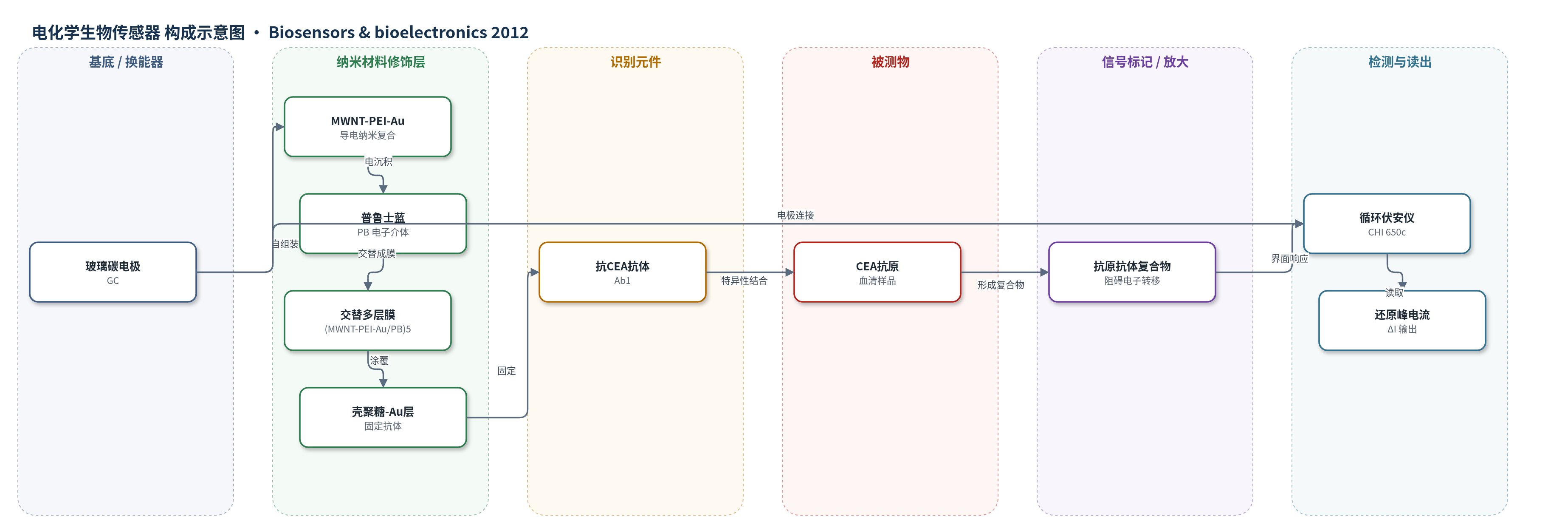
点击图片查看大图 · 依据论文自动绘制
传感器类型
电化学生物传感器
检测对象
癌胚抗原(CEA),样品基质:人血清(human serum)
检测原理
该传感器为无标记安培免疫传感器。玻璃碳电极表面交替构建 (MWNT–PEI–Au/PB)5 多层膜,其中 PB 作为可逆电子介体,在 0.025 M PBS/0.1 M KCl(pH 6.0)中发生普鲁士蓝/普鲁士白氧化还原反应,产生稳定还原峰电流。壳聚糖–Au 层固定抗 CEA 抗体 Ab1,BSA 封闭后,CEA 与 Ab1 特异性结合形成抗原–抗体复合物。复合物在电极界面形成空间位阻,阻碍 PB 与电极间电子转移,使还原峰电流降低。以 ΔI=I0−I 作为响应信号,ΔI 随 CEA 浓度增加而增大,实现定量检测。
检测灵敏度
LOD: 0.08 ng/mL (at 3σ);检测范围: 0.5–160 ng/mL;线性范围: 0.5–2.0 ng/mL,ΔI = 4.58CCEA(ng/mL) + 0.9,r = 0.995;2.0–160 ng/mL,ΔI = 0.37CCEA(ng/mL) + 19.18,r = 0.992
效应效果
该传感器对血清中常见干扰物抗坏血酸、甘氨酸、葡萄糖、半胱氨酸、BSA 和 PSA 的电流比在 1.02±0.02 至 1.05±0.05(n=5),选择性良好。批间重现性(5 个电极测 20 ng/mL CEA)RSD 为 4.9%,连续测量 RSD 为 3.7%。用 0.1 M 甘氨酸–HCl(pH 3.5)再生 15 min 后,RSD 为 3.6%,CV 信号保留 94–97%。4℃干燥保存 4 周后保留 87.5% 初始响应。与人血清 ELISA 结果比较,5 个样本相对偏差为 5.9%、−3.1%、5.8%、1.2%、−4.5%,表明可用于临床血清 CEA 检测。
传感器的构成
- 基底/换能器电极:玻璃碳电极(GC),提供导电基底与电子转移动力
- 纳米材料修饰层:多壁碳纳米管/聚乙烯亚胺/金纳米粒子(MWNT–PEI–Au),形成导电网络并锚定普鲁士蓝
- 电子介体层:普鲁士蓝(PB)纳米粒子,通过循环伏安电沉积形成,提供可逆氧化还原信号
- 有序多层膜:(MWNT–PEI–Au/PB)5 交替复合膜,稳定 PB 并增强电子传递
- 抗体固定层:壳聚糖–金纳米粒子(chitosan–Au)混合膜,固定抗体并保护内层
- 识别元件:抗 CEA 抗体(anti-CEA, Ab1),特异性结合 CEA
- 封闭剂:牛血清白蛋白(BSA),封闭剩余活性位点,减少非特异吸附
中文摘要
开发了一种用于检测癌胚抗原(CEA)的新型安培免疫传感器。首先通过交替电沉积与自组装策略,在玻璃碳电极表面构建普鲁士蓝(PB)与多壁碳纳米管/聚乙烯亚胺/金(MWNT–PEI–Au)纳米复合的有序多层膜;随后在电极表面涂覆壳聚糖/金纳米粒子混合层,再固定抗 CEA 抗体(Ab1)并用牛血清白蛋白(BSA)封闭。透射电镜表征了 MWNT–PEI–Au 纳米复合形貌,扫描电镜和电化学测量分别表征了有序多层结构及免疫传感器构建过程。该策略有效保证了 PB 作为电子介体的稳定性。在优化条件下,传感器对 CEA 响应良好,检测范围为 0.5–160 ng/mL,检出限为 0.08 ng/mL(3σ)。所制备免疫传感器具有良好灵敏度、选择性和长期稳定性,表明交替电沉积与自组装策略在生物传感器构建中具有应用前景。
英文摘要
A novel amperometric immunosensor for the determination of carcinoembryonic antigens (CEA) was developed. Firstly, ordered multilayer films of Prussian blue (PB) and multiwalled-carbon nanotube/polyethylenimine/Au (MWNT-PEI-Au) nanocomposite were fabricated onto the surface of a glassy carbon electrode via alternate electrodeposition and self-assembly. Then a layer of chitosan mixed with gold nanoparticles was cast onto the surface of the electrode. Subsequently, the electrode was coated with antibody (Ab(1)) and blocked with BSA. The morphology of the MWNT-PEI-Au nanocomposite was characterized by transmission electron microscopy (TEM). The fabrication process of the ordered multilayer structure and immunosensor were characterized by scanning electron microscopy (SEM) and electrochemical measurements, respectively. The proposed fabrication strategy effectively ensured the stability of the Prussian blue as electron mediator. Under optimal conditions, the fabricated immunosensor exhibited a good response to CEA, with a detection range from 0.5 to 160 ng/mL and a detection limit of 0.08 ng/mL at 3δ. The current fabricated immunosensor exhibited good sensitivity, selectivity, and long-term stability. Furthermore, current study demonstrated the promising application of the alternate strategy based on electrodeposition and self-assembly for the construction of biosensor.