组成图示
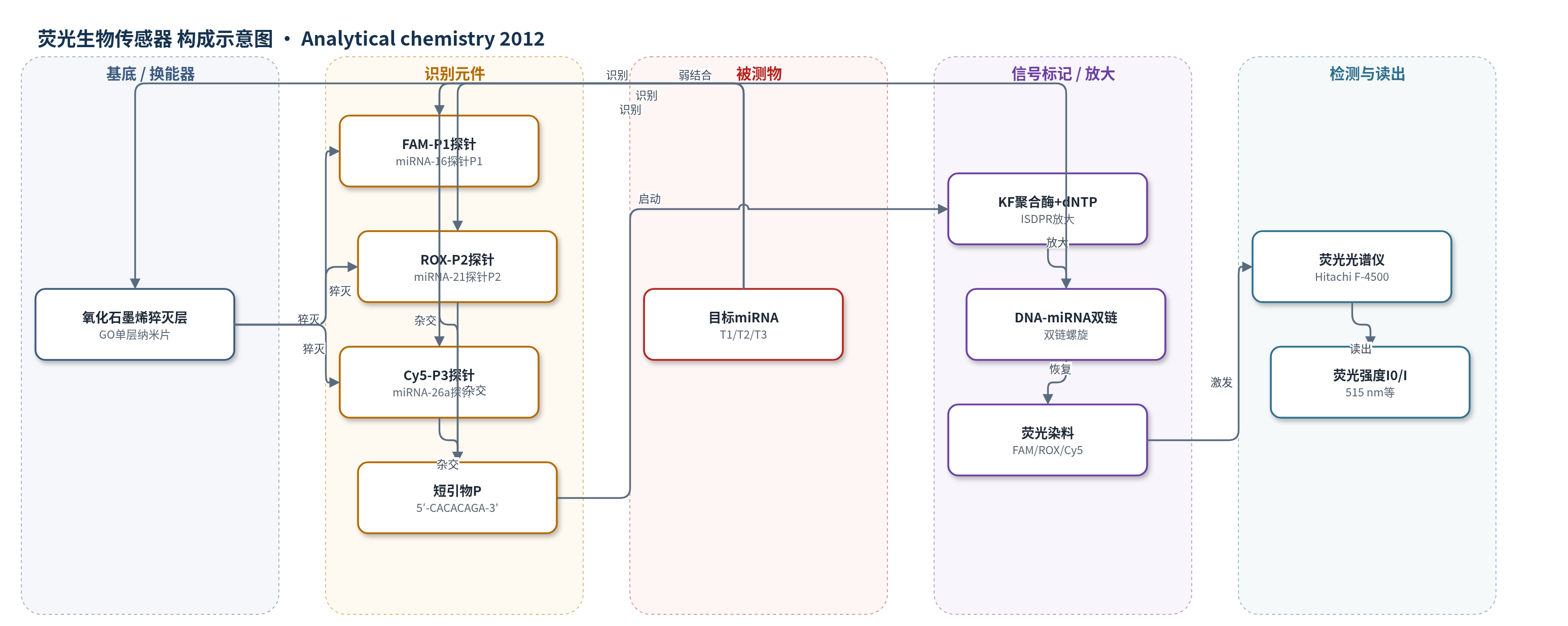
点击图片查看大图 · 依据论文自动绘制
传感器类型
荧光生物传感器
检测对象
microRNA-16(miRNA-16)、microRNA-21(miRNA-21)、microRNA-26a(miRNA-26a);样品基质:缓冲液/溶液(Tris-HCl 反应缓冲液与 DNA 杂交缓冲液 HB)
检测原理
荧光标记的单链 DNA 探针 P1/P2/P3 与短引物 P 混合。无目标时,P 与探针形成的双链稳定性低,ISDPR 不启动;ssDNA 探针通过碱基堆积和氢键吸附到 GO 表面,染料(FAM/ROX/Cy5)经距离依赖 FRET 被 GO 猝灭,背景低。当目标 miRNA 与对应探针互补结合后,邻近碱基堆积使 P1/P 双链 Tm 升高,在 25 °C 下触发 KF 聚合酶和 dNTP 参与的等温链置换聚合酶反应(ISDPR),产生大量 DNA-miRNA 双链螺旋。双链与 GO 相互作用弱,染料远离 GO,荧光恢复。目标浓度越高,ISDPR 产物越多,荧光强度比 I0/I 越大,实现定量。GO 大平面同时猝灭不同染料探针,实现多重检测。
检测灵敏度
LOD: 2.1 fM;线性范围: 5 pM to 5 fM(原文:linear range of 4 orders of magnitude)
效应效果
该方法对完全互补 miRNA-16 的 I0/I 响应为单碱基错配的 2.78 倍,三碱基错配响应仅为完全互补的 32%,空白对照为 28%,显示高序列特异性。多重检测中,T1 仅使 FAM 通道强发射,T2/T3 对 FAM 的干扰分别为 15.5% 和 11%;T2 和 T3 分别选择性增强 ROX 与 Cy5 通道。LOD 2.1 fM,低于 GO 后混合 DNA 检测的 10 nM 和 GO 预混合 DNA 检测的 100 pM,也优于分子信标、金纳米颗粒-DNA-染料、SWNT 及银纳米簇等均相方法,并与 SPR、纳米晶荧光和电化学方法具有竞争力。作者认为该平台可用于 miRNA 表达谱分析、疾病分子诊断和生物医学研究。
传感器的构成
- 换能/猝灭介质:氧化石墨烯(GO),Hummers 法制备的单层纳米片,提供距离依赖荧光猝灭并区分 ssDNA 与双链核酸
- 识别元件:FAM 标记 miRNA-16 探针 P1、ROX 标记 miRNA-21 探针 P2、Cy5 标记 miRNA-26a 探针 P3,特异性识别目标 miRNA
- 识别元件:短引物 P(5′-CACACAGA-3′),与探针形成低稳定性双链并在目标存在时启动 ISDPR
- 信号标记物:有机荧光染料 FAM、ROX、Cy5,分别标记 P1、P2、P3,被 GO 猝灭或恢复
- 放大元件:Klenow fragment exo−(KF)DNA 聚合酶与 dNTPs,驱动等温链置换聚合酶反应(ISDPR)
- 反应介质:Tris-HCl 反应缓冲液(含 Mg2+、K+、DTT、dNTP、Tween 20)和 DNA 杂交缓冲液 HB(PBS 含 Mg2+),维持酶反应与杂交猝灭
中文摘要
本文提出一种基于氧化石墨烯(GO)荧光猝灭和等温链置换聚合酶反应(ISDPR)的简单、高灵敏、选择性多重 microRNA(miRNA)检测方法。GO 能区分单链 DNA 与双链核酸结构,并对多种有机荧光染料具有强猝灭能力,因此可在同一溶液中同时、选择性地检测标记不同染料的多个 miRNA 探针;ISDPR 信号放大赋予方法高灵敏度。由于单链 DNA 与 GO 的强相互作用,荧光标记的单链 DNA 探针背景荧光极低;当特异性目标 miRNA 被识别后,触发 ISDPR 产生大量 DNA-miRNA 双链螺旋,双链与 GO 相互作用较弱,荧光恢复,产生强发射。该方法获得 2.1 fM 的检出限和 4 个数量级的线性范围。GO 的大平面表面可同时猝灭多个不同染料标记的 DNA 探针,构建高灵敏、高选择性的多重生物传感平台,有望用于 miRNA 表达谱分析和生物医学研究。
英文摘要
A simple, highly sensitive, and selective multiple microRNA (miRNA) detection method based on the graphene oxide (GO) fluorescence quenching and isothermal strand-displacement polymerase reaction (ISDPR) was proposed. The capability to discriminate ssDNA and double-stranded nucleic acid structure coupled with the extraordinary fluorescence quenching of GO on multiple organic dye allows the proposed strategy to simultaneously and selectively detect several miRNA labeled with different dyes in the same solution, while the ISDPR amplification endows the detection method with high sensitivity. The strong interaction between ssDNA and GO led to the fluorescent ssDNA probe exhibiting minimal background fluorescence. Upon the recognition of specific target miRNA, an ISDPR was triggered to produce numerous massive specific DNA-miRNA duplex helixes, and a strong emission was observed due to the weak interaction between the DNA-miRNA duplex helix and GO. A miRNA biosensor down to 2.1 fM with a linear range of 4 orders of magnitude was obtained. Furthermore, the large planar surface of GO allows simultaneous quenching of several DNA probes with different dyes and produces a multiple biosensing platform with high sensitivity and selectivity, which has promising application in profiling the pattern of miRNA expression and biomedical research.