组成图示
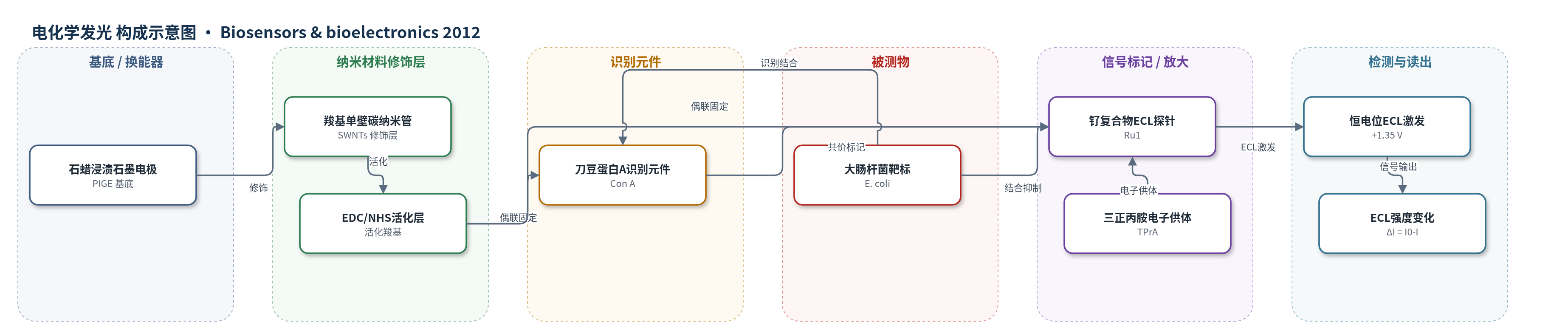
点击图片查看大图 · 依据论文自动绘制
传感器类型
电化学发光(ECL)生物传感器
检测对象
大肠杆菌 Escherichia coli(E. coli,含 O157:H7、DH5α、K12 菌株);样品基质:细菌悬液、自来水加标样品
检测原理
Ru1-Con A 探针通过 EDC/NHS 化学共价固定于羧基 SWNT/PIGE 表面。E. coli 细胞表面的脂多糖/糖基化结构与 Con A 特异性结合,形成 Con A-LPS 复合物。结合事件使电极界面发生物理阻碍和微环境改变:一方面抑制 TPrA 氧化为 TPrA•+ 以及 Ru1 氧化为 Ru1^3+,减少激发态 Ru1^2+* 的生成;另一方面结合复合物对激发态产生类似猝灭作用,使 ECL 强度下降。在 100 mM TPrA 中施加 +1.35 V 恒电位,积分 30 s 的 ECL 强度变化 ΔI=I0-I 随 E. coli 浓度增加而增大,并与 log C 成正比,从而实现定量检测。
检测灵敏度
LOD: 127 cells/mL;线性范围: 5.0 × 10^2–5.0 × 10^5 cells/mL;线性方程: ΔI = 209,82lgC − 19,844 (C: cells/mL);相关系数: 0.9647
效应效果
该传感器对大肠杆菌各菌株响应较高:E. coli K12 和 DH5α 的 ΔI 分别为 O157:H7 的 95.8% 和 101%,而对 Micrococcus luteus 和 Staphylococcus aureus 仅 13.1% 和 15.3%,表明可区分革兰阴性 E. coli 与革兰阳性菌,但不能区分不同 E. coli 菌株。重现性方面,5 个传感器 RSD 为 4.8%,同一传感器 7 次测量 RSD 为 3.6%。自来水加标回收率为 95%(5.0×10^3 cells/mL)和 89%(5.0×10^4 cells/mL)。与 QCM(750 cells/mL)、肽基阻抗(1000 CFU/mL)和 DNA 化学发光(136 cells/mL)相比,127 cells/mL 的检出限接近带磁富集的 ECL 免疫传感器(100 cells/mL),检测总时间约 70 min。
传感器的构成
- 基底/换能器电极:石蜡浸渍石墨电极(PIGE),提供导电基底与 ECL 信号换能。
- 纳米材料修饰层:羧基功能化单壁碳纳米管(SWNTs),增大表面积、提高探针负载并增强 ECL 响应。
- 活化偶联层:EDC/NHS 活化 SWNTs 表面羧基,用于与 Ru1-Con A 探针共价偶联。
- 识别元件:刀豆蛋白A(Con A),识别 E. coli 表面糖基化/LPS 相关结构。
- 信号标记物:双(2,2′-联吡啶)-4′-甲基-4-羧基联吡啶钌(II)(Ru1),作为 ECL 发光中心,与 Con A 共价结合形成 Ru1-Con A 探针。
- 封闭剂:1% 牛血清白蛋白(BSA),封闭 SWNT/PIGE 表面非特异性活性位点。
- 电子供体/检测介质:三正丙胺(TPrA,100 mM)与 10 mM PBS,TPrA 作为共反应剂参与 ECL 反应。
中文摘要
本文首次报道了一种用于高灵敏检测大肠杆菌(Escherichia coli, E. coli)的电化学发光(ECL)生物传感器。该传感器以刀豆蛋白A(Concanavalin A, Con A)作为生物识别元件,以双(2,2′-联吡啶)-4′-甲基-4-羧基联吡啶钌(II)(Ru1)配合物作为检测探针。制备时,先将羧基功能化单壁碳纳米管(SWNTs)吸附于石蜡浸渍石墨电极(PIGE)表面,再将 Ru1-Con A 探针共价偶联到 SWNT 修饰电极表面。当模型靶标大肠杆菌 O157:H7 与传感器结合后,在三正丙胺(TPrA)存在下,ECL 强度降低,且降低值 ΔI 与 E. coli 浓度在 5.0×10^2–5.0×10^5 cells/mL 范围内呈对数线性关系。该传感器检出限为 127 cells/mL,并能较好地区分革兰阴性大肠杆菌与革兰阳性细菌。该策略有望扩展到其他细菌的高灵敏、快速 ECL 检测。
英文摘要
A novel electrogenerated chemiluminescence (ECL) biosensor for highly sensitive detection of Escherichia coli (E. coli) was first developed by employing Concanavalin A (Con A) as a biological recognition element and bis(2,2'-bipyridine)-4'-methyl-4-carboxybipyridine ruthenium (II) (Ru1) complex as the detector. The ECL biosensor was fabricated by adsorbing carboxyl-functionalised single-wall carbon nanotubes (SWNTs) onto a paraffin-impregnated graphite electrode and further covalently coupling the Ru1-Con A probe onto the surface of the SWNT-modified electrode. Upon the binding of E. coli O157:H7 (as a model target), the biosensor showed a decreased ECL intensity in the presence of tri-n-propylamine (TPrA), which was in logarithmically direct proportion to the concentration of E. coli over a range from 5.0 × 10(2) to 5.0 × 10(5)cells/mL. The detection limit of this sensor was 127 cells/mL. Additionally, the ECL biosensor also showed satisfactory selectivity in discriminating gram-negative E. coli from gram-positive bacteria. The strategy developed in this study may be a promising approach and could be extended to the design of ECL biosensors for highly sensitive and rapid detection of other desired bacteria.