组成图示
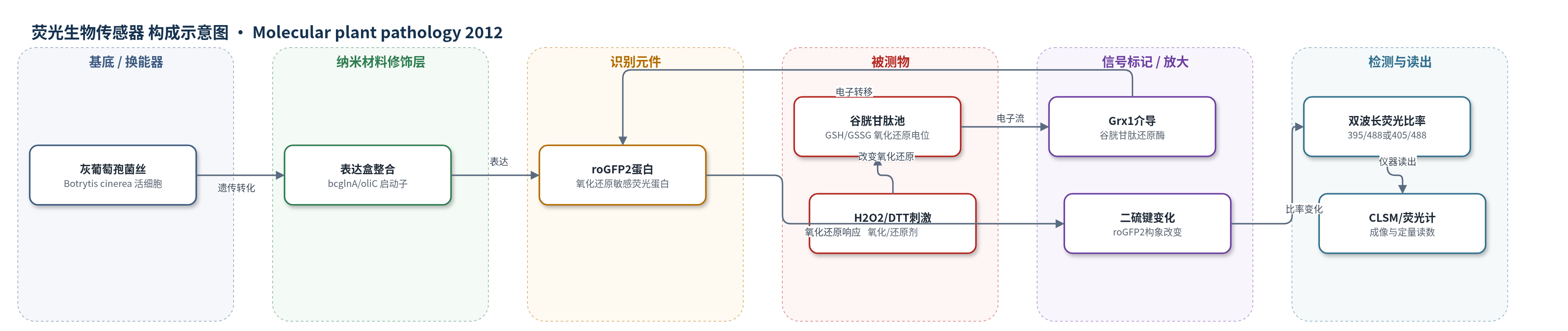
点击图片查看大图 · 依据论文自动绘制
传感器类型
荧光生物传感器
检测对象
细胞谷胱甘肽氧化还原电位(glutathione redox potential, GSH/GSSG)、氧化还原状态(redox status,受 H2O2/DTT 调节);样品基质:灰葡萄孢(Botrytis cinerea)活菌丝/孢子及洋葱表皮渗透结构
检测原理
roGFP2 在相邻 β 链上工程化两个半胱氨酸,氧化条件下形成二硫键,还原条件下断裂;二硫键状态改变荧光素质子化状态,使氧化态在 395/405 nm 激发下荧光增强,还原态在 488 nm 激发下荧光增强。传感器并非直接检测总 ROS,而是通过谷胱甘肽还原酶 Grx 介导细胞谷胱甘肽池(GSH/GSSG)与 roGFP2 之间的可逆电子流,使 roGFP2 氧化还原态反映谷胱甘肽池氧化还原电位。H2O2 等氧化剂使 GSH 氧化为 GSSG,roGFP2 被氧化,395/488 或 405/488 荧光比率升高;DTT 或 GSH 恢复使比率下降。Grx1-roGFP2 融合体通过共价连接 Grx1 加速响应。最终由 CLSM 或荧光计双波长激发、约 510 nm 发射,计算比率实现定量、可逆、比率型读出。
检测灵敏度
原文未报告 LOD、线性范围、灵敏度斜率或相关系数。H2O2 浓度响应:1 mM H2O2 使比率由约0.45升至约0.61,10 mM 升至约1.15,100 mM 升至约1.3。
效应效果
传感器静息态几乎完全还原,DTT 不改变比率,说明菌丝胞质维持还原状态。响应具氧化剂特异性:0.3% NaClO 引起与 10 mM H2O2 相似的比率变化,1 M NaCl 和 menadione 无影响;比率变化随 H2O2 浓度增加,1、10、100 mM 分别约增加 0.16、0.7、0.85。反应可逆且可重复,H2O2 后换新鲜培养基可部分还原,DTT 可完全还原;Grx1-roGFP2 在 3 min 时氧化略快。Δbap1 单次 H2O2 后 GSH 恢复与野生型相似,重复 H2O2 后不能恢复至还原态。洋葱表皮实验中,类附着孢更氧化,侵染菌丝更还原。作者认为可用于突变体氧化还原表型分析和植物-真菌互作研究。
传感器的构成
- 传感基质:Botrytis cinerea 野生型 B05.10 或 Δbap1 突变体菌丝/孢子,作为活体表达与检测基质
- 遗传表达元件:bcglnA 启动子/终止子或 oliC 启动子/葡聚糖酶终止子、hygromycin 抗性、bcniaD/bcniiA 同源整合侧翼,驱动 roGFP2/Grx1-roGFP2 稳定表达
- 识别/传感元件:roGFP2(ratiometric redox-sensitive green fluorescent protein),工程化二硫键响应谷胱甘肽氧化还原电位
- 介导/放大元件:内源或融合 Grx1(glutaredoxin 1),介导 GSH/GSSG 与 roGFP2 之间可逆电子流
- 信号标记物:roGFP2 自身荧光,氧化态 395/405 nm 激发增强,还原态 488 nm 激发增强
- 读出装置:CLSM(Leica TCS SP2)或荧光计(Tecan Safire),双波长激发并计算 395/488 或 405/488 比率
中文摘要
植物受病原菌侵染时会产生活性氧(ROS)防御反应,但 ROS 对丝状真菌的作用仍不清楚。本研究将比率型氧化还原敏感绿色荧光蛋白 roGFP2 引入灰葡萄孢(Botrytis cinerea),构建真菌表达系统,用于活体测量细胞氧化还原状态。在野生型菌丝中,roGFP2 对 H2O2 诱导的氧化和 DTT 诱导的还原呈可逆响应,可通过共聚焦激光扫描显微镜(CLSM)和荧光计测定。由于 roGFP2 通过谷胱甘肽还原酶(GRX)反映细胞谷胱甘肽池的氧化还原电位,作者利用其分析 H2O2 处理后还原型谷胱甘肽(GSH)的恢复动力学。转录因子 Bap1 是 H2O2 清除蛋白的主要转录调控因子;与野生型相比,Δbap1 缺失突变体在重复 H2O2 处理后 GSH 恢复受损。体内实验表明,氧化还原过程可能参与侵染结构分化:洋葱表皮渗透过程中,类附着孢结构周围谷胱甘肽池更氧化,而侵染菌丝中更还原。
英文摘要
The production of reactive oxygen species (ROS) is part of the defence reaction of plants against invading pathogens. The effect of ROS on filamentous fungi is still unclear. In this study, ratiometric redox-sensitive green fluorescent protein (roGFP) was introduced as a tool for in vivo measurement of the cellular redox status in filamentous fungi. A fungal expression system for roGFP2 was constructed. Expressed in Botrytis cinerea, roGFP2 reversibly responded to redox changes induced by incubation with H(2)O(2) or dithiothreitol, which was determined by confocal laser scanning microscopy imaging and fluorometry. As the sensor detects the redox potential of the cellular glutathione pool, it was used to analyse the kinetics of GSH (glutathione, reduced form) recovery after H(2)O(2) treatment. The transcription factor Bap1 is the main transcriptional regulator of H(2)O(2) -scavenging proteins in B. cinerea. When compared with the wild-type, GSH recovery in the Δbap1 deletion mutant was affected after repeated H(2)O(2) treatment. ROS and intracellular redox changes can be used by fungi for signalling purposes. In planta experiments, performed in this study, indicated that redox processes seem to be important for the differentiation of penetration structures. During the penetration of onion epidermal cells, the status of the cellular glutathione pool differed between appressoria-like structures and infecting hyphae, being reduced in the presence of infecting hyphae and more oxidized around appressoria-like structures.