组成图示
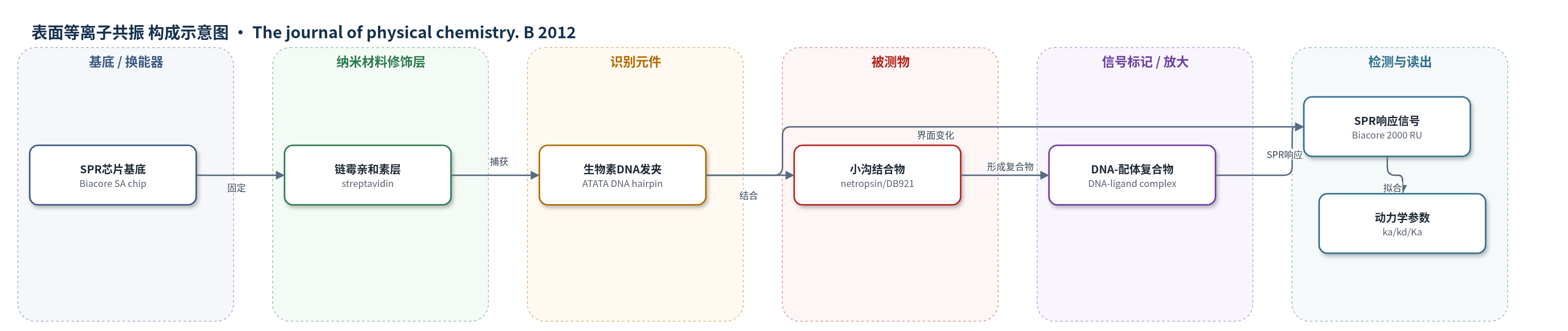
点击图片查看大图 · 依据论文自动绘制
传感器类型
表面等离子共振(SPR)生物传感器
检测对象
净霉素(netropsin)、DB921、DB911;样品基质为 SPR 流动相(cacodylic acid buffer 含 0.01% P-20)及 NMR 缓冲液(BPES 磷酸盐缓冲液,含 NaCl/EDTA)
检测原理
SPR 检测中,5′-生物素标记的 ATATA DNA 发夹通过链霉亲和素非共价固定在 Biacore SA 芯片表面,形成含交替 AT 小沟结合位点的识别层。被测小沟结合物(netropsin、DB921、DB911)随流动相流过表面,与 DNA 小沟结合后改变界面质量与折射率,Biacore 2000 以 SPR 响应单位(RU)实时记录结合与解离曲线,响应随配体浓度升高而增大。按 1:1 结合模型拟合得到 ka、kd 和 Ka,反映宏观解离寿命。NMR 则通过 1D 线形、2D NOESY/ROESY 和 EXSY 检测结合态等价位点间的化学交换,温度依赖的 coalescence 给出微观重排速率;该速率远快于 SPR 测得的宏观解离,说明配体在保持 DNA 缔合时发生取向翻转。
检测灵敏度
原文未报告LOD、线性范围、灵敏度斜率或相关系数。
效应效果
SPR 拟合良好:netropsin Ka=4.1×10^8 M^-1、Kd=2.4×10^-9 M、ka=2.6×10^7 M^-1 s^-1、kd=0.06 s^-1(1/kd=17 s);DB921 Ka=1.0×10^8 M^-1、Kd=1.0×10^-8 M、ka=1.0×10^6 M^-1 s^-1、kd=0.01 s^-1(1/kd=100 s);DB911 Ka=1.2×10^7 M^-1、Kd=8.3×10^-8 M,ka/kd 未准确测定。NMR 得 netropsin 300 K 交换速率约 16 s^-1,DB921 295/298 K 约 44/62 s^-1,远快于宏观解离。侧翼序列影响有限;强结合物未见自由 DNA 交换,DB911 线宽明显。作者认为取向翻转贡献结合熵,影响小沟结合物设计与热力学解释。
传感器的构成
- 换能基底:Biacore SA 传感器芯片,作为 SPR 光学换能表面
- 捕获修饰层:链霉亲和素(streptavidin),非共价捕获生物素标记 DNA
- 识别元件:5′-生物素标记 ATATA DNA 发夹(5′-GCG ATA TAC GTC TCC GTA TAT CGC-3′),提供交替 AT 小沟结合位点
- 流动相:含 0.01% 表面活性剂 P-20 的 cacodylic acid buffer,输送被测小分子并维持结合环境
- 再生剂:10 mM glycine(pH 2.0),用于解离表面复合物并再生 DNA 表面
- 读出装置:Biacore 2000 SPR 仪器,实时监测表面响应单位(RU)
中文摘要
热力学和结构研究常用于优化小分子与特定 DNA 相互作用,因此已有大量结合数据。然而,小沟复合物形成和维持所涉及的动态过程尚未完全理解。为帮助界定相关过程,作者对多种化合物以及对称和非对称 AT 序列 DNA 进行了 1D 和 2D NMR 并结合生物传感器-SPR 实验。令人惊讶的是,NMR 数据清楚显示,对于 netropsin 和 DB921 等强结合化合物(Ka > 10^8 M^-1),存在等价结合位点之间的交换,且该交换不涉及从 DNA 上解离。定量分析表明,这些结合态交换速率确实远快于由生物传感器-SPR 独立测定的宏观解离速率。此外,作者证明这些化合物与非对称 DNA 序列相互作用时,在同一位点至少存在两种 1:1 化合物-DNA 复合物。为解释该行为,作者提出一个模型:配体在与 DNA 紧密缔合的同时在两种取向之间快速翻转。配体重取向对结合熵有有利贡献。由于小沟结合物与对称及非对称双链形成多个复合物的潜力普遍未知,文章讨论了其对结合热力学和化合物设计的影响。
英文摘要
Thermodynamic and structural studies are commonly utilized to optimize small molecules for specific DNA interactions, and, thus, a significant amount of binding data is available. However, the dynamic processes that are involved in minor groove complex formation and maintenance are not fully understood. To help define the processes involved, we have conducted 1D and 2D NMR in conjunction with biosensor-SPR experiments with a variety of compounds and symmetric, as well as asymmetric, AT tract DNA sequences. Surprisingly, the NMR data clearly show exchange between equivalent binding sites for strongly binding compounds like netropsin and DB921 (Ka > 10(8) M(-1)) that does not involve dissociation off the DNA. A quantitative analysis of the data revealed that these bound exchange rates are indeed much faster than the macroscopic dissociation rates which were independently determined by biosensor-SPR. Additionally, we could show the existence of at least two 1:1 compound DNA complexes at the same site for the interaction of these compounds with an asymmetric DNA sequence. To explain this behavior we introduced a model in which the ligand is rapidly flipping between two orientations while in close association with the DNA. The ligand reorientation will contribute favorably to the binding entropy. As the potential of minor groove binders to form more than a single complex with asymmetric, as well as symmetric, duplexes is widely unknown, the consequences for binding thermodynamics and compound design are discussed.