组成图示
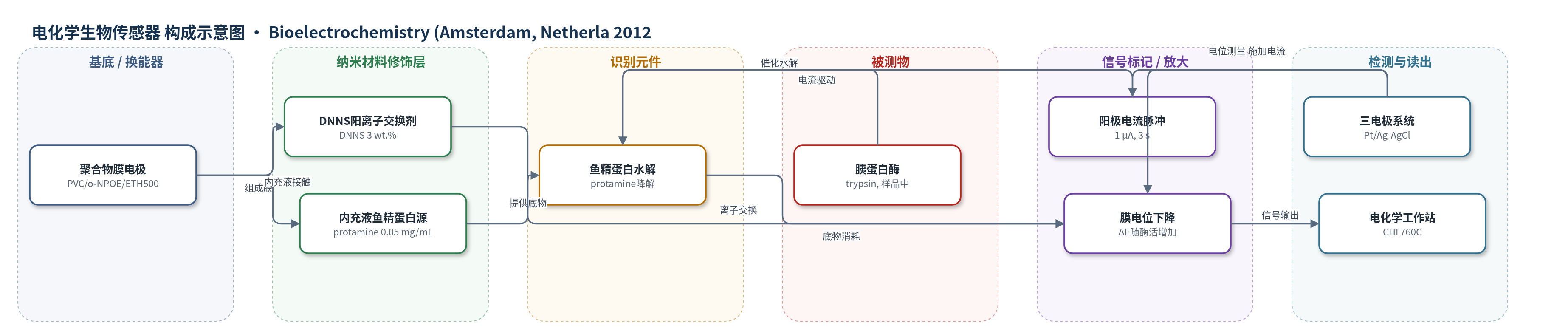
点击图片查看大图 · 依据论文自动绘制
传感器类型
电化学生物传感器
检测对象
胰蛋白酶(trypsin);样品基质:50 mM Tris-HCl缓冲液(pH 7.4)含120 mM NaCl
检测原理
传感器以聚合物膜多阳离子敏感电极为换能器。施加阳极电流脉冲驱动内充液中的鱼精蛋白(protamine)穿过膜进入样品-膜界面。样品中胰蛋白酶催化水解鱼精蛋白,使界面自由鱼精蛋白浓度降低;由于膜中DNNS与多阳离子形成离子对产生电位,鱼精蛋白消耗后样品中Na+更易与膜表面鱼精蛋白发生离子交换,使膜相中鱼精蛋白被剥离,膜电位下降。记录加酶前后电位差ΔE,ΔE随胰蛋白酶浓度增加而增大。电流脉冲实现底物按需释放和膜恢复,提供快速、可逆、无外加试剂的检测。
检测灵敏度
LOD: 0.3 U mL−1;线性范围: 0.5–5 U mL−1;灵敏度: 4.49 mV/(U mL−1);相关系数: r = 0.9973
效应效果
在最优条件下,电极对胰蛋白酶响应可逆且重复性好,5 U mL−1时RSD为8.0%(n=6);同一内充液和膜连续100次测量未观察到电位响应损失。交替测量缓冲液与胰蛋白酶溶液显示脉冲间响应可逆、信号完全重复;达到98%满量程响应仅需3 s,恢复至初始值98%约3 min。检出限0.3 U mL−1,与其他电位法传感器相当或更优。作者认为该策略快速、可逆、无需外加试剂,适用于蛋白酶活性实时检测,并有望用于以蛋白酶为标记的同相免疫分析。未报告选择性、抗干扰或实际样品回收率。
传感器的构成
- 换能器电极:聚合物膜离子选择性电极(ISE),由PVC、o-NPOE、DNNS、ETH 500组成,用于电位响应
- 膜基质:高相对分子质量聚氯乙烯(PVC)29 wt.%,作为膜骨架
- 增塑剂:2-硝基苯基辛基醚(o-NPOE)58 wt.%,提高膜中离子迁移
- 阳离子交换剂:二壬基萘磺酸盐(DNNS)3 wt.%,与多阳离子形成离子对并产生电位响应
- 脂溶性盐:四(4-氯苯基)硼酸四十二烷基铵(ETH 500)10 wt.%,提高膜电导并稳定电位
- 内充液/底物源:0.05 mg mL−1鱼精蛋白(protamine)、120 mM NaCl、50 mM Tris-HCl(pH 7.4),在电流驱动下释放底物
- 识别/反应元件:无固定识别元件;样品中胰蛋白酶(trypsin)催化水解鱼精蛋白
- 外部电极与读出:铂辅助电极(Pt)、Ag/AgCl(3 M KCl)参比电极和CHI 760C电化学工作站,用于施加电流并记录膜电位差
中文摘要
本文报道了一种基于电流控制试剂递送的电位法生物传感器,用于检测胰蛋白酶。该传感器采用以二壬基萘磺酸盐(DNNS)为阳离子交换剂的聚合物膜鱼精蛋白敏感电极,用于原位产生鱼精蛋白。通过施加外部电流,可精确控制鱼精蛋白穿过聚合物膜的扩散。样品溶液中胰蛋白酶催化的水解反应降低样品-膜界面处释放的自由鱼精蛋白浓度,并促进膜表面的鱼精蛋白通过样品溶液中钠离子的离子交换过程被剥离,从而使膜电位下降,实现电位法检测蛋白酶。研究了阳极电流幅值、电流脉冲持续时间以及内充液中鱼精蛋白浓度对膜电位响应的影响。在最优条件下,该鱼精蛋白敏感电极可在0.5–5 U mL−1范围内连续、可逆地检测胰蛋白酶,检出限为0.3 U mL−1。该检测策略为蛋白酶活性检测提供了快速、无试剂添加的方式,并在以蛋白酶为标记的同相免疫分析中具有重要应用潜力。
英文摘要
A potentiometric biosensor for the determination of trypsin is described based on current-controlled reagent delivery. A polymeric membrane protamine-sensitive electrode with dinonylnaphthalene sulfonate as cation exchanger is used for in situ generation of protamine. Diffusion of protamine across the polymeric membrane can be controlled precisely by applying an external current. The hydrolysis catalyzed with trypsin in sample solution decreases the concentration of free protamine released at the sample-membrane interface and facilitates the stripping of protamine out of the membrane surface via the ion-exchange process with sodium ions from the sample solution, thus decreasing the membrane potential, by which the protease can be sensed potentiometrically. The influences of anodic current amplitude, current pulse duration and protamine concentration in the inner filling solution on the membrane potential response have been studied. Under optimum conditions, the proposed protamine-sensitive electrode is useful for continuous and reversible detection of trypsin over the concentration range of 0.5-5UmL(-1) with a detection limit of 0.3UmL(-1). The proposed detection strategy provides a rapid and reagentless way for the detection of protease activities and offers great potential in the homogeneous immunoassays using proteases as labels.