组成图示
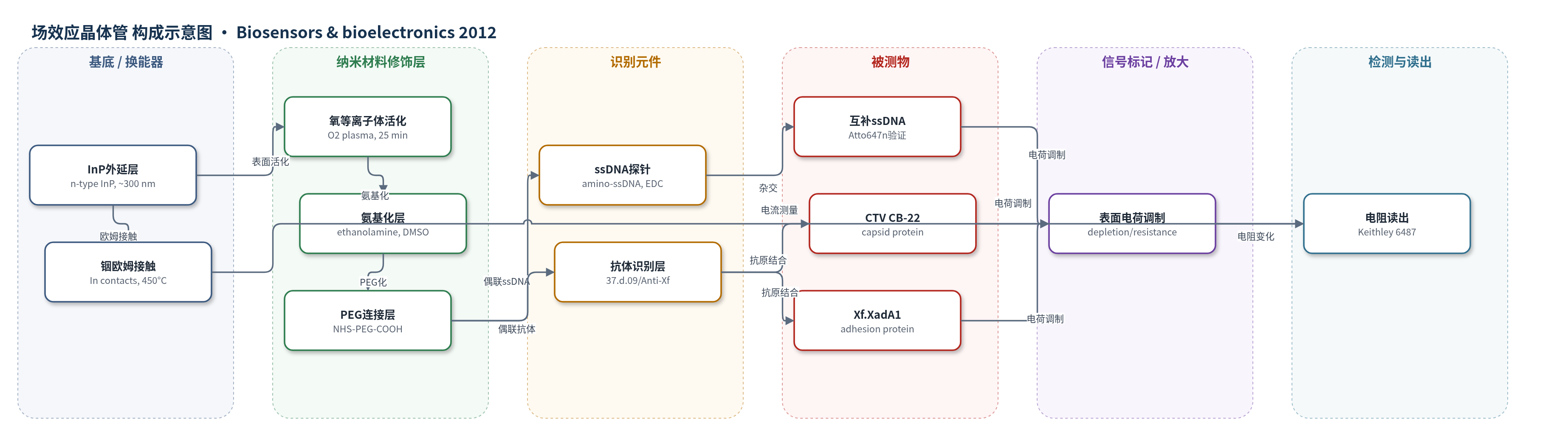
点击图片查看大图 · 依据论文自动绘制
传感器类型
场效应晶体管(FET)生物传感器
检测对象
互补单链DNA(complementary ssDNA)、柑橘tristeza病毒CB-22衣壳蛋白(Citrus Tristeza Virus CB-22 capsid protein)、Xylella fastidiosa XadA1黏附蛋白(Xylella fastidiosa Xf.XadA1 adhesion protein);样品基质:PBS、TRIS/NaCl杂交缓冲液等液体缓冲体系
检测原理
该传感器采用无标记电阻式换能机制。n 型 InP 外延层作为半导体导电通道,表面经氧等离子体活化、乙醇胺氨基化和 NHS-PEG-COOH 连接后,共价固定 ssDNA 探针或抗体。当互补 ssDNA、CTV CB-22 或 Xf.XadA1 与识别元件结合时,受体-配体界面产生新的电荷分布和偶极变化,等效于对 InP 表面施加栅压调制,改变耗尽层宽度与载流子浓度。两端施加小电压扫描时,通道电流随之变化,通过皮安计计算相对电阻变化 ΔR/R0。配体浓度越高,表面结合事件越多,ΔR/R0 越大并趋于饱和。PEG 间隔臂和乙二醇/BSA 封闭降低非特异吸附,提高信噪比。
检测灵敏度
LOD: 1 pM (specific ssDNA); about 2 nM (CTV and X. fastidiosa surface proteins); MCE: 4 ng/ml (ssDNA), 18 ng/ml (Xf.XadA1), 32 ng/ml (CB-22); 敏感范围(SeR): 30-715 ng/ml (ssDNA), 34-250 ng/ml (Xf.XadA1), 60-340 ng/ml (CB-22)
效应效果
荧光验证显示非特异吸附仅 6%-8%,非特异受体/配体对照的电阻变化约 10% 且与浓度无相关性;特异性体系最大 ΔR/R0 分别约为 DNA 68%、Xf.XadA1 60%、CTV CB-22 50%,四次重复结果误差棒无显著差异。与 ELISA 相比,CTV 检测最低浓度由 2 μg/mL 降至约 2 nM,提高约两个数量级;与 PCR 的 1.2 μg/mL(2.41 mM)相比,DNA 检测达 1 pM,低约两个数量级;与 a-Si:H FET 的 50 nM 相比低约四个数量级,并与电化学抗体-抗原检测的约 1 nM 相当。作者认为该无标记 InP 传感器可用于植物病原早期诊断,未来可微型化阵列用于田间快速检测。
传感器的构成
- 基底/换能器:半绝缘 InP 衬底上 CBE 生长约 300 nm n 型 InP 外延层,作为导电通道和电阻传感元件
- 欧姆接触:边缘 In 铟接触,450 °C 氮气退火,定义活性区并连接铜线至皮安计
- 表面预活化:氧等离子体处理(50 sccm、200 W、25 min),产生高密度硅醇/可酯化位点
- 氨基化层:5 M 乙醇胺盐酸盐(ethanolamine hydrochloride)在无水 DMSO 中 24 h,形成氨基接枝位点
- PEG 连接层:NHS-PEG-COOH(MW 3400)在无水氯仿/三乙胺中固定,作为柔性间隔臂并抗非特异吸附
- 识别元件:氨基标记 ssDNA 寡核苷酸或抗体(CTV 37.d.09、Anti-Xf.XadA1),经 EDC 羧基活化与 PEG-COOH 共价偶联
- 封闭剂:ssDNA 体系用 33% 乙二醇(ethylene glycol)封闭;抗体体系用 3% BSA 封闭,降低非特异吸附
- 信号标记物:无标记(label-free);荧光验证使用 Atto647n 标记互补 ssDNA 或荧光二抗
- 样品池/读出:PVC 支撑与 30 μL 液体池,Keithley 6487 皮安计测量 ΔR/R0
中文摘要
本文报道了一种基于磷化铟(InP)半导体的高灵敏度、无标记电阻型生物传感器,用于低浓度生物材料检测,并面向环境科学、生物医学研究和医学诊断等应用。作者以 InP 晶体半导体在生物分子吸附后电子性质变化作为传感元件,通过优化表面功能化和生物分子共价固定流程,提高受体分子密度与重现性。研究采用三个生物体系进行表征:合成 dsDNA 标准体系、柑橘 tristeza 病毒(CTV)CB 型衣壳蛋白 CB-22,以及植物病原菌 Xylella fastidiosa 的 XadA1 黏附蛋白。结果表明,该传感器对特异性单链 DNA 的检测灵敏度可达 1 pM,对 CTV 和 X. fastidiosa 表面蛋白的特异性检测灵敏度约为 2 nM。与其他半导体生物传感器及 ELISA、PCR 等方法相比,该 InP 生物传感器具有较高灵敏度和重现性,有望用于植物病原早期感染诊断。
英文摘要
The development of highly-sensitive and label-free operating semiconductor-based, biomaterial detecting sensors has important applications in areas such as environmental science, biomedical research and medical diagnostics. In the present study, we developed an Indium Phosphide (InP) semiconductor-based resistive biosensor using the change of its electronic properties upon biomaterial adsorption as sensing element. To detect biomaterial at low concentrations, the procedure of functionalization and covalent biomolecule immobilization was also optimized to guarantee high molecule density and high reproducibility which are prerequisite for reliable results. The characterization, such as biomolecular conjugation efficiency, detection concentration limits, receptor:ligand specificity and concentration detection range was analyzed by using three different biological systems: i) synthetic dsDNA and two phytopathogenic diseases, ii) the severe CB-form of Citrus Tristeza Virus (CTV) and iii) Xylella fastidiosa, both causing great economic loss worldwide. The experimental results show a sensitivity of 1 pM for specific ssDNA detection and about 2 nM for the specific detection of surface proteins of CTV and X. fastidiosa phytopathogens. A brief comparison with other semiconductor based biosensors and other methodological approaches is discussed and confirms the high sensitivity and reproducibility of our InP based biosensor which could be suitable for reliable early infection diagnosis in environmental and life sciences.