组成图示
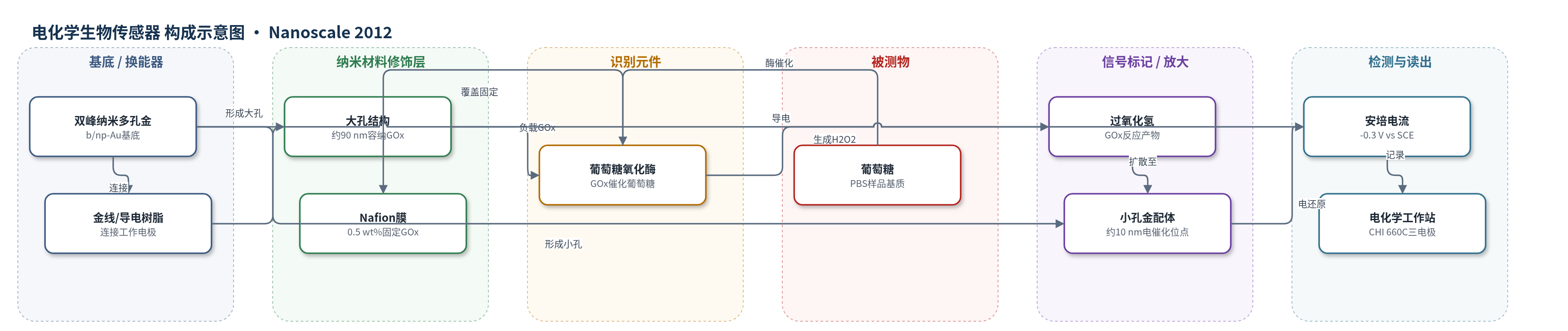
点击图片查看大图 · 依据论文自动绘制
传感器类型
电化学生物传感器
检测对象
葡萄糖(glucose)、过氧化氢(H2O2);样品基质为0.1 M PBS(pH 7.0)溶液
检测原理
葡萄糖扩散进入双峰np-Au的大孔,被负载的葡萄糖氧化酶(GOx)催化氧化,生成过氧化氢(H2O2)。H2O2随后扩散至约10 nm的小孔/细金配体表面,在-0.3 V(vs. SCE)下发生电催化还原,产生还原电流。双峰结构使大孔作为GOx容器,小孔/细金配体提供高比表面积、更多低配位表面位点和更强H2O2电催化活性,从而放大电流响应。Nafion膜固定GOx并阻挡干扰物。随着葡萄糖浓度升高,酶促生成H2O2增多,稳态安培电流相应增大,实现葡萄糖检测。
检测灵敏度
葡萄糖:LOD: ~10 mM (S/N = 3);线性范围: 0–21 mM;R = 0.996。H2O2:LOD: ~2 mM (S/N = 3);线性范围: 0.05–1.55 mM;R = 0.997(均匀np-Au: 0.05–1.35 mM,R = 0.996)。
效应效果
原文报告:双峰np-Au对H2O2响应4 s达稳态,线性范围0.05–1.55 mM(R=0.997),优于均匀np-Au的0.05–1.35 mM(R=0.996)。葡萄糖传感器线性范围0–21 mM(R=0.996),LOD约10 mM(S/N=3),宽于均匀np-Au的0–18 mM;400 s时GOx/双峰np-Au电流密度约为GOx/均匀np-Au的3倍。AA(0.1 mM)、UA(0.02 mM)、AP(0.1 mM)干扰可忽略。5 mM葡萄糖五个新制传感器RSD约4.5%;4 ℃保存1个月后响应保持约97%;连续工作20 min以上双峰电流变化可忽略,均匀np-Au降至约90%。作者认为适用于快速、灵敏、选择性葡萄糖检测。
传感器的构成
- 基底/换能器电极:双峰纳米多孔金(bimodal nanoporous gold, b/np-Au),由Au7.5Ag17.5Al75前驱体两步脱合金制备,大孔约90 nm、小孔约10 nm,提供高比表面积与电子传导
- 电极连接:金线(Au wire)与导电树脂连接np-Au宏观片,形成工作电极
- 识别元件:葡萄糖氧化酶(glucose oxidase, GOx),负载于大孔中,催化葡萄糖氧化生成H2O2
- 封闭/固定层:Nafion(0.5 wt%)涂覆于GOx/np-Au表面,防止GOx泄漏并提供抗干扰屏障
- 检测体系:三电极体系,铂线对电极(Pt wire)与饱和甘汞电极(SCE)参比,在0.1 M PBS(pH 7.0)中-0.3 V安培检测
中文摘要
纳米多孔金(np-Au)在催化、等离激元效应和传感等领域具有巨大潜力。本研究通过两步脱合金法,以设计良好的AuAgAl三元前驱体合金为原料,成功制备了具有双峰配体/孔径分布的np-Au。第一步在HCl溶液中脱合金去除Al,生成纳米多孔AuAg合金;随后在200 ℃下温和退火30 min,使合金配体均匀化并增大配体/孔径。接着,将纳米多孔AuAg合金在HNO3溶液中进一步脱合金,刻蚀Ag,获得具有分级微结构的np-Au。结果表明,这种新型双峰np-Au对H2O2还原表现出增强的电催化活性,与孔径/配体尺寸均匀为30–40 nm的常规np-Au相比,更适合作为氧化酶型生物传感器的载体。在概念验证研究中,将葡萄糖氧化酶固定于双峰np-Au上,制备出线性范围可达21 mM的灵敏葡萄糖生物传感器。
英文摘要
Nanoporous gold (np-Au) has shown great potential in catalysis, plasmonics, sensing, etc. In this work, by two-step dealloying a well-designed AuAgAl ternary precursor alloy, np-Au with bimodal ligament/pore size distributions is successfully fabricated. The first dealloying in HCl solution removes Al and generates a nanoporous AuAg alloy which would be mildly annealed at 200 °C for 30 min to homogenize the alloy ligament and enlarge the ligament/pore size. Next, the nanoporous AuAg alloy is further dealloyed in a HNO(3) solution to etch Ag and fabricate np-Au with a hierarchical microstructure. This novel bimodal np-Au is demonstrated to exhibit enhanced electrocatalytic activity towards H(2)O(2) reduction and be a better support for the fabrication of an oxidase-based biosensor compared with normal np-Au, with a uniform pore/ligament size of 30-40 nm. In a proof-of-concept study, a sensitive glucose biosensor with a linear range up to 21 mM is fabricated by immobilization of glucose oxidase on the bimodal np-Au.