组成图示
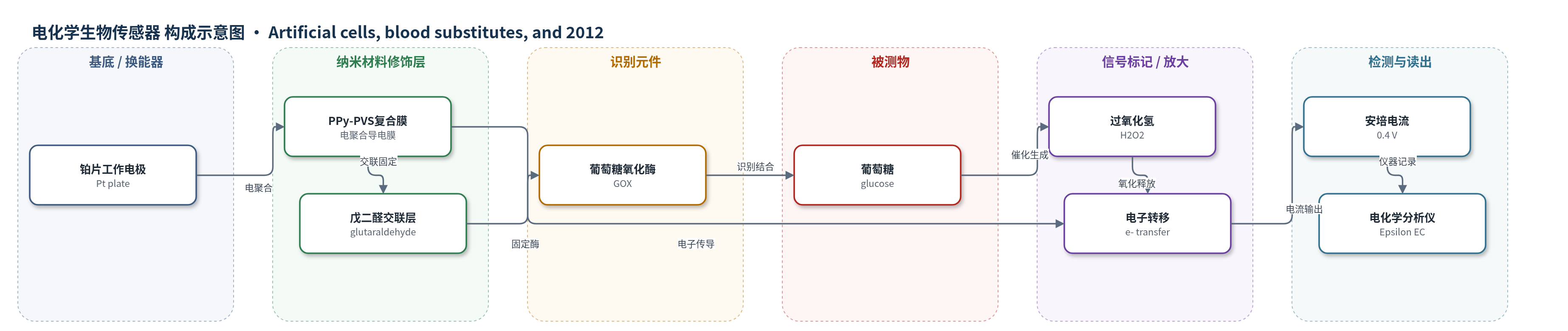
点击图片查看大图 · 依据论文自动绘制
传感器类型
电化学生物传感器
检测对象
葡萄糖(glucose);样品基质:磷酸盐缓冲液、人血清(1:15稀释)
检测原理
葡萄糖氧化酶(GOX)识别葡萄糖并催化β-D-葡萄糖与溶解氧反应,生成葡萄糖酸内酯和过氧化氢(H2O2)。H2O2扩散至铂/PPy-PVS电极表面,在+0.4 V(vs. Ag/AgCl)下发生阳极氧化:H2O2 → O2 + 2H+ + 2e-,释放电子形成安培电流。电流增量与葡萄糖浓度成正比。PPy-PVS导电复合膜提供电子/物质传输通道,其磺酸基团通过静电作用辅助固定GOX;戊二醛交联进一步稳定酶构象并减少泄漏。低工作电位降低尿酸、抗坏血酸等可氧化干扰物的影响。
检测灵敏度
LOD: 1.0 × 10^-7 M;线性范围: 1.0×10^-6–5.0×10^-5 M (R^2: 0.9977)、5.0×10^-5 M–1.0 mM (R^2: 0.9963);响应时间: 200 s;Km(app): 0.44 mM;Imax: 30.2 μA/min
效应效果
在0.4 V下,尿酸(3.0×10^-4 M)、抗坏血酸(1.0×10^-4 M)和扑热息痛(1.0×10^-4 M)使响应增加2.19%–3.91%,半胱氨酸、胆碱和多巴胺无影响,选择性较好。操作稳定性良好,27次测定RSD为2.48%;4 °C、pH 7.5磷酸盐缓冲液中储存93天后保留63%初始活性。采用标准加入法测定5份人血清(1:15稀释),与医院自动比色酶法比较,相对偏差为1.71%、0.6%、-7.59%、-5.58%和-3.17%,表明其可用于血清葡萄糖检测。
传感器的构成
- 基底/换能器电极:铂片(Pt plate,0.5 cm²)作为工作电极,提供导电基底与电子转移动态。
- 修饰层:聚吡咯-聚磺化乙烯(PPy-PVS)复合膜,由吡咯(pyrrole)与聚磺化乙烯钠盐(PVS)在Pt表面电聚合形成,提供导电、多孔和带负电磺酸基表面。
- 交联固定层:戊二醛(glutaraldehyde,2.5%,30 μL)交联固定酶,减少酶泄漏并提高稳定性。
- 识别元件:葡萄糖氧化酶(GOX,EC 1.1.3.4,5204 U/mL)识别并催化葡萄糖氧化。
- 辅助固定组分:牛血清白蛋白(BSA,1 mg)作为固定液组分,与GOX和戊二醛共同作用。
- 信号换能产物:过氧化氢(H2O2)为GOX催化葡萄糖与O2反应的产物,在电极上氧化产生电流。
- 电解液/支持电解质:0.1 M磷酸盐缓冲液(pH 7.5)含0.1 M高氯酸钠(NaClO4),提供离子导电环境。
中文摘要
本研究开发了一种新型安培法葡萄糖生物传感器。在铂(Pt)电极表面,通过循环伏安法在-1.0至+2.0 V(vs. Ag/AgCl)、扫描速率50 mV/s条件下电聚合吡咯与聚磺化乙烯(PVS),制备聚吡咯-聚磺化乙烯(PPy-PVS)复合膜。随后以戊二醛交联法将葡萄糖氧化酶(GOX)固定于膜上。传感器基于酶促反应中葡萄糖氧化生成过氧化氢(H2O2),并在+0.4 V(vs. Ag/AgCl)下对H2O2进行阳极氧化,通过安培电流测定葡萄糖。研究考察了pH、温度和工作电位的影响,最佳pH为7.5,最佳温度为65 °C,最佳工作电位为0.4 V。传感器重现性良好,相对标准偏差(RSD)为2.48%;在pH 7.5、0.1 M磷酸盐缓冲液中4 °C储存93天后仍保留63%初始活性。由于工作电位较低,传感器对常见干扰物影响较小。
英文摘要
In this study, a novel amperometric glucose biosensor was developed by immobilizing glucose oxidase (GOX) by cross-linking via glutaraldehyde on electrochemically polymerized polypyrrole-poly(vinyl sulphonate) (PPy-PVS) films on the surface of a platinum (Pt) electrode. Electropolymerization of pyrrole and poly(vinyl sulphonate) on the Pt surface was carried out with an electrochemical cell containing pyrrole and poly(vinyl sulphonate) by cyclic voltammetry between -1.0 and + 2.0 V (vs.Ag/AgCl) at a scan rate of 50 mV/s upon the Pt electrode. The amperometric determination was based on the electrochemical detection of H(2)O(2) generated in enzymatic reaction of glucose. Determination of glucose was carried out by the oxidation of enzymatically produced H(2)O(2) at 0.4 V vs. Ag/AgCl. The effects of pH and temperature were investigated and optimum parameters were found to be 7.5 and 65°C, respectively. The effect of working potential was investigated and optimum potential was determined to be 0.4 V. The operational stability of the enzyme electrode was also studied. The response of the PPy/PVS-GOX glucose biosensor exhibited good reproducibility with a relative standard deviation (RSD) of 2.48%. The glucose biosensor retained 63% of initial activity after 93 days when stored in 0.1 M phosphate buffer solution of pH 7.5 at 4°C. With the low operating potential, the biosensor demonstrated little interference from the possible interferants.