组成图示
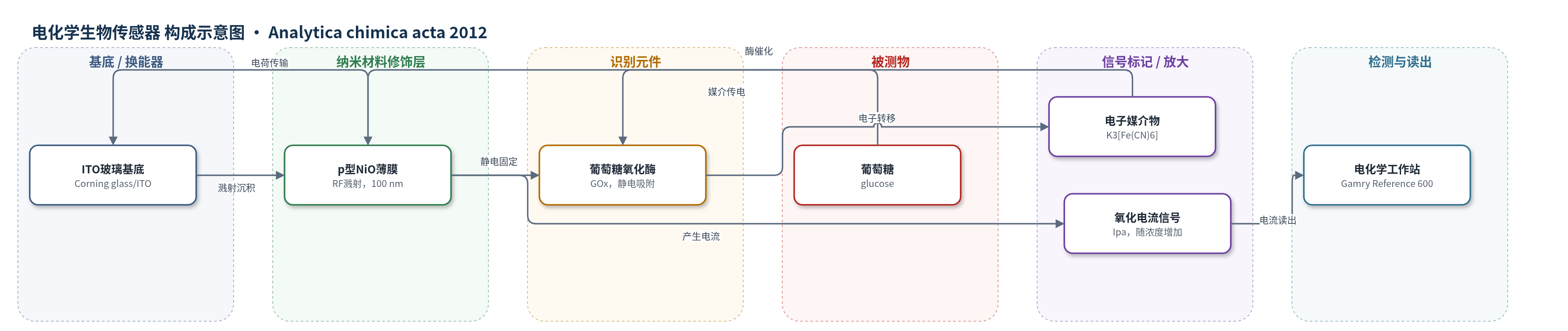
点击图片查看大图 · 依据论文自动绘制
传感器类型
电化学生物传感器
检测对象
葡萄糖(glucose);样品基质为 PBS 缓冲液(50 mM,pH 7.0),文中亦提及可用于血液/尿液等生物流体监测
检测原理
葡萄糖氧化酶(GOx)催化葡萄糖氧化生成葡萄糖酸内酯和 H2O2,同时 GOx 被还原。p 型 NiO 薄膜具有较高空穴迁移率,可通过晶格空穴传输将还原态 GOx 的电子快速传递至 ITO 电极;PBS 中的 K3[Fe(CN)6] 作为可溶性电子受体/媒介物,进一步促进 GOx 再氧化,降低氧化电位至约 0.39 V。因此,葡萄糖浓度升高时,电极表面氧化电流(Ipa)线性增大,无需直接氧化 H2O2。NiO 的高表面覆盖、纳米多孔结构和低应力提高了酶负载与电荷通信,使传感器获得快速响应和高灵敏度。
检测灵敏度
LOD: 0.80 mM(14.4 mg dL−1;图中标注 LD=0.805 mM);线性范围: 25–300 mg dL−1(1.38–16.66 mM);灵敏度: 0.10 mA (mM−1 cm−2)(101.8 µA (mM−1 cm−2));R = 0.99923
效应效果
该生物电极 Km 为 1.05 mM,表面覆盖量 2.32×10⁻⁷ mol cm−2,响应时间约 5 s,4 °C 保存 20 周仍保持约 95% 活性,重复使用 200 次以上且响应偏差在 5% 以内。干扰实验中,胆固醇、尿酸和尿素对葡萄糖响应的最大偏差分别为 3.4%、2.1% 和 1.5%。表 1 显示其灵敏度 101.80 µA (mM−1 cm−2) 高于 NiO 空心纳米球(3.43)、NiO/MWCNT(4.36)、TiO2 薄膜(1.25)、ZnO 纳米管(21.70)和 Au/Pt 合金(8.53)等体系,作者认为 p 型 NiO 薄膜适合用于葡萄糖生物芯片。
传感器的构成
- 基底/换能器电极:ITO 导电玻璃(Corning glass/ITO),提供导电基底并收集电子
- 纳米材料修饰层:p 型 NiO 薄膜(RF sputtering,100 nm,400 °C),高孔迁移率、纳米多孔,负责电荷传输与电催化
- 识别元件:葡萄糖氧化酶(GOx),通过静电相互作用物理吸附于 NiO 表面,催化葡萄糖氧化
- 电子媒介物:K3[Fe(CN)6](PBS 缓冲液中的可溶性电子受体),介导 GOx 与 NiO 之间的电子转移
- 工作缓冲液:PBS(50 mM,pH 7.0),维持 GOx 活性与离子环境
中文摘要
本文报道了一种基于射频溅射 p 型氧化镍(NiO)薄膜的葡萄糖电化学生物传感器。通过优化沉积条件,制备出具有可调半导体特性的 NiO 薄膜,其电导率为 1.5×10⁻³ S cm−1,空穴迁移率达 2.8 cm2 V−1 s−1。以 ITO 玻璃为基底,在 NiO 薄膜表面通过静电吸附固定葡萄糖氧化酶(GOx),构建 GOx/NiO/ITO/glass 生物电极。该电极的 Michaelis–Menten 常数 Km 为 1.05 mM,表明固定化 GOx 对葡萄糖具有较高亲和力;酶表面覆盖量达 2.32×10⁻⁷ mol cm−2,并表现出较强电催化活性。传感器对葡萄糖的灵敏度为 0.1 mA (mM−1 cm−2),在 25–300 mg dL−1 范围内线性良好,响应时间约 5 s。结果表明,NiO 薄膜的迁移率、结晶度和应力显著影响其电荷传输特性,从而提升葡萄糖传感响应。
英文摘要
RF sputtered p-type nickel oxide (NiO) thin film exhibiting tunable semiconductor character which in turns enhanced its functional properties. NiO thin film with high hole mobility is developed as a potential matrix for the realization of glucose biosensor. NiO thin film prepared under the optimized deposition conditions offer good electrical conductivity (1.5×10(-3) Ω(-1)-cm(-1)) with high hole mobility (2.8 cm(2) V(-1) s(-1)). The bioelectrode (GO(x)/NiO/ITO/glass) exhibits a low value of Michaelis-Menten constant (K(m)=1.05 mM), indicating high affinity of the immobilized GO(x) toward the analyte (glucose). Due to the high surface coverage (2.32×10(-7) mol cm(-2)) of the immobilized enzyme on to the NiO matrix and its high electrocatalytic activity, the prepared biosensor exhibits a high sensitivity of 0.1 mA(mM(-1)-cm(-2)) and a good linearity from 25 to 300 mg dL(-1) of glucose concentration with fast response time of 5 s. Various functional properties of the material (mobility, crystallinity and stress) are found to influence the charge communication feature of NiO thin film matrix to a great extent, resulting in enhanced sensing response characteristics.