组成图示
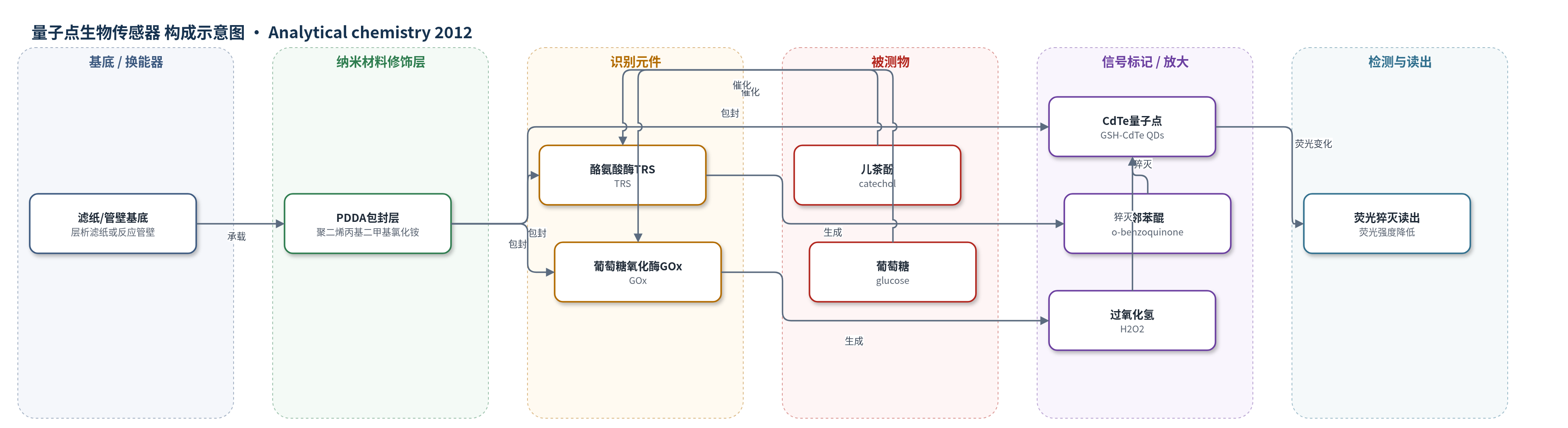
点击图片查看大图 · 依据论文自动绘制
传感器类型
量子点生物传感器
检测对象
儿茶酚(catechol)、葡萄糖(glucose);样品基质为磷酸盐缓冲液(PBS,50 mmol/L,pH 7.4/6.5),试纸条检测为浸渍缓冲液样品
检测原理
PDDA作为阳离子聚电解质,通过静电作用将带负电的GSH-CdTe量子点和酶共同包封成杂化膜,使量子点荧光与酶活性均保持稳定。检测时,TRS催化儿茶酚与溶解氧反应生成邻苯醌,GOx催化葡萄糖氧化生成H2O2;邻苯醌或H2O2作为猝灭剂接近量子点,引起荧光强度降低。荧光寿命由24.7 ns分别缩短至19.7 ns(邻苯醌)和23.0 ns(葡萄糖),表明发生动态猝灭。I0/I与猝灭剂浓度符合Stern-Volmer线性关系,因此荧光猝灭程度可反映被测物浓度。该体系无需额外标记或核酸放大,依靠酶催化产生猝灭剂实现信号转换。
检测灵敏度
儿茶酚:LOD: 1.0 × 10⁻⁵ mol/L;线性范围: 1.0 × 10⁻⁵–5.0 × 10⁻⁴ mol/L;I0/I = 1.07 + 2.12 × 10^3 Ccatechol;r^2 = 0.9788。葡萄糖:LOD: 5.0 × 10⁻⁶ mol/L;线性范围: 5.0 × 10⁻⁶–6.0 × 10⁻⁴ mol/L;I0/I = 1.16 + 2.60 × 10^3 Cglucose;r^2 = 0.990。
效应效果
该杂化膜中QDs荧光至少稳定3个月,试纸条中荧光与酶活性至少保持4周;TRS的Km为0.90 mmol/L,Vmax约为游离酶的15%,GOx活性为7.92 U/L,TRS活性为774 U/L。儿茶酚检测10次重复RSD为1.75%,且儿茶酚对不含酶的PDDA-QDs无明显猝灭。儿茶酚LOD比QDs与TRS包埋于聚合物水凝胶的方法低10倍以上;葡萄糖LOD与Mn掺杂ZnS量子点方法相当,比GSH-CdTe QDs与GOx分散法低10倍,且GOx用量比肽水凝胶法低约6倍仍获更低LOD。试纸条对儿茶酚响应约1 min,葡萄糖约10 min,作者认为其适合低成本便携式荧光传感。
传感器的构成
- 基底/载体:层析滤纸或反应管壁,承载PDDA-QD-酶杂化膜,用于试纸条或溶液检测
- 聚合物包封层:PDDA(聚二烯丙基二甲基氯化铵),通过静电作用共同包封QDs和酶,形成稳定杂化膜
- 信号探针:GSH-CdTe量子点(GSH-CdTe QDs),提供荧光发射,并被酶促产物猝灭
- 识别/转化元件:酪氨酸酶(TRS)或葡萄糖氧化酶(GOx),分别催化儿茶酚氧化或葡萄糖氧化
- 酶促猝灭产物:邻苯醌(o-benzoquinone,儿茶酚体系)或过氧化氢(H2O2,葡萄糖体系),猝灭QDs荧光
- 缓冲介质:磷酸盐缓冲液(PBS,50 mmol/L,pH 7.4/6.5),维持酶活性与QDs分散稳定
- 信号读出:荧光光谱仪或365 nm紫外灯,通过荧光强度降低进行定量
中文摘要
本文报道了一种将谷胱甘肽(GSH)包覆的CdTe量子点(QDs)与酶通过静电作用共同包封于聚二烯丙基二甲基氯化铵(PDDA)中,形成PDDA-QD-酶杂化膜的方法。该杂化材料兼具高荧光稳定性和生物识别功能:QDs荧光在4 ℃下至少稳定3个月,酶的结构与活性也得到较好保持,其中酪氨酸酶的米氏常数测得为0.90 mmol/L,仅为游离酶的约2倍。基于酶促产物对QDs荧光的猝灭效应,作者以儿茶酚和葡萄糖为例开发了荧光生物传感器,检测限分别为1.0×10−5 mol/L和5.0×10−6 mol/L。此外,该杂化材料还被用于制备荧光试纸条,试纸条中QDs荧光和酶活性至少可保持1个月,显示出用于低成本、便携式传感器件的潜力。
英文摘要
Both glutathione capped CdTe quantum dots (QDs) and enzymes were encapsulated with poly(diallyldimethylammonium chloride) (PDDA) via electrostatic attraction to form hybrid films. The obtained PDDA QD-enzyme hybrids feature both high fluorescence and biorecognition. In the obtained hybrid materials, the fluorescence emission of the QDs was stable for at least 3 months, and the structure and activity of the enzyme was also well maintained as the Michaelis constant of tyrosinase was determined to be 0.90 mmol/L, which is just 2 times higher than that of free enzyme. This hybrid material was then utilized as a platform for the development of biosensors based on the quenching effects of the enzymatic products on the emission of the QDs with a kind of phenol (catechol) and glucose as example analytes. The detection limits of catechol and glucose were 1.0 × 10(-5) and 5.0 × 10(-6) mol/L, respectively. Moreover, this hybrid material was applied to the fabrication of test paper for these two analytes. The test paper was very stable with respect to the fluorescence of the QDs and the activity of the enzyme maintained for at least 1 month.