组成图示
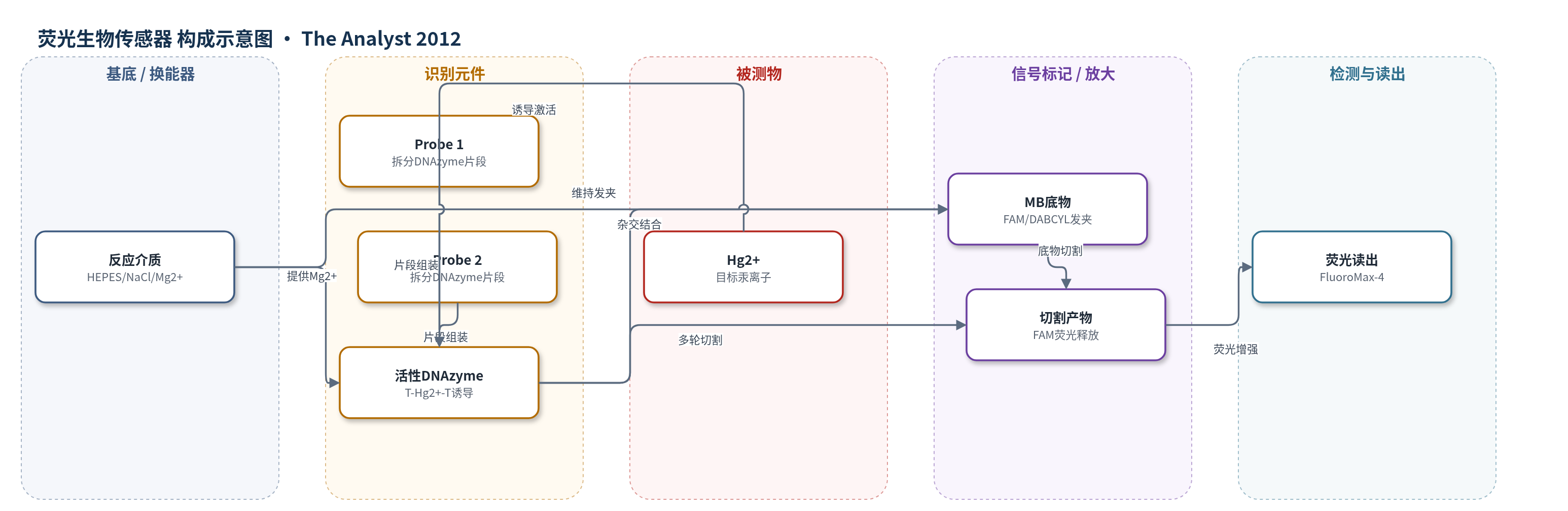
点击图片查看大图 · 依据论文自动绘制
传感器类型
荧光生物传感器
检测对象
二价汞离子(Hg2+,mercury(II) ions);样品基质:水溶液、河水样品
检测原理
在无Hg2+时,Probe 1与Probe 2因茎区存在T–T错配而不能稳定折叠为活性DNAzyme,且臂区与MB底物杂交不稳定,背景荧光低。加入Hg2+后,T–Hg2+–T配位使两个片段通过互补配对组装成Mg2+依赖性DNAzyme活性结构;其臂区与MB底物环区互补杂交形成CAMB。在Mg2+存在下,活性DNAzyme催化切割MB底物,使FAM与DABCYL分离,荧光增强;切割后DNAzyme释放并可循环切割多个MB底物,实现多轮酶促放大。Hg2+浓度越高,激活的DNAzyme越多,切割的MB底物越多,F/F0信号越大。
检测灵敏度
LOD: 0.2 nM;线性范围: 1–20 nM;灵敏度斜率: 0.403(F/F0 = 0.403C + 0.696);相关系数: 0.9928
效应效果
在20 nM Hg2+下,体系较背景产生约7.5倍荧光增强。选择性方面,13种常见干扰金属离子(各2 mM)及其混合物(总1.3 mM)响应接近空白,可在100倍过量干扰离子存在下选择性检测Hg2+。线性范围内重复测量最大RSD为3.9%(n=3)。河水加标实验在2.5和10 nM水平回收率分别为96.0%(2.4±0.1 nM)和105.0%(10.5±0.3 nM)。作者认为该法20 min内达到0.2 nM LOD,优于多数已报道荧光法,适用于现场快速检测。
传感器的构成
- 识别元件:Probe 1与Probe 2(人工拆分Mg2+依赖性DNAzyme片段,含T–T mismatch茎区、催化核心和臂区,Hg2+诱导组装为活性DNAzyme)
- 信号底物:MB substrate(发夹结构分子信标,5′-FAM标记、3′-DABCYL淬灭,切割后FAM荧光释放)
- 辅因子:Mg2+(10 mM,DNAzyme催化切割MB底物的必需辅因子)
- 反应介质:HEPES buffer(250 mM)、NaCl(1 M)、pH 7.0,维持DNAzyme活性与T–Hg2+–T配位
- 信号读出:FluoroMax-4荧光光谱仪(激发495 nm,发射518 nm,监测FAM荧光增强)
中文摘要
本文报道了一种基于目标诱导DNAzyme级联与催化分子信标(CAMB)的荧光传感策略,用于水溶液中二价汞离子(Hg2+)的高灵敏、高选择性检测。作者将一种Mg2+依赖性DNAzyme人工拆分为Probe 1和Probe 2两个寡核苷酸片段。当存在Hg2+时,T–Hg2+–T配位作用诱导两个片段组装为具有催化活性的Mg2+依赖性DNAzyme,并与发夹结构分子信标(MB)底物杂交形成CAMB体系。随后,每个由目标诱导激活的DNAzyme可通过真正的酶促多轮转化催化切割多个MB底物,使FAM荧光基团与DABCYL淬灭基团分离,产生显著荧光增强。该方法在20 min内将Hg2+检出限降至0.2 nM,低于多数已报道荧光检测法。由于Hg2+与T–T错配对的强配位,体系在100倍过量其他干扰金属离子存在下仍具优异选择性,并在河水样品检测中取得满意结果。
英文摘要
In this work, a fluorescent sensing strategy was developed for the detection of mercury(II) ions (Hg(2+)) in aqueous solution with excellent sensitivity and selectivity using a target-induced DNAzyme cascade with catalytic and molecular beacons (CAMB). In order to construct the biosensor, a Mg(2+)-dependent DNAzyme was elaborately designed and artificially split into two separate oligonucleotide fragments. In the presence of Hg(2+), the specific thymine-Hg(2+)-thymine (T-Hg(2+)-T) interaction induced the two fragments to produce the activated Mg(2+)-dependent DNAzyme, which would hybridize with a hairpin-structured MB substrate to form the CAMB system. Eventually, each target-induced activated DNAzyme could catalyze the cleavage of many MB substrates through true enzymatic multiple turnovers. This would significantly enhance the sensitivity of the Hg(2+) sensing system and push the detection limit down to 0.2 nM within a 20 min assay time, much lower than those of most previously reported fluorescence assays. Owning to the strong coordination of Hg(2+) to the T-T mismatched pairs, this proposed sensing system exhibited excellent selectivity for Hg(2+) detection, even in the presence of 100 times of other interferential metal ions. Furthermore, the applicability of the biosensor for Hg(2+) detection in river water samples was demonstrated with satisfactory results. These advantages endow the sensing strategy with a great potential for the simple, rapid, sensitive, and specific detection of Hg(2+) from a wide range of real samples.