组成图示
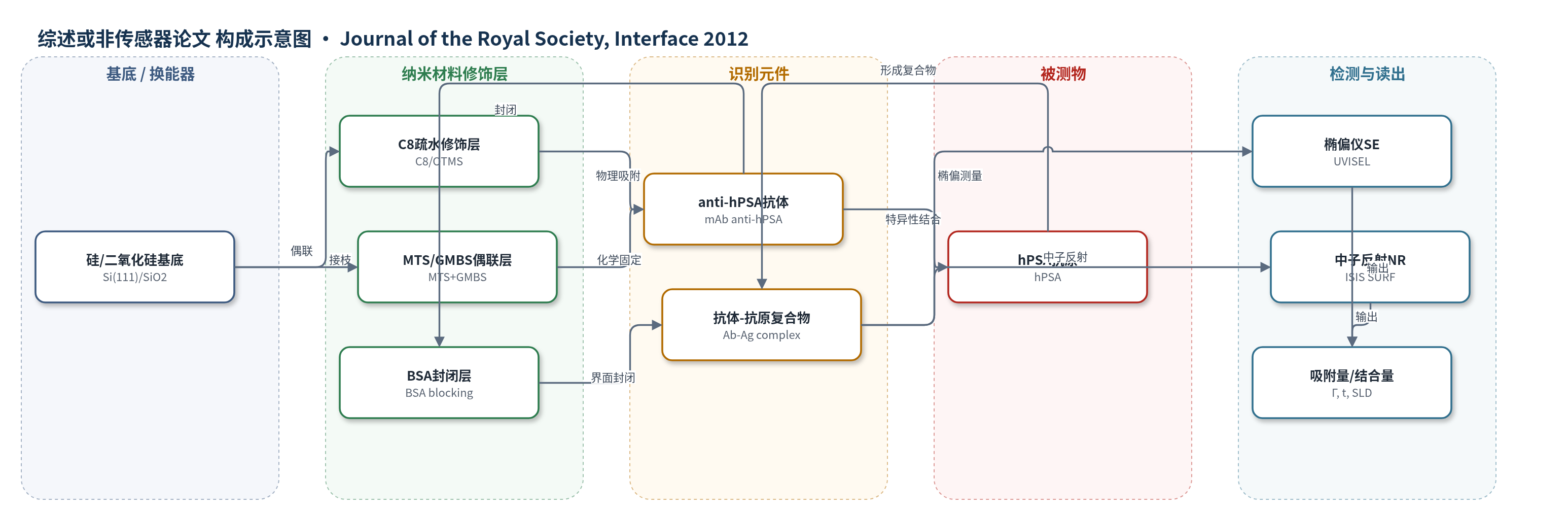
点击图片查看大图 · 依据论文自动绘制
传感器类型
综述或非传感器论文
检测对象
人前列腺特异性抗原(human prostate-specific antigen, hPSA/PSA);样品基质为磷酸盐缓冲液(PBS,离子强度5–150 mM,pH 4–8;中子反射实验使用 D2O 缓冲液)
检测原理
该体系以固定化 anti-hPSA 单克隆抗体作为识别元件,hPSA 抗原通过 Fab 段与抗体特异性结合。结合事件使界面蛋白质层质量、厚度和散射长度密度发生变化:在二氧化硅、C8 或 MTS/GMBS 修饰表面上,抗体先以物理吸附或化学偶联方式形成界面层,hPSA 结合后嵌入抗体层,使层厚基本不变而 SLD 下降,或使椭偏参数变化。SE 通过 ΔΨ 和折射率/厚度模型计算吸附量 Γ;NR 通过反射率曲线拟合层厚、SLD 和体积分数,区分抗体、BSA 与 hPSA 的贡献。pH 和离子强度改变抗体表面电荷、静电屏蔽、吸附量与堆积密度,从而改变结合位点可及性和结合比;文中未使用 HCR、RCA 等信号放大策略。
检测灵敏度
原文未报告 LOD、线性范围、灵敏度斜率或相关系数。
效应效果
在 SiO2 表面,抗体吸附量在 pH 5–6 附近最大,接近抗体等电点;hPSA 结合量在 pH 6 附近最高,结合比在 pH 7 附近最高。增加离子强度降低抗体吸附量,但 20–100 mM 范围内抗原结合量基本稳定,5 mM 时结合量更高。C8 疏水表面抗体吸附量为 1.21 mg m−2,hPSA 结合量约 0.2 mg m−2,最佳结合比约 30%;SiO2 表面最大 hPSA 结合量约 0.22 mg m−2,最佳结合比约 60%。MTS/GMBS 化学偶联抗体量为 1.5 mg m−2,hPSA 结合量为 0.19±0.03 mg m−2,未明显优于物理吸附。所有表面抗体主要呈 flat-on 取向,BSA 封闭在 C8 表面无显著吸附。作者认为优化物理吸附可替代复杂共价固定。
传感器的构成
- 基底:硅(111)晶片/硅块(Si(111))及其天然二氧化硅层(SiO2,约12±2 Å),作为固体-液体界面与 SE/NR 测量基底
- 疏水修饰层:八基三甲氧基硅烷(C8, octyltrimethoxysilane)接枝层(约7–8 Å),提供疏水表面以物理吸附抗体
- 化学偶联修饰层:(3-巯基丙基)三甲氧基硅烷(MTS)与4-马来酰亚胺丁酸N-羟基琥珀酰亚胺酯(GMBS)修饰层(约20 Å),提供马来酰亚胺基团用于抗体化学固定
- 识别元件:小鼠单克隆抗人前列腺特异性抗原抗体(anti-hPSA, Clone 214),通过物理吸附或化学偶联固定,特异性识别 hPSA
- 封闭剂:牛血清白蛋白(BSA, 50 mg l−1),用于封闭非特异结合位点
- 被测物结合层:人前列腺特异性抗原(hPSA, 5 mg l−1)与固定抗体结合,形成界面抗原-抗体复合物
- 读出层:光谱椭偏仪(SE, Jobin-Yvon UVISEL)与中子反射仪(NR, ISIS SURF),测量界面吸附量、层厚与散射长度密度
中文摘要
单克隆抗体(抗人前列腺特异性抗原抗体,anti-hPSA)与其抗原(人前列腺特异性抗原,hPSA)之间的特异性识别在前列腺癌诊断及其他生物传感器应用中具有前景。然而,由于界面堆积和分子取向带来的空间位阻,实际结合效率通常很低。本研究采用光谱椭偏术(SE)和中子反射(NR)考察溶液 pH、盐浓度和表面化学对抗体吸附及后续抗原结合的影响。结果显示,抗体吸附量随 pH 变化,最大吸附出现在 pH 5–6 之间,接近抗体等电点;相比之下,最高抗原结合效率出现在接近中性 pH。提高离子强度会降低二氧化硅-水界面的抗体吸附量,但对抗原结合影响较小。研究还考察了抗体在疏水 C8(八基三甲氧基硅烷)表面的吸附,以及抗体在 (3-巯基丙基)三甲氧基硅烷/4-马来酰亚胺丁酸N-羟基琥珀酰亚胺酯修饰表面的化学固定。结果表明,在所有研究表面上,抗体主要采取“平躺”取向,且抗原结合能力相当。结果说明,通过适当物理吸附固定抗体可替代涉及复杂共价偶联的精细界面分子工程。
英文摘要
The specific recognition between monoclonal antibody (anti-human prostate-specific antigen, anti-hPSA) and its antigen (human prostate-specific antigen, hPSA) has promising applications in prostate cancer diagnostics and other biosensor applications. However, because of steric constraints associated with interfacial packing and molecular orientations, the binding efficiency is often very low. In this study, spectroscopic ellipsometry and neutron reflection have been used to investigate how solution pH, salt concentration and surface chemistry affect antibody adsorption and subsequent antigen binding. The adsorbed amount of antibody was found to vary with pH and the maximum adsorption occurred between pH 5 and 6, close to the isoelectric point of the antibody. By contrast, the highest antigen binding efficiency occurred close to the neutral pH. Increasing the ionic strength reduced antibody adsorbed amount at the silica-water interface but had little effect on antigen binding. Further studies of antibody adsorption on hydrophobic C8 (octyltrimethoxysilane) surface and chemical attachment of antibody on (3-mercaptopropyl)trimethoxysilane/4-maleimidobutyric acid N-hydroxysuccinimide ester-modified surface have also been undertaken. It was found that on all surfaces studied, the antibody predominantly adopted the 'flat on' orientation, and antigen-binding capabilities were comparable. The results indicate that antibody immobilization via appropriate physical adsorption can replace elaborate interfacial molecular engineering involving complex covalent attachments.