组成图示
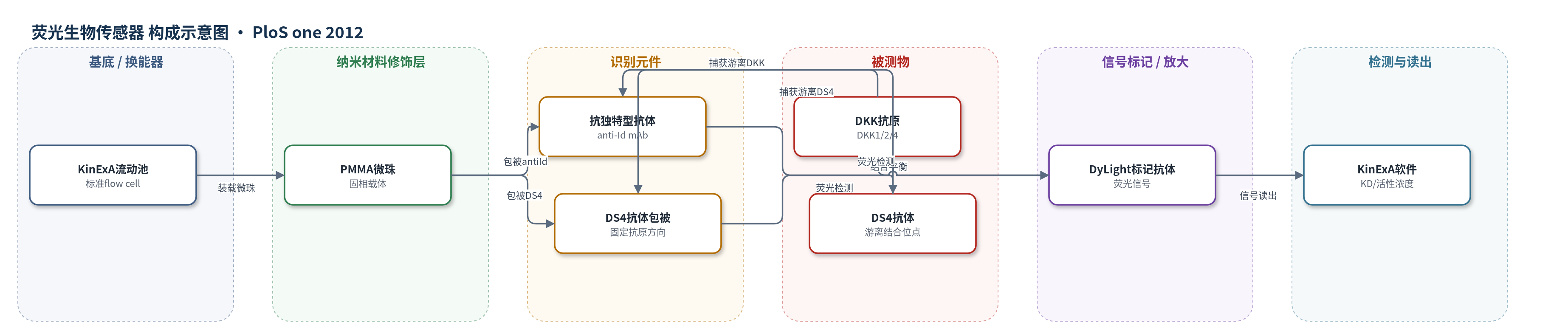
点击图片查看大图 · 依据论文自动绘制
传感器类型
荧光生物传感器
检测对象
Dickkopf 蛋白(DKK1、DKK2、DKK4;重组纯化样品、293F 条件培养基、Hep3B 细胞上清);抗 DKK1 单克隆抗体 DS4(重组 IgG/Fab,PBS/BSA 缓冲)
检测原理
KinExA 将 DKK 抗原滴定至固定浓度的 DS4 抗体结合位点,室温平衡后快速通过含 anti-Id 包被 PMMA 微珠的流动池。游离 DS4 结合位点被 anti-Id 捕获,而 DKK 饱和的 DS4-DKK 复合物被洗去;DyLight 标记抗人 IgG 结合捕获的 DS4,荧光强度与游离 DS4 量成正比,随 DKK 浓度升高而降低,形成抑制滴定曲线。固定抗原方向则用 DS4 包被微珠捕获游离 DKK,并以 DyLight 标记抗 DKK 抗体检测,荧光随 DS4 浓度升高而降低。系统通过双分子结合方程全局拟合滴定曲线,获得表观 KD 和活性浓度;sweet spot 浓度(固定结合伙伴/KD 约 4–6)可单次实验同时估计两者。
检测灵敏度
未报告LOD、线性范围、灵敏度斜率或相关系数。
效应效果
KinExA 对 DS4/DKK 体系的表观 KD 覆盖约 100 fM–100 nM。人 DKK1 表观 KD 为 490 fM,活性 91%;固定抗体与固定抗原方向结果在 95% 置信限内一致。小鼠 DKK4 六次独立重复平均 KD 6.9 pM、SD 0.6 pM。条件培养基中恒河猴 DKK4 KD 2.8 pM,浓度 310 nM(8 mg/mL),与 ELISA 估计一致;Hep3B 上清天然人 DKK1 KD 160 fM,浓度 1.7 nM(44 ng/mL),与 ELISA >30 ng/mL 相符。人/食蟹猴 DKK2 KD 约 110/120 nM,0.3 与 1.2 mL/min 流速数据可叠加。Biacore/Octet 正交验证:DKK4 KD 约 5.5/2.9 pM,DKK2 约 140/98 nM,Biacore 溶液法小鼠 DKK4/DS4 Fab KD 6.8 pM(SE 0.5 pM),与 KinExA 一致。
传感器的构成
- 换能器/流动池:KinExA 3000 标准流动池,提供样品流路与荧光检测环境
- 固相载体:PMMA 微珠,作为抗体或抗原捕获载体
- 捕获识别层(固定抗体方向):鼠源抗独特型单克隆抗体(anti-Id mAb)吸附于 PMMA 微珠,特异性捕获游离 DS4 抗体结合位点
- 捕获识别层(固定抗原方向):DS4 单克隆抗体包被 PMMA 微珠,捕获游离 DKK 抗原
- 封闭层:BSA(10 mg/mL BSA/PBS)封闭微珠非特异结合位点
- 信号标记物:DyLight 649 标记抗人 IgG 多克隆抗体、DyLight 标记抗 DKK1/DKK4 单抗或 DyLight 649 链霉亲和素,产生荧光信号
- 样品缓冲体系:PBS pH 7.4 含 0.01% Tween-20,样品缓冲含 1 mg/mL BSA,维持结合平衡并降低非特异结合
中文摘要
治疗性抗体通常被工程化或筛选为具有极高的靶点结合亲和力,而多数生物物理方法难以精确测定。本文以抗 Dickkopf(DKK)单克隆抗体 DS4 与一组 DKK 抗原的相互作用为模型,探索动力学排除法(KinExA)的动态范围。通过针对每种抗原定制 KinExA 条件,作者获得了跨越六个数量级的表观平衡解离常数(KD),约从 100 fM 到 100 nM。在采用已校准抗体浓度并选择合适浓度范围时,单次实验即可同时准确、精确地获得表观 KD 和抗原表观活性浓度,从而提高检测信息量并减少样品消耗。Biacore 和 Octet 无标签生物传感器平台的正交测量进一步验证了 KinExA 所得亲和力与活性浓度。无论采用固定抗体还是固定抗原检测方向,也不论使用重组或天然抗原及其纯度,各平台间表观亲和力均高度一致。
英文摘要
Therapeutic antibodies are often engineered or selected to have high on-target binding affinities that can be challenging to determine precisely by most biophysical methods. Here, we explore the dynamic range of the kinetic exclusion assay (KinExA) by exploiting the interactions of an anti-DKK antibody with a panel of DKK antigens as a model system. By tailoring the KinExA to each studied antigen, we obtained apparent equilibrium dissociation constants (K(D) values) spanning six orders of magnitude, from approximately 100 fM to 100 nM. Using a previously calibrated antibody concentration and working in a suitable concentration range, we show that a single experiment can yield accurate and precise values for both the apparent K(D) and the apparent active concentration of the antigen, thereby increasing the information content of an assay and decreasing sample consumption. Orthogonal measurements obtained on Biacore and Octet label-free biosensor platforms further validated our KinExA-derived affinity and active concentration determinations. We obtained excellent agreement in the apparent affinities obtained across platforms and within the KinExA method irrespective of the assay orientation employed or the purity of the recombinant or native antigens.