组成图示
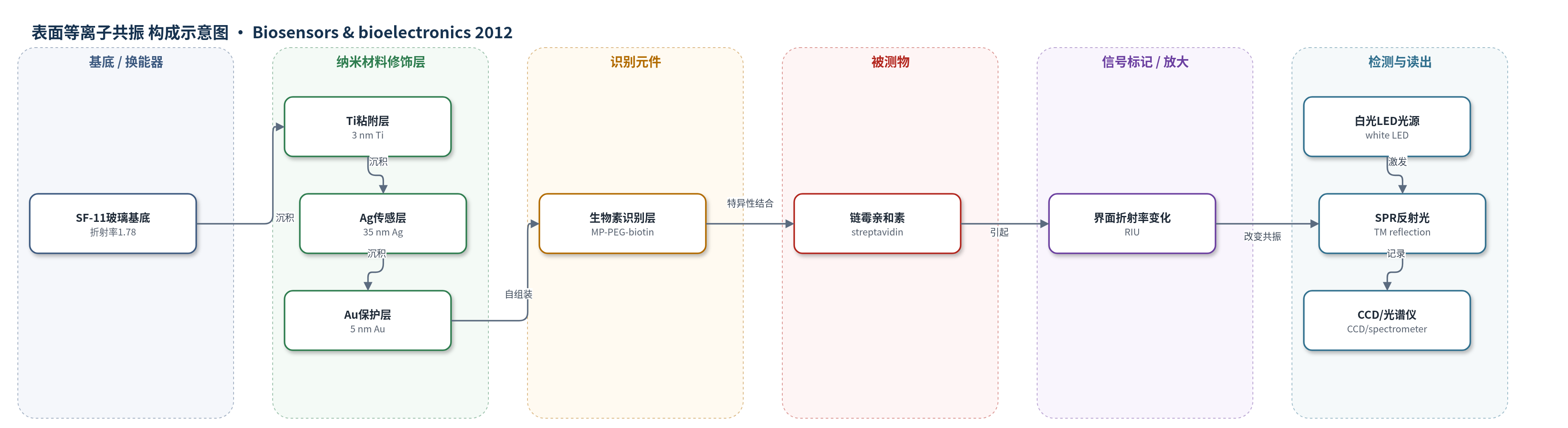
点击图片查看大图 · 依据论文自动绘制
传感器类型
表面等离子共振(SPR)生物传感器
检测对象
葡萄糖(glucose,水溶液)、链霉亲和素(streptavidin,PBS缓冲液)
检测原理
该传感器采用 Kretschmann–Raether 衰减全反射(ATR)构型,白光经偏振后以 TM 模式入射到 SF-11 棱镜/Ag/Au 双金属膜界面。Ag 层降低金属介电常数实部,使 SPR 色散关系改变,共振波长偏移更大且 SPR 曲线更陡;Au 层提供化学稳定与生物亲和。表面 MP-PEG-生物素自组装层捕获链霉亲和素后,界面局部折射率升高;葡萄糖浓度变化则改变溶液整体折射率。折射率变化使共振波长移动,反射光中非共振波长成分改变,从而呈现红—绿—黄等颜色变化。灵敏度增强主要来自双金属膜对 SPR 色散关系的调控,无需额外标记。CCD 相机直接读取颜色,光谱仪可定量共振波长。
检测灵敏度
LOD: 49.7 nM(streptavidin,direct observation);线性范围: 0.0254 RIU;灵敏度: 1266.3 nm/RIU(experimental, 35/5 nm Ag/Au);灵敏度: 1949.5 nm/RIU(simulation, 35/5 nm Ag/Au);线性度: 13.94%(Ag/Au)/23.75%(Au);颜色分辨: 5.08 × 10^-3 RIU(Ag/Au)/5.08 × 10^-2 RIU(Au)
效应效果
35/5 nm Ag/Au 双金属膜较 50 nm Au 膜共振波长偏移增强约 2.54 倍,颜色对比度提高约 10 倍,线性范围保持至 0.0254 RIU,线性度分别为 13.94% 和 23.75%。葡萄糖检测中,Ag/Au 最小可分辨颜色对比为 0–0.2 M(5.08×10^-3 RIU),Au 为 2.0 M(5.08×10^-2 RIU)。生物素–链霉亲和素模型中,100 nM 链霉亲和素在 Ag/Au 上产生 12 nm 偏移,Au 仅 5 nm,Ag/Au 40–60 min 内由红变绿,Au 无明显变化;最小可分辨链霉亲和素为 49.7 nM。水与 0.3 M 葡萄糖交替冲洗无积累,作者认为适用于 POCT。
传感器的构成
- 基底/棱镜:SF-11 玻璃基底与 SF-11 圆柱棱镜,提供 ATR 光路与折射率匹配
- 粘附层:3 nm Ti,增强金属膜与玻璃基底附着
- 传感金属层:35 nm Ag,作为主要 SPR 传感层,提高共振波长偏移与颜色对比
- 保护金属层:5 nm Au,覆盖 Ag 层,提供化学稳定性和生物亲和性
- 识别元件:巯基丙酰基聚乙二醇-生物素(MP-PEG-biotin)自组装单分子层,固定于金属表面并捕获链霉亲和素
- 读出装置:白光 LED、线性偏振器、CCD 相机与光谱仪,记录反射颜色与共振波长
中文摘要
本文报道了一种基于银/金(Ag/Au)双金属膜的彩色表面等离子共振(SPR)生物传感器。研究首次在波长 SPR 传感中利用 Ag/Au 双金属膜调控 SPR 色散关系。由于 Ag/Au 双金属膜能够增大共振波长偏移并使 SPR 曲线斜率更陡,反射光的颜色对比度较传统 SPR 生物传感器提高约一个数量级。该 Ag/Au 双金属膜基彩色 SPR 生物传感器(CSPRB)无需依赖光谱仪,仅通过肉眼直接观察反射颜色变化即可分辨细微生物相互作用,例如 100 nM 链霉亲和素。除增强灵敏度和颜色对比度外,该传感器还保持高达 0.0254 RIU 的宽线性检测范围,因而有望用于即时检测(POCT)等去中心化诊断场景。
英文摘要
In wavelength surface plasmon resonance (SPR) biosensor, the manipulation of SPR dispersion relation by Ag/Au bi-metallic film was first time implemented. Due to the enhanced resonant wavelength shift and the sharper SPR slope of using Ag/Au bi-metallic film, the illuminated color of reflection shows one order of magnitude greater contrast than conventional SPR biosensors. Such an Ag/Au bi-metallic film based color SPR biosensor (CSPRB) allows the detail bio-interactions, for example 100 nM streptavidin, to be distinguished by directly observing the color change of reflection through naked eyes rather than the analysis of spectrometer. In addition to the enhanced sensitivity and color contrast, this CSPRB also possesses a great linear detection range up to 0.0254 RIU, which leading to the application of point-of-care tests.