组成图示
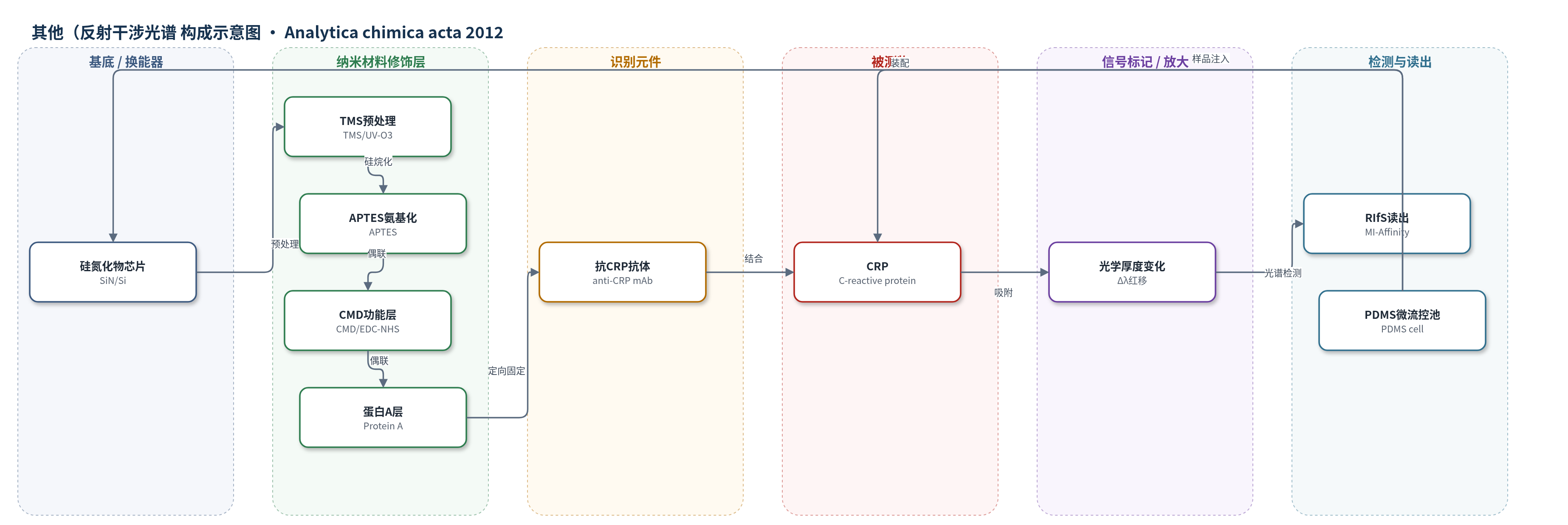
点击图片查看大图 · 依据论文自动绘制
传感器类型
其他(反射干涉光谱(RIfS)生物传感器)
检测对象
C-反应蛋白(C-reactive protein, CRP);样品基质:HEPES缓冲液(pH 7.4,含CaCl2和Tween 20),面向人血清检测。
检测原理
该传感器基于反射干涉光谱(RIfS)原理:垂直入射光在氮化硅/硅多层膜中发生反射干涉,形成反射率极小值。当CRP与表面定向固定的anti-CRP结合后,传感界面光学厚度增加,反射干涉极小值发生红移,波长偏移Δλ与结合量相关,从而实现无标记、时间分辨检测。表面构建采用TMS/UV-O3生成均一硅醇,APTES引入氨基,CMD经EDC/NHS共价接枝提供羧基,蛋白A再经EDC/NHS偶联并特异性结合IgG Fc区,使anti-CRP定向排列,提高识别位点暴露和响应。系统使用PDMS微流控池连续进样,无需荧光或酶标记放大。
检测灵敏度
原文未报告LOD、线性范围、斜率或R^2;实验浓度范围: 0.01–10 μg/mL;100 ng/mL时净RIfS响应0.048 nm,基线漂移标准差0.013 nm。
效应效果
与未TMS处理芯片相比,TMS处理提高了氨基化均一性和CRP响应;与直接固定anti-CRP相比,蛋白A定向固定显著提高灵敏度。100 ng/mL CRP可产生明显响应,净响应0.048 nm,超过30 s基线漂移标准差0.013 nm的3倍。使用10 mM甘氨酸-HCl(pH 1.5)再生后,重复注入10 μg/mL CRP,平均净响应0.59 nm,变异系数0.87%(n=3),表明芯片可重复使用。原文未报告选择性、抗干扰、实际血清回收率或与ELISA/HPLC/qPCR的对比。作者认为低成本硅芯片和简单光学装置可替代昂贵SPR传感器。
传感器的构成
- 基底/换能器:氮化硅涂层硅芯片(SiN chip,66.5 nm SiN/Si),作为RIfS反射干涉传感基底。
- 预处理层:三甲基氯硅烷(TMS)经UV-O3处理生成均一硅醇/硅氧烷,提高硅烷偶联均一性。
- 氨基化层:3-氨基丙基三乙氧基硅烷(APTES)接枝氨基,提供与CMD偶联的氨基位点。
- 功能化层:羧甲基葡聚糖(CMD)经EDC/NHS共价接枝,提供高密度羧基并降低非特异结合。
- 定向固定层:蛋白A(Protein A)经EDC/NHS偶联到CMD,特异性结合IgG Fc区。
- 识别元件:抗CRP单克隆抗体(anti-CRP,mouse clone C2)通过蛋白A定向固定,识别CRP。
- 封闭剂:2-氨基乙醇(2-aminoethanol,10 mM,pH 8.5)封闭多余NHS酯基。
- 微流控/读出:PDMS微流控池(5 mm×1 mm×0.2 mm,1 μL)与RIfS仪器(MI-Affinity LCR-01)实现连续流动和光谱读出。
中文摘要
反射干涉光谱(RIfS)是一种无标记、时间分辨技术,适用于检测抗体–抗原相互作用。本文报道了一种用于C-反应蛋白(CRP)的连续流动生物传感器,通过有效的单克隆抗CRP抗体(anti-CRP)固定方法实现高灵敏度RIfS检测。首先用三甲基氯硅烷(TMS)处理氮化硅涂层硅芯片(SiN chip),再经紫外光照射原位生成均一硅醇;随后用3-氨基丙基三乙氧基硅烷(APTES)氨基化,接枝羧甲基葡聚糖(CMD),并固定蛋白A,构建定向anti-CRP表面。通过依次注入氨基偶联试剂、蛋白A和anti-CRP,用RIfS实时监测固定过程。采用全部步骤后灵敏度提高,表明TMS处理SiN芯片上经CMD和蛋白A定向固定anti-CRP可增强响应。该传感系统采用低成本硅芯片和简单光学装置,可替代昂贵的表面等离子共振传感器,用于生命科学其他靶标检测。
英文摘要
Reflectometric interference spectroscopy (RIfS) is a label-free, time-resolved technique, and suitable for detecting antibody-antigen interaction. This work describes a continuous flow biosensor for C-reactive protein (CRP), involving an effective immobilization method of a monoclonal antibody against CRP (anti-CRP) to achieve highly sensitive RIfS-based detection of CRP. The silicon nitride-coated silicon chip (SiN chip) for the RIfS sensing was first treated with trimethylsilylchloride (TMS), followed by UV-light irradiation to in situ generation of homogeneous silanols on the surface. Following amination by 3-aminopropyltriethoxysilane, carboxymethyldextran (CMD) was grafted, and subsequently, protein A was immobilized to create the oriented anti-CRP surface. The immobilization process of protein A and anti-CRP was monitored with the RIfS system by consecutive injections of an amine coupling reagent, protein A and anti-CRP, respectively, to confirm the progress of each step in real time. The sensitivity was enhanced when all of the processes were adopted, suggesting that the oriented immobilization of anti-CRP via protein A that was coupled with the grafted CMD on the aminated surface of TMS-treated SiN chip. The feasibility of the present sensing system was demonstrated on the detection of CRP, where the silicon-based inexpensive chips and the simple optical setup were employed. It can be applied to other target molecules in various fields of life science as a substitute of surface plasmon resonance-based expensive sensors.