组成图示
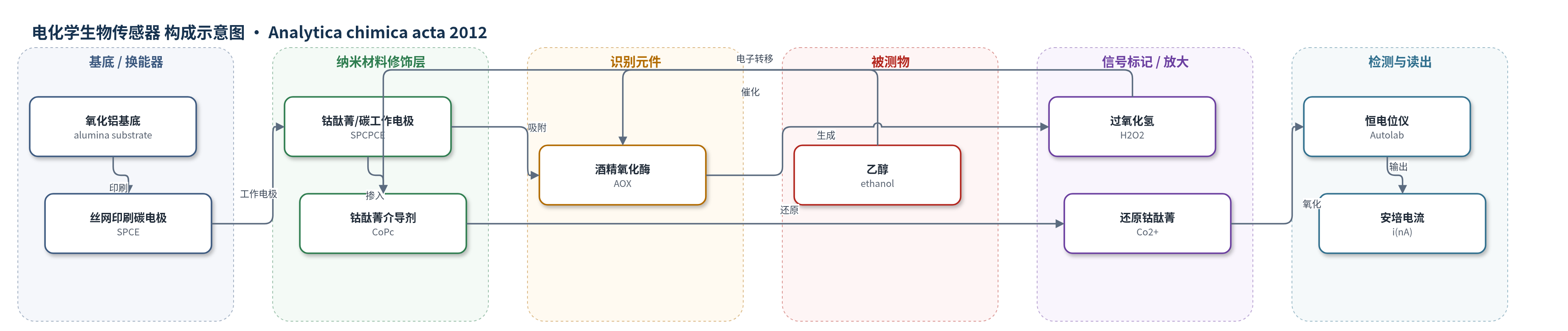
点击图片查看大图 · 依据论文自动绘制
传感器类型
电化学生物传感器
检测对象
乙醇(ethanol, EtOH);样品基质:磷酸盐缓冲液稀释的乙醇溶液、Rioja 葡萄酒、榛子利口酒、龙舌兰酒等酒精饮料。
检测原理
该传感器以 AOX 为识别元件。乙醇在 AOX 催化下与 O2 反应生成乙醛和 H2O2,反应不可逆。生成的 H2O2 与掺入工作电极的 CoPc 发生氧化还原作用,使 CoPc 的 Co(III) 被还原为 Co(II),即还原钴酞菁形式。在 +0.4 V(vs. Ag 伪参比电极)下,Co(II) 被电化学氧化为 Co(III),产生阳极电流。乙醇浓度越高,酶催化生成的 H2O2 越多,Co(II) 浓度越高,安培电流越大,因此电流与乙醇浓度呈线性关系。对于 SPPBCE 和 SPFCE,则需加入 HRP,由 HRP 催化 H2O2 氧化 Fe(CN)6^4− 生成 Fe(CN)6^3−,并在 −0.1 V 检测其还原电流。
检测灵敏度
LOD: 0.02 mM;线性范围: 0.05–1.00 mM;灵敏度斜率: 1211 nA mM−1;R^2 = 0.9991
效应效果
该传感器对乙醇具有良好选择性:在甲醇(10−6 M)、抗坏血酸(10−7 M)、没食子酸(10−5 M)和半胱氨酸(10−5 M)存在下,信号与背景相当。重现性良好,5 个独立制备传感器的斜率平均值为 (1205 ± 26) nA mM−1,RSD 为 2.1%。−20 ℃避光保存 30 和 60 天后无活性损失,混合校准斜率为 1219 ± 160 nA mM−1,R^2 = 0.997。实际酒精饮料仅需 1:10000 稀释,Rioja 葡萄酒、榛子利口酒和龙舌兰酒的测定结果与 GC 无显著差异(0.05 水平),RSD 为 1.8%–3.9%。作者认为该传感器制备简单、成本低、可一次性使用,适合酒精饮料快速检测。
传感器的构成
- 基底/换能器电极:氧化铝基底上的丝网印刷碳电极(screen-printed carbon electrode, SPCE),含工作电极、碳辅助电极和银伪参比电极,提供电化学测量平台
- 工作电极材料:钴酞菁/碳(Co-phthalocyanine/Carbon, SPCPCE)碳墨,作为导电工作电极并承载介导剂;比较中亦使用普鲁士蓝/碳(SPPBCE)或亚铁氰化物/碳(SPFCE)
- 电子介导层:钴酞菁(Co-phthalocyanine, CoPc)掺入碳墨,介导 H2O2 相关电子转移并在 +0.4 V 产生安培信号;比较中亦使用普鲁士蓝(PB)或亚铁氰化物(ferrocyanide)
- 识别元件:酒精氧化酶(alcohol oxidase, AOX,Hansenula sp.),催化乙醇氧化为乙醛并生成 H2O2;比较中亦使用 P. pastoris 或 C. boidinii 来源 AOX
- 固定化层:AOX 溶液滴加干燥形成的物理吸附酶层,无聚合物、膜或交联剂;SPPBCE/SPFCE 中为 AOX/辣根过氧化物酶(horseradish peroxidase, HRP)混合液
- 反应介质:0.1 M 磷酸盐缓冲液(phosphate buffer, pH 6),用于酶反应和样品稀释
中文摘要
本研究比较了基于丝网印刷碳电极(SPCE)的多种一次性乙醇酶传感器。作者采用来自 Hansenula sp.、Pichia pastoris 和 Candida boidinii 的酒精氧化酶(AOX),并分别使用掺有普鲁士蓝(PB)、亚铁氰化物(ferrocyanide)和钴酞菁(Co-phthalocyanine, CoPc)三种商业中介体的 SPCE 作为换能器。酶通过滴加干燥法物理吸附于工作电极表面,无需聚合物、膜或交联剂。对三种酶源和三种电极的组合进行安培法评价后,发现 SPCPCE 与 Hansenula sp. AOX 组合性能最佳:在 +0.4 V(vs. Ag 伪参比电极)检测还原钴酞菁形式,对乙醇具有较高灵敏度(1211 nA mM−1)、良好精密度(斜率 RSD 2.1%)和较宽线性范围(0.05–1.00 mM),检出限为 0.02 mM。该传感器还可用于葡萄酒、利口酒和龙舌兰酒中乙醇的准确定量,表明其可用于酒精饮料的快速、低成本检测。
英文摘要
Different very simple single-use alcohol enzyme sensors were developed using alcohol oxidase (AOX) from three different yeast, Hansenula sp., Pichia pastoris and Candida boidinii, and employing three different commercial mediator-based Screen-Printed Carbon Electrodes as transducers. The mediators tested, Prussian Blue, Ferrocyanide and Co-phthalocyanine were included into the ink of the working electrode. The procedure to obtain these sensors consists of the immobilization of the enzyme on the electrode surface by adsorption. For the immobilization, an AOX solution is deposited on the working electrode and left until dried (1h) at room temperature. The best results were obtained with the biosensor using Screen-Printed Co-phthalocyanine/Carbon Electrode and AOX from Hansenula sp. The reduced cobalt-phthalocyanine form is amperometrically detected at +0.4V (vs. Ag pseudo reference electrode). This sensor shows good sensitivity (1211 nA mM(-1)), high precision (2.1% RSD value for the slope value of the calibration plot) and wide linear response (0.05-1.00 mM) for ethanol determination. The sensor provides also accurate results for ethanol quantification in alcoholic drinks.