组成图示
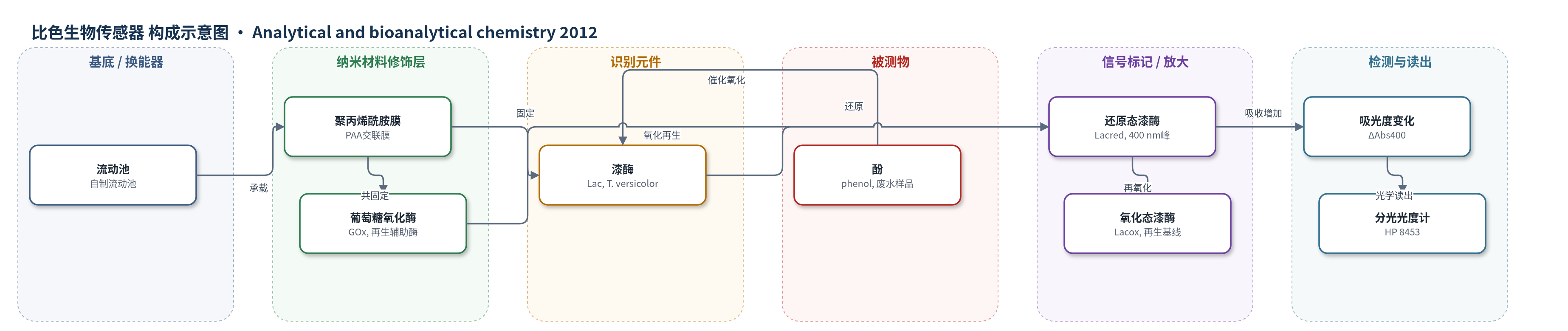
点击图片查看大图 · 依据论文自动绘制
传感器类型
比色生物传感器
检测对象
酚(phenol);样品基质:环境水样/废水(waste water)及加标废水
检测原理
漆酶(Lac)作为识别与换能元件,催化酚氧化并将 O2 还原为水。反应中 Lac 的铜中心由氧化态转变为还原态(Lacred),在 400 nm 处出现特征吸收峰;酚浓度越高,Lac 还原速率和吸光度增量越大,因此以 ΔAbs400 或初始斜率 V0 作为分析信号。传感器膜中 Lac 固定于聚丙烯酰胺(PAA)膜内,酚从流动相扩散进入膜并发生酶促反应,分光光度计连续监测 400 nm 吸光度变化。为恢复氧化态 Lac,共固定葡萄糖氧化酶(GOx),其氧化酶反应消耗 O2 并产生 H2O2,促进 Lacred 再氧化,实现膜的可重复使用。高浓度酚还会生成 425 nm 聚合物吸收。
检测灵敏度
溶液法 ΔAbs: LOD: 2.94·10−6 M;线性范围: 9.79·10−6–7.50·10−4 M;斜率: 4.20·103。溶液法 V0: LOD: 4.07·10−5 M;线性范围: 1.36·10−4–5.00·10−3 M;斜率: 1.70·101。传感器膜 ΔAbs: LOD: 3.27·10−5 M;线性范围: 1.09·10−4–2.50·10−3 M;斜率: 5.40·101。
效应效果
该方法以漆酶自身光学性质为信号,无需外源标记物,具有简单、可逆和绿色可持续的特点。溶液法 ΔAbs 的 RSD 为 1.07%,LOQ 为 9.79·10−6 M,低于欧盟废水酚限值 1.06·10−5 M;传感器膜 RSD 为 3.11%,可连续使用至少 15 次,共固定 GOx 后寿命提高至 30 次以上,且储存 6 个月以上酶活性无明显下降。对邻苯二酚和邻硝基酚无吸收信号变化,显示一定选择性。实际废水中酚低于 LOD,加标废水回收率约 95%(RSD 7%)。相比 HPLC/CG-MS,方法更简单。
传感器的构成
- 基底/载体:自制流动池(flow cell)与分光光度计比色皿位,承载传感器膜并实现连续流动光学检测
- 膜基质:聚丙烯酰胺(polyacrylamide, PAA)膜,由丙烯酰胺、N,N'-亚甲基双丙烯酰胺和过二硫酸盐聚合形成,用于固定酶并允许酚扩散
- 识别元件:漆酶(laccase, Lac,Trametes versicolor),催化酚氧化并通过铜中心价态变化提供 400 nm 自指示吸收信号
- 再生辅助酶:葡萄糖氧化酶(glucose oxidase, GOx,Aspergillus niger),与 Lac 共固定化,促进 Lac 再氧化并提高膜寿命
- 缓冲介质:MES 缓冲液用于酶固定化,磷酸盐缓冲液(pH 6)作为载流液维持反应环境
- 信号读出:紫外-可见分光光度计(Hewlett-Packard 8453)监测 400 nm 吸光度变化
中文摘要
在可持续分析化学背景下,本文基于漆酶(Laccase, Lac)与酚的酶促反应,利用漆酶自身的固有分子吸收和荧光性质,建立了酚的自指示光学检测方法,并对方法进行了优化。分子吸收法在 0.1 M 磷酸盐缓冲液(pH 6)中,以 400 nm 处吸光度变化或初始反应速率为分析参数,酚的线性范围为 9.79·10−6 至 7.50·10−4 mol/L,相对标准偏差为 1.07%。随后将漆酶固定化于聚丙烯酰胺膜中,构建了自指示光学生物传感器膜,用于连续测定样品中的酚。针对酶反应可逆性不足的问题,作者提出以葡萄糖氧化酶(GOx)作为氧化酶类再生漆酶的新策略,使传感器膜使用寿命从约 15 次测定提高至 30 次以上。研究还通过荧光和分子吸收证实了反应机制,并将方法应用于环境水样中酚的测定。
英文摘要
In the context of sustainable analytical chemistry, phenol has been determined through its enzymatic reaction with laccase. The method has been studied and optimized through the autoindicating optical properties of laccase both by intrinsic molecular absorption and fluorescence. The method shows a linear range from 9.79·10(-6) to 7.50·10(-4) M with a relative standard deviation of 1.07 %. The molecular absorption methodology has been implemented in a polyacrylamide film for the design of an autoindicating optical sensor. In order to increase the lifetime of the sensor, the reversibility study of the enzymatic reaction has proposed, as a novelty, the regeneration of laccase with an oxidase-type enzyme (glucose oxidase). The lifetime of the sensor film has improved from 15 to 30 measurements. The reaction mechanism has also been studied and confirmed by fluorescence and molecular absorption. The method leads to the determination of phenol in environmental samples.