组成图示
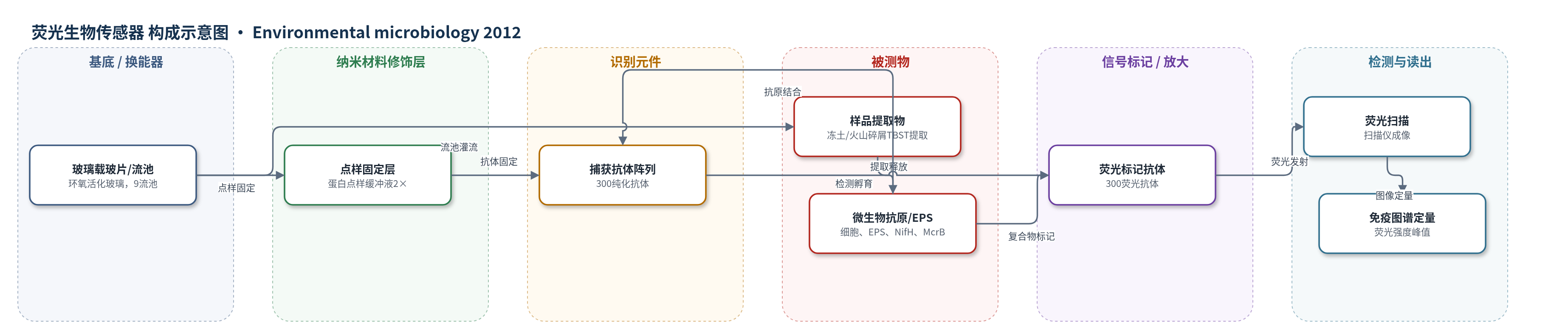
点击图片查看大图 · 依据论文自动绘制
传感器类型
荧光生物传感器
检测对象
细菌与古菌抗原(bacterial/archaeal antigens)、胞外多糖(EPS)、代谢蛋白/肽(NifH、NifD、GlnB、HscA、McrB、ferritins、DPS、ABC transporters);样品基质:南极Deception Island表面火山碎屑/地衣及永久冻土芯(pyroclasts, lichens, permafrost cores)
检测原理
样品经TBST超声提取并过滤后,灌入LDChip300的流池,与固定在环氧玻璃载玻片上的300余种捕获抗体孵育。样品中的细菌/古菌细胞、EPS、NifH/NifD、McrB、铁蛋白/DPS等抗原与对应抗体特异性结合,形成抗原-抗体复合物。洗涤后加入300种荧光标记抗体混合物,与复合物结合,再洗涤去除未结合荧光抗体。荧光扫描仪读取各点荧光强度,强度随对应抗原丰度增加而升高,从而生成多重免疫图谱。该传感器依靠抗体特异性识别和荧光标记直接报告,无酶促放大,但通过300通道并行检测实现广谱微生物与代谢标志物谱分析。
检测灵敏度
未报告
效应效果
LDChip300在Deception Island表面火山碎屑、地衣和冻土表层均给出阳性免疫图谱,且与寡核苷酸微阵列、16S rRNA测序、活菌计数和显微镜结果部分一致,显示其多重识别与现场适用性。含地衣样品信号最强,无可见生命的岩石也出现阳性,提示可检测内生微生物。冻土活性层5 cm以下信号锐减,浓缩粗提物可检出Acidithiobacillus。好氧活菌在表层达10^3–10^4 cfu g^-1,Simpson指数由表层0.018增至4.2 m处0.219,反映深度分层。作者认为该传感器可用于极端环境生命检测、生物标志物谱分析和火星类地模拟。
传感器的构成
- 基底/流控模块:环氧活化玻璃载玻片(Arrayit)与多阵列分析模块(9个流池),承载微阵列并实现样品灌流
- 点样固定层:商品化蛋白点样缓冲液2×(Whatman)加0.02% Tween 20,用于抗体点样与固定
- 识别元件:300余种经Protein A纯化的抗体(抗细菌/古菌细胞、EPS、NifH/NifD、McrB、铁蛋白/DPS、ABC转运体等),以双点阵列固定
- 样品处理缓冲液:TBST(0.4 M Tris-HCl pH 8、0.3 M NaCl、0.1% Tween 20),用于超声提取、孵育与洗涤
- 信号标记物:300种不同荧光标记抗体混合物,与样品抗原/抗体复合物结合产生荧光
- 读出装置:荧光扫描仪与多阵列分析模块,读取各点荧光强度并生成免疫图谱
中文摘要
本研究利用现场抗体微阵列生物传感器LDChip300(Life Detector Chip)分析南极Deception Island表面与永久冻土(钻深至4.2 m)中微生物群落组成及运行代谢。LDChip300含300余种针对细菌和古菌抗原的抗体,通过夹心微阵列免疫分析检测样品中的胞外多糖、细胞抗原及代谢蛋白。免疫图谱显示所有表面样品(地衣、火山碎屑)和冻土表层均出现阳性反应,指示α、δ、γ变形菌、拟杆菌、放线菌、厚壁菌及古菌(可能为Methanobacterium)存在,并检测到固氮(NifHD、GlnB、HscA)、产甲烷(McrB)、铁稳态/铁捕获(铁蛋白、DPS蛋白)和ABC转运体等活性标志物。结果经寡核苷酸微阵列、16S rRNA基因测序、好氧活菌计数和显微镜验证。分子生态显示群落随深度分层:表层多样性最高,酸杆菌、放线菌、变形菌、拟杆菌及蓝细菌/绿弯菌为主;0.5–2 m以放线菌和厚壁菌为主;3–4.2 m以β变形菌为主。地化分析发现乙酸、甲酸等低分子有机酸,可作为厌氧条件下硫酸盐、硝酸盐和金属还原的电子供体。
英文摘要
In this study we examined the microbial community composition and operating metabolisms on the surface and in the permafrost of Deception Island, (Antarctica) with an on site antibody microarray biosensor. Samples (down to a depth of 4.2 m) were analysed with LDChip300 (Life Detector Chip), an immunosensor containing more than 300 antibodies targeted to bacterial and archaeal antigens. The immunograms showed positive antigen-antibody reactions in all surface samples (lichens, pyroclasts) and the top layer of the permafrost. The results indicated the presence of exopolysaccharides, bacteria belonging to the Alpha-, Delta- and Gammaproteobacteria, Bacteroidetes, Gram-positive Actinobacteria and Firmicutes, as well as archaeal species, most probably Methanobacterium spp. Positive reactions with antibodies to proteins and peptides revealed the presence of nitrogen fixation (NifHD, GlnB, HscA), methanogenic (McrB), iron homeostasis and iron scavenging (ferritins and DPS proteins) proteins, as well as ABC transporters, which indicated that these processes were operating at the time of sampling. These results were validated with other molecular ecology techniques such as oligonucleotide microarrays, 16S bacterial rRNA gene sequence analysis, aerobic viable counts and microscopy. Molecular ecology results showed a differentiated pattern along the depth of the drill, being the top active layer the most diverse, with Acidobacteria, Actinobacteria, Proteobacteria, Bacteroidetes and the phototrophs Cyanobacteria and Chloroflexi as dominant groups. Actinobacteria and Firmicutes were dominant in depths from 0.5 to 2 m, and Betaproteobacteria from 3 to 4.2 m. The geochemical analysis revealed the presence of low molecular weight organic acids (acetate, formate) which could be used by microorganisms as energy sources for sulfate, nitrate and metal reduction under anaerobic conditions.