组成图示
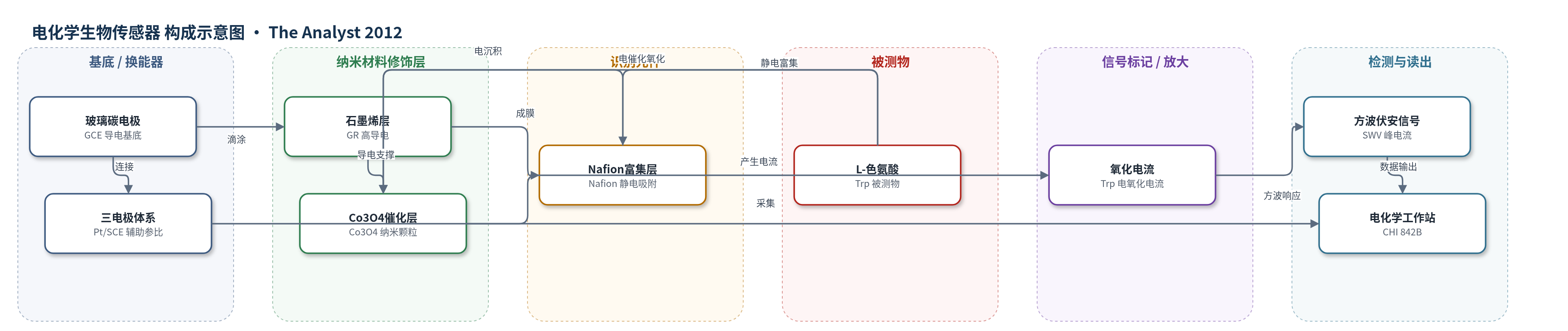
点击图片查看大图 · 依据论文自动绘制
传感器类型
电化学生物传感器
检测对象
L-色氨酸(L-tryptophan, Trp);样品基质:0.1 M PBS(pH 4.0)、氨基酸注射液(18AA)、Dulbecco 改良 Eagle 培养基(D-MEM)
检测原理
在 pH 4.0 的 0.1 M PBS 中,L-色氨酸(Trp,pI 5.89)带正电,被 Nafion 阳离子交换膜静电吸附并富集于电极界面。石墨烯(GR)提供高比表面积和快速电子传递通道,Co3O4 纳米颗粒则作为电催化中心,降低 Trp 直接电氧化过电位并促进电子转移。Trp 在 Co3O4/GR/Nafion/GCE 表面发生两电子氧化反应,氧化峰电位较裸 GCE 负移,氧化峰电流随 Trp 浓度增加而增大。方波伏安法在固定电位读取峰电流,电流响应与 Trp 浓度呈线性关系,从而实现定量检测。
检测灵敏度
LOD: 0.01 mM (S/N = 3);线性范围: 0.05–10 mM;R = 0.996;灵敏度斜率: 0.1859 mA/mM;电流灵敏度: 2631.28 mA mM−1 cm2;回归方程: Ip (mA) = 0.4166 + 0.1859C (mM)
效应效果
该传感器对 100 倍葡萄糖、半胱氨酸、丙氨酸、苯丙氨酸和亮氨酸无明显干扰;5 mM 多巴胺(DA)和 10 mM 尿酸(UA)与 Trp 共存时,因氧化电位分离,对 Trp 测定无干扰。对 10 mM Trp 连续 8 次测量 RSD 为 4.3%;室温储存 4 周后催化电流保持初始值的 94%。实际样品中,氨基酸注射液 Trp 标称 5.70 mg L−1,测得 5.51 和 5.62 mg L−1,回收率 96.7% 和 98.6%,RSD 0.67% 和 0.89%;D-MEM 中 Trp 标称 0.784 mM,测得 0.794 和 0.776 mM,回收率 101.28% 和 99.04%,RSD 3.5% 和 2.8%。与文献修饰电极相比,其灵敏度更高,作者认为可用于食品、药品和生物样品中 Trp 检测。
传感器的构成
- 基底/换能器电极:玻璃碳电极(GCE),经抛光和清洗,提供导电基底与电化学换能界面
- 石墨烯修饰层:石墨烯(GR)悬浮液(4 mg mL−1)滴涂于 GCE 表面,提供高比表面积、快速电子传递和良好生物相容性
- Nafion 富集层:Nafion 阳离子交换聚合物与 GR 共同成膜,在 pH 4.0 下通过静电作用吸附 Trp(pI = 5.89)并固定纳米材料
- Co3O4 催化层:Co3O4 纳米颗粒在 0.1 M KCl/0.02 M CoCl2 中经循环伏安电沉积(−0.8 至 1.2 V,15 圈)生成,提供 Trp 电催化氧化活性
- 三电极体系:Pt 箔辅助电极与饱和甘汞电极(SCE),配合 GCE 构成电化学测量池
- 读出装置:CHI 842B 电化学工作站,采集 CV/SWV 电流信号并计算 Trp 浓度
中文摘要
本文报道了一种由 Co3O4 纳米颗粒修饰石墨烯(GR)复合材料构建的电化学生物传感器,用于 L-色氨酸(Trp)的灵敏测定。该复合材料通过电沉积法制备,并采用扫描电子显微镜(SEM)、能量色散 X 射线光谱(EDS)、X 射线光电子能谱(XPS)和透射电子显微镜(TEM)进行表征。随后,以 Co3O4/GR/Nafion 修饰玻璃碳电极(GCE)为工作电极,利用循环伏安法(CV)和方波伏安法(SWV)研究 Trp 的直接电氧化行为。结果表明,与裸 GCE 相比,Trp 在修饰电极上的氧化峰电流明显增大,氧化峰电位负移。在优化条件下,该传感器对 Trp 的线性范围为 0.05–10 mM(R = 0.996),检出限为 0.01 mM。实验还表明,传感器具有良好的重现性、长期稳定性和高选择性,并成功应用于实际氨基酸样品中 Trp 的检测,结果令人满意。
英文摘要
A novel Co(3)O(4) nanoparticles-decorated graphene (GR) composite was synthesized by electro-deposition and characterized by scanning electron micrographs, energy dispersive X-ray spectroscopy, X-ray photoelectron spectroscopy and transmission electron microscopy. Then, amperometric biosensors based on a Co(3)O(4) nanoparticles-decorated GR composite modified glassy carbon electrode (GCE) were developed for the sensitive determination of L-tryptophan (Trp). The direct electrooxidation behaviors of Trp on the Co(3)O(4)/GR/Nafion/GCE were carefully investigated by cyclic voltammetry and square wave voltammetry. The results indicated that Trp showed an increase of the oxidation peak current with a negative shift of the oxidation peak potential compared with that on the bare GCE. Under optimum conditions, the proposed biosensor can be applied to the quantification analysis of Trp with a wide linear range covering 0.05-10 μM (R = 0.996) and a low detection limit of 0.01 μM. The experimental results also showed that the sensor exhibited good reproducibility, long-term stability as well as high selectivity. Moreover, the novel biosensor for the detection of Trp in a real amino acid sample with satisfactory results has been proved.