组成图示
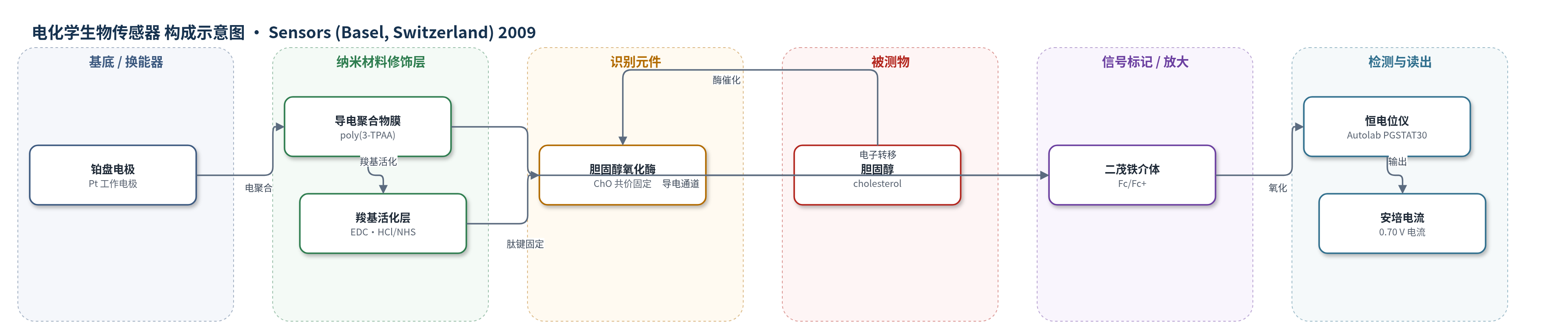
点击图片查看大图 · 依据论文自动绘制
传感器类型
电化学生物传感器
检测对象
胆固醇(cholesterol,Chol),样品基质为含 Triton X-100 的 PBS/KCl 缓冲液,适用于人血浆/血清胆固醇分析
检测原理
胆固醇进入修饰电极界面后,被共价固定的 ChO 催化氧化为 cholestenone,ChO 由氧化态 ChOox 转变为还原态 ChOred。随后 ChOred 将电子传递给二茂铁介体 Fc+,生成 Fc 并再生 ChOox;在 0.70 V 下,Fc 在电极表面被氧化为 Fc+ 并释放电子,形成安培电流。poly(3-TPAA) 导电膜提供电子通道并共价固定酶,二茂铁介体降低氧化电位、避免直接检测 H2O2 带来的干扰。由于酶催化循环持续进行,稳态电流随胆固醇浓度升高而增大,在 0–8 mM 范围内近似线性。
检测灵敏度
LOD: 0.42 mM;线性范围: 0–8 mM;灵敏度: 4.49 mA M-1 cm-2;相关系数: 0.981;Michaelis-Menten 常数: 14.53 mM (R^2=0.992)
效应效果
该传感器在 0–8 mM 范围内线性响应,覆盖正常人血浆胆固醇水平(3.96±0.8 mM),最佳灵敏度为 4.49 mA M−1 cm−2,响应时间 t95 为 70–90 s,检出限为 0.42 mM。选择性方面,0.10 mM 抗坏血酸和 0.40 mM 尿酸分别使电流增加 5.2% 和 10.3%,干扰较小。长期稳定性良好,13 天后仍保留初始电流的 88%,并在 4–5 天后趋于稳定。与文献中包埋法胆固醇传感器相比,共价固定策略提供更优的长期稳定性,线性范围较宽;但 LOD 相对偏高,作者认为可通过流动注射系统降低噪声和扩散层厚度进一步改善。
传感器的构成
- 基底电极:Pt 盘电极,作为工作电极与电子转导基底
- 导电聚合物修饰层:poly(3-TPAA),电聚合形成红橙色膜,提供羧基与导电网络
- 共价活化层:EDC·HCl 与 NHS,活化 poly(3-TPAA) 游离羧基,形成可连接氨基的活性酯
- 识别元件:ChO,通过氨基与活化羧基形成肽键,催化胆固醇氧化
- 信号介体:ferrocene(Fc/Fc+),接受 ChO 还原态电子并在电极上氧化,产生安培电流
- 样品介质:PBS/KCl/Triton X-100,提供缓冲、离子传导、提高胆固醇溶解并稳定酶活性
中文摘要
本研究提出一种共价酶固定化方法,将胆固醇氧化酶(ChO)固定在导电聚合物聚(3-噻吩乙酸)(poly(3-TPAA))上,构建安培法胆固醇生物传感器。在铂电极上以 1.5 mA 恒流电聚合 5、20 和 100 s,分别制备电极 A、B 和 C 的红橙色 poly(3-TPAA) 膜。随后用 1-乙基-3-(3-二甲氨基丙基)碳二亚胺盐酸盐(EDC·HCl)和 N-羟基琥珀酰亚胺(NHS)活化聚合物游离羧基,使 ChO 的氨基与活化基团形成肽键。最佳电极 B 的灵敏度为 4.49 mA M−1 cm−2,线性范围为 0–8 mM,适合人体胆固醇分析。响应时间(t95)为 70–90 s,基于信噪比 3 的检出限为 0.42 mM。抗坏血酸和尿酸的干扰分别使电流响应增加 5.2% 和 10.3%(以胆固醇响应为 100%)。长期稳定性方面,13 天后传感电流仍保留初始值的 88%。
英文摘要
In this study, use of the covalent enzyme immobilization method was proposed to attach cholesterol oxidase (ChO) on a conducting polymer, poly(3-thiopheneacetic acid), [poly(3-TPAA)]. Three red-orange poly(3-TPAA) films, named electrodes A, B and C, were electropolymerized on a platinum electrode by applying a constant current of 1.5 mA, for 5, 20 and 100 s, respectively. Further, 1-ethyl-3-(3-dimethylamiopropyl)carbodiimide hydrochloride (EDC · HCl) and N-hydroxysuccinimide (NHS) were used to activate the free carboxylic groups of the conducting polymer. Afterwards, the amino groups of the cholesterol oxidase were linked on the activated groups to form peptide bonds. The best sensitivity obtained for electrode B is 4.49 mA M(-1) cm(-2), with a linear concentration ranging from 0 to 8 mM, which is suitable for the analysis of cholesterol in humans. The response time (t(95)) is between 70 and 90 s and the limit of detection is 0.42 mM, based on the signal to noise ratio equal to 3. The interference of species such as ascorbic acid and uric acid increased to 5.2 and 10.3% of the original current response, respectively, based on the current response of cholesterol (100%). With respect to the long-term stability, the sensing response retains 88% of the original current after 13 days.