组成图示
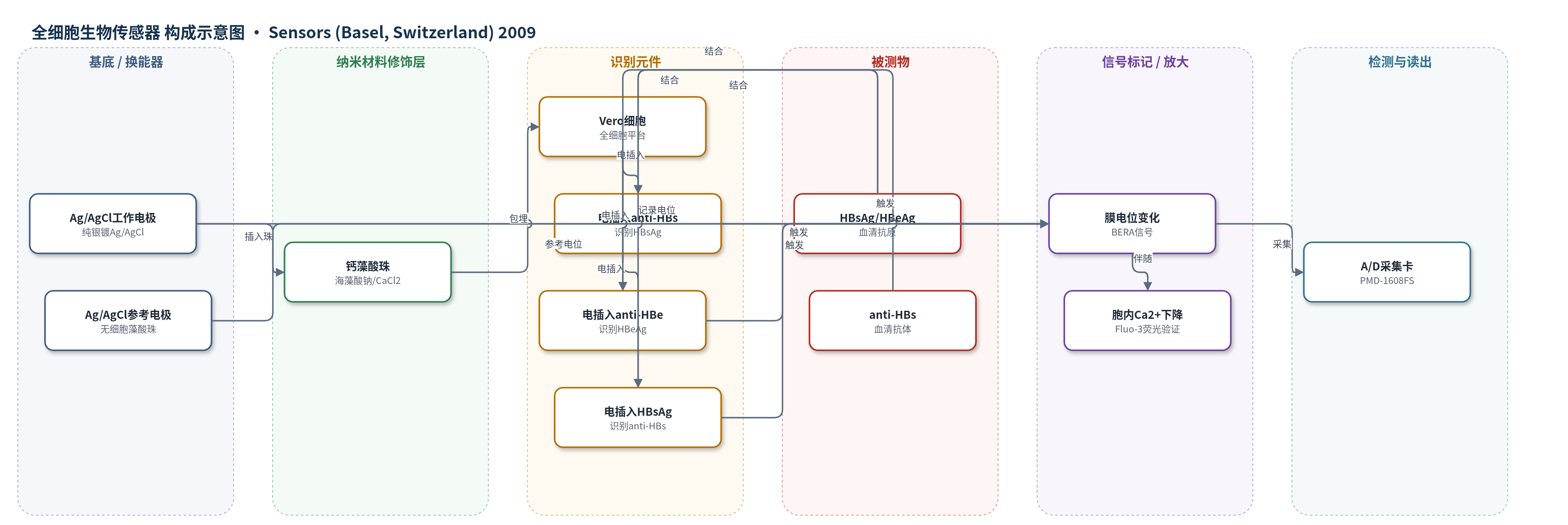
点击图片查看大图 · 依据论文自动绘制
传感器类型
全细胞生物传感器
检测对象
乙型肝炎病毒表面抗原(HBsAg)、乙型肝炎病毒e抗原(HBeAg)、抗乙型肝炎表面抗体(anti-HBs);样品基质:临床人血清
检测原理
传感器以电插入HBV特异性抗体或抗原的Vero细胞为识别元件,固定于钙藻酸珠中。当血清中的HBsAg、HBeAg或anti-HBs与膜上对应识别分子结合时,在细胞膜结合位点产生机电应力,改变膜通透性与膜电导,引起细胞膜电位超极化和胞内Ca2+浓度下降。Ag/AgCl微电极按BERA原理记录45 s内最大膜电位变化,作为定性信号。响应大小随目标物存在与否变化,阳性样本显著高于阴性和异源肝炎病毒样本;该过程无标记、非滴定式,不依赖线性定量。
检测灵敏度
LOD: 未明确报告;原文称灵敏度约10^3 viral copies/mL;参考ELISA检测限:HBsAg/HBeAg约0.05 ng/mL,HBeAg <1 PEI U/μL;未报告线性范围、斜率、R^2。
效应效果
在双盲临床血清筛查中,133份样本(98阳性、35阴性)分别用三种传感器检测,每份样本以15个独立传感器重复。HBsAg阳性响应7.1±0.8 mV,HBeAg阳性3.5±0.6 mV,anti-HBs阳性23±4 mV,均显著高于阴性及HCV、HAV等异源样本,显示良好选择性。重现性变异为8.9%(HBsAg)及总体11–17%。单次检测45 s,若采用多电极阵列可达>1150 test/h,高于常规免疫分析80–100 test/h。作者认为其适合HBV抗原/抗体的快速、定性、高通量筛查,但灵敏度比核酸传感器低10–100倍,有限比较约10^3 copies/mL。
传感器的构成
- 换能器电极:纯银工作电极,电化学镀Ag/AgCl层,直径0.75 mm,插入含细胞钙藻酸珠,测量膜电位
- 参考电极:Ag/AgCl微电极,插入无细胞钙藻酸珠,提供电位参考
- 固定基质:4% (w/v)海藻酸钠与0.8 M CaCl2交联形成约2 mm钙藻酸珠,包埋约4×10^4个Vero细胞
- 识别细胞:Vero成纤维细胞,作为全细胞识别平台并维持膜电位响应
- 识别元件:电插入Vero细胞膜的HBV小鼠多克隆抗体anti-HBs或anti-HBe,或抗原HBsAg,用于特异性结合目标
- 信号读出:PMD-1608FS A/D采集卡与InstaCal软件,记录45 s内最大膜电位变化
中文摘要
本文报道一种用于检测乙型肝炎病毒(HBV)相关抗原和抗HBV的新型微型细胞生物传感器。该传感器基于“膜工程”改造的Vero成纤维细胞,并将其固定于海藻酸基质中。膜工程通过电脉冲将HBV特异性抗体(anti-HBs、anti-HBe)或抗原(HBsAg)插入Vero细胞膜。当同源抗原与电插入抗体结合,或抗体与电插入抗原结合时,细胞膜电位发生特异性变化,并由微电极按生物电识别检测(BERA)原理测量。该传感器按双盲方案筛查133份临床血清样本,HBV阳性样本响应显著高于阴性样本及HCV等异源肝炎病毒样本。利用携带HBsAg的固定Vero细胞传感器可检测anti-HBs抗体。检测响应快速(45 s)且可重复。荧光显微镜显示,anti-HBs膜工程细胞结合HBV颗粒后胞内Ca2+浓度下降。作者讨论了该传感器作为临床样本HBV抗原和anti-HBs定性、快速、高通量筛查工具的应用前景。
英文摘要
A novel miniature cell biosensor detection system for the detection of Hepatis B virus (HBV)-associated antigens and anti-HBV is described. The biosensor is based on "membrane-engineered" Vero fibroblast cells immobilized in an alginate matrix. The membrane-engineering process involved the electroinsertion of anti-HBV specific antibodies (anti-HBs, anti-HBe) or antigens (HBsAg) in the membranes of the Vero cells. The attachment of a homologous antigen to the electroinserted antibody (or, respectively, of the antibody to the electroinserted antigen) triggered specific changes to the cell membrane potential that were measured by appropriate microelectrodes, according to the principle of the Bioelectric Recognition Assay (BERA). The sensor was used for screening 133 clinical blood serum samples according to a double-blind protocol. Considerably higher sensor responses were observed against HBV-positive samples, compared with responses against negative samples or samples positive for heterologous hepatitis viruses such as Hepatitis C (HCV) virus. Detection of anti-HBs antibodies was made possible by using a biosensor based on immobilized Vero cells bearing the respective antigen (HBsAg). The observed response was rapid (45 sec) and quite reproducible. Fluorescence microscopy observations showed that attachment of HBV particles to cells membrane-engineered with anti-HBs was associated with a decrease of [Ca(2+)]cyt. The perspectives for using the novel biosensor as a qualitative, rapid screening, high throughput assay for HBV antigens and anti-HBs in clinical samples is discussed.