组成图示
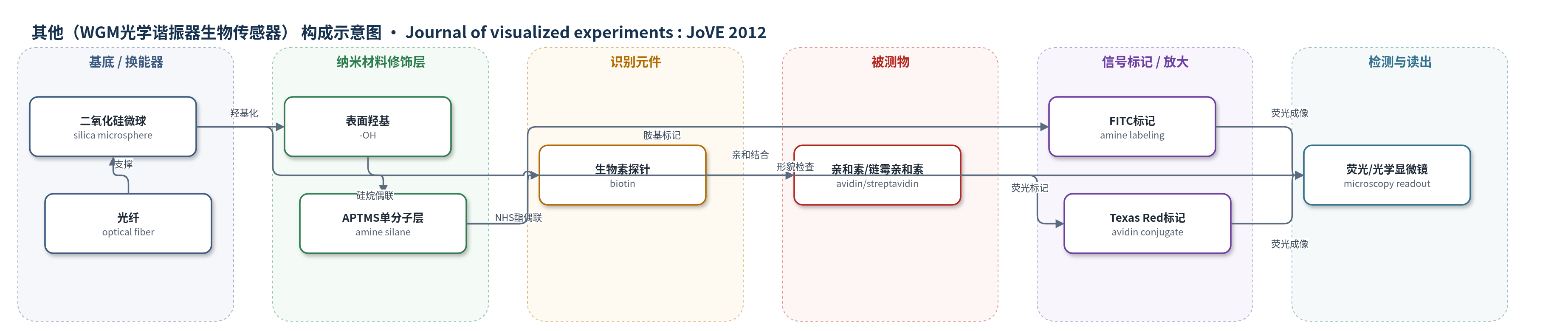
点击图片查看大图 · 依据论文自动绘制
传感器类型
其他(WGM光学谐振器生物传感器)
检测对象
未报道特定被测物;表面验证对象:亲和素/链霉亲和素(avidin/streptavidin),样品基质:PBS缓冲液
检测原理
该传感器基于回音壁模式(WGM)光学谐振器:光在二氧化硅微球内全反射形成驻波,倏逝场延伸至周围介质。当表面固定探针与目标分子结合时,界面有效折射率改变,引起共振频率偏移;光场在微球内循环多次,使微小折射率变化被本征放大。表面功能化通过氧等离子体或piranha溶液生成羟基,APTMS经水解缩合形成胺基单分子层,NHS-biotin与伯胺形成酰胺键,实现生物素共价固定。本文未报告浓度-频率响应,而是用FITC与伯胺共价标记、Texas Red-avidin与生物素亲和标记,通过荧光显微镜验证表面覆盖均匀性和结合能力。
检测灵敏度
未报告
效应效果
作者重点评价表面功能化质量而非定量检测性能。正确功能化微球在光学显微镜下无损伤、无污染、无裂纹,荧光显微镜显示胺基或生物素覆盖均匀致密;错误处理会出现灰尘、试剂团聚、涂层不均或表面凹坑,导致灵敏度显著下降。采用玻璃载片-胶带卷固定微球茎部,可批量转移并减少接触损伤,获得约90%的无损伤功能化微球成功率。氧等离子体羟基化比piranha溶液更快、无需液体接触和干燥,更利于减少团聚。作者认为该硅烷-NHS酯策略可推广至任意二氧化硅器件,为WGM光学生物传感器提供通用、可重复的探针固定方法。
传感器的构成
- 基底/换能器:二氧化硅微球(silica microsphere)固定在光纤(optical fiber)端,作为回音壁模式(WGM)光学谐振器,束缚光场并产生共振频率读出
- 表面清洁/羟基化层:氧等离子体或piranha溶液处理形成表面羟基(-OH),为硅烷偶联提供反应位点
- 硅烷偶联剂修饰层:氨基丙基三乙氧基硅烷(APTMS)经水解缩合形成胺基单分子层,桥接无机表面与有机探针
- 识别元件:N-羟基琥珀酰亚胺生物素(NHS-biotin)通过伯胺-NHS酯反应共价连接,作为可与亲和素/链霉亲和素结合的探针
- 表征标记物:异硫氰酸荧光素(FITC)与表面伯胺形成硫脲键,用于荧光显微镜验证胺基覆盖
- 表征标记物:Texas Red-avidin 通过生物素-亲和素相互作用标记表面生物素,用于验证生物素覆盖与结合能力
- 读出/表征:光学显微镜检查表面缺陷与污染,荧光显微镜检查覆盖均匀性;WGM共振频率用于后续无标记检测
中文摘要
生物传感器平台需通过表面修饰实现抗污、亲疏水调控及特异性识别,以适用于血液、尿液和废水等复杂基质。回音壁模式(WGM)光学谐振器可无标记检测多种物质,其束缚光场具有倏逝尾,与周围分子相互作用后改变有效折射率,引起共振频率偏移,并因光场循环而获得本征信号放大。二氧化硅微球是最常见的WGM谐振器,但三维微球表面易受污染、缺陷和涂层不均影响,传统平面硅表面化学方法难以直接适用。本文报道一种简便的硅烷偶联剂表面功能化方法,通过氧等离子体或piranha溶液羟基化二氧化硅微球,再气相沉积氨基丙基三乙氧基硅烷(APTMS),最后以N-羟基琥珀酰亚胺(NHS)酯化学将生物素共价连接至表面。该方法可用于任何二氧化硅器件的生物素化,为WGM光学生物传感器提供通用探针固定策略。
英文摘要
In order to interface with biological environments, biosensor platforms, such as the popular Biacore system (based on the Surface Plasmon Resonance (SPR) technique), make use of various surface modification techniques, that can, for example, prevent surface fouling, tune the hydrophobicity/hydrophilicity of the surface, adapt to a variety of electronic environments, and most frequently, induce specificity towards a target of interest. These techniques extend the functionality of otherwise highly sensitive biosensors to real-world applications in complex environments, such as blood, urine, and wastewater analysis. While commercial biosensing platforms, such as Biacore, have well-understood, standard techniques for performing such surface modifications, these techniques have not been translated in a standardized fashion to other label-free biosensing platforms, such as Whispering Gallery Mode (WGM) optical resonators. WGM optical resonators represent a promising technology for performing label-free detection of a wide variety of species at ultra-low concentrations. The high sensitivity of these platforms is a result of their unique geometric optics: WGM optical resonators confine circulating light at specific, integral resonance frequencies. Like the SPR platforms, the optical field is not totally confined to the sensor device, but evanesces; this "evanescent tail" can then interact with species in the surrounding environment. This interaction causes the effective refractive index of the optical field to change, resulting in a slight, but detectable, shift in the resonance frequency of the device. Because the optical field circulates, it can interact many times with the environment, resulting in an inherent amplification of the signal, and very high sensitivities to minor changes in the environment. To perform targeted detection in complex environments, these platforms must be paired with a probe molecule (usually one half of a binding pair, e.g. antibodies/antigens) through surface modification. Although WGM optical resonators can be fabricated in several geometries from a variety of material systems, the silica microsphere is the most common. These microspheres are generally fabricated on the end of an optical fiber, which provides a "stem" by which the microspheres can be handled during functionalization and detection experiments. Silica surface chemistries may be applied to attach probe molecules to their surfaces; however, traditional techniques generated for planar substrates are often not adequate for these three-dimensional structures, as any changes to the surface of the microspheres (dust, contamination, surface defects, and uneven coatings) can have severe, negative consequences on their detection capabilities. Here, we demonstrate a facile approach for the surface functionalization of silica microsphere WGM optical resonators using silane coupling agents to bridge the inorganic surface and the biological environment, by attaching biotin to the silica surface. Although we use silica microsphere WGM resonators as the sensor system in this report, the protocols are general and can be used to functionalize the surface of any silica device with biotin.