组成图示
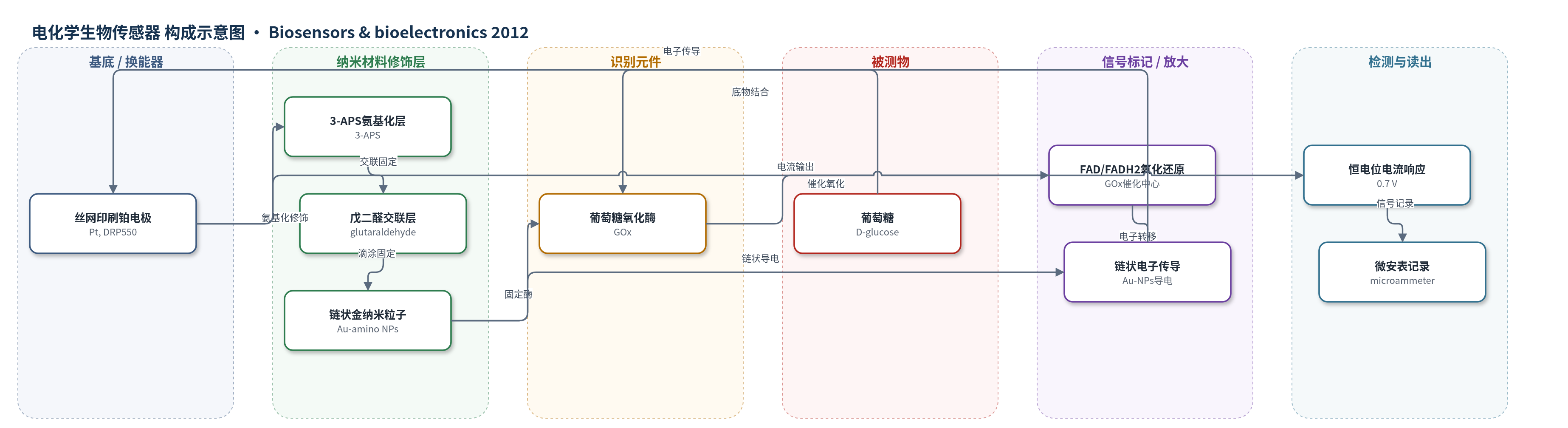
点击图片查看大图 · 依据论文自动绘制
传感器类型
电化学生物传感器
检测对象
葡萄糖(glucose,D-glucose);样品基质:0.1 M PBS(pH 7.0)缓冲液,干扰评估针对生理流体浓度(文中未明确血清/尿液等实际样品)
检测原理
该传感器为无标记电化学生物传感器。葡萄糖氧化酶(GOx)固定于链状氨基功能化金纳米粒子(Au-amino NPs)修饰的铂电极上。当样品中的D-葡萄糖接近GOx时,酶催化葡萄糖氧化,其催化中心的FAD被还原为FADH2。链状Au-amino NPs通过共价耦合形成连续导电通路,并缩短FAD/FADH2与电极之间的距离,从而促进GOx与电极之间的直接电子转移(DET)。在恒电位0.7 V下,FADH2向电极传递电子产生安培电流,电流随葡萄糖浓度升高而增大。链状结构提高电化学活性面积和电子转移速率,氨基功能化改善酶固定与稳定性,因此无需外加电子媒介物即可实现灵敏检测。
检测灵敏度
LOD: 1.0 μM(Table 1;正文另报1 mM);线性范围: 0.001–5 mM(Table 1;摘要/正文另报1 mM–5 mM);灵敏度: 47.2 mA mM−1 cm−2
效应效果
传感器选择性良好:0.4 V下抗坏血酸至24.6 mg/dL、尿酸至9 mg/dL无明显干扰,覆盖生理流体浓度。1 mM葡萄糖重复10次,RSD为0.84%,优于柠檬酸金纳米粒子传感器的1.38%。响应时间4 s,快于柠檬酸金纳米粒子传感器8 s和直接固定GOx的415 s。灵敏度47.2 mA mM−1 cm−2,约为柠檬酸金纳米粒子传感器16.4的3倍。Km,app为3.11 mM,低于4.3 mM;ks为3.12 s−1,高于2.4 s−1。4 ℃ PBS保存60天活性保留85%以上。作者认为其适合高灵敏、稳定葡萄糖检测。
传感器的构成
- 基底/换能器电极:丝网印刷铂工作电极(Pt,DRP550,Drop Sens),对电极为Pt,参比电极为Ag,用于电子传导与电流读出
- 电极氨基化修饰层:3-氨基丙基三乙氧基硅烷(3-APS,5 mM)沉积于Pt电极,提供氨基官能团
- 交联固定层:戊二醛(glutaraldehyde,10% v/v)作为交联剂,用于固定纳米粒子与酶
- 纳米材料修饰层:L-丝氨酸(L-Serine)还原/封端制备的氨基功能化链状耦合金纳米粒子(Au-amino NPs,平均直径约20 nm),增强电子转移
- 识别元件:葡萄糖氧化酶(GOx,20 U)固定于Au-amino NPs表面,特异性催化葡萄糖氧化
- 信号标记物:无外加标记物,依赖GOx催化中心FAD/FADH2与电极之间的直接电子转移(DET)
- 电子供体:D-葡萄糖(D-glucose)作为底物,被GOx氧化后提供电子
中文摘要
本研究通过氨基酸诱导金纳米粒子之间的耦合来调控其电子转移性能。除提高导电性外,纳米粒子的氨基功能化还使所制备生物传感器的活性和操作稳定性增强。以氨基酸为还原剂合成的金纳米粒子(平均直径约20 nm)具有氨基酸固有的耦合特性,呈链状排列;吸收光谱和透射电子显微镜证实单个纳米粒子耦合形成链状结构。将葡萄糖氧化酶(GOx)吸附固定于这些耦合金纳米粒子上所构建的葡萄糖生物传感器,其效率高于将GOx固定于传统柠檬酸钠还原法制备金纳米粒子上的传感器。所制备传感器具有1 mM–5 mM的宽线性范围和47.2 mA mM−1 cm−2的高灵敏度,并对葡萄糖表现出良好选择性,在生理范围内尿酸和抗坏血酸等易氧化生物分子干扰可忽略。此外,该电化学生物传感器具有优异的长期稳定性,60天内保持85%以上活性。
英文摘要
Present study concerns modulating the electron transfer properties of gold nanoparticles through amino acid induced coupling among them. In addition to conductivity, the amino functionalization of the nanoparticles results in enhanced activity and operational stability of the biosensor fabricated using the same. Nanoparticles synthesized using amino acid as reducing agent (average diameter-20 nm), incorporate the natural coupling property of amino acids and are seen to align in a chain-like arrangement. The coupling of the individual nanoparticles to form chain like structure was confirmed by both absorption spectroscopy as well as transmission electron microscopy. The glucose biosensor developed by adsorption of glucose oxidase (GOx) enzyme onto these coupled gold nanoparticles showed enhanced efficiency as compared to the one with glucose oxidase immobilized onto gold nanoparticles synthesized using the conventional method (trisodium citrate as reducing agent). The fabricated biosensor demonstrated a wide linear concentration range from 1 μM-5mM and a high sensitivity of 47.2 μA mM(-1) cm(-2). Also, an enhanced selectivity to glucose was observed with negligible interference in the physiological range, from easily oxidizable biospecies, e.g. uric acid and ascorbic acid. Furthermore, the electrochemical biosensor has excellent long term stability- retaining greater than 85% of the biosensor activity up to 60 days.