组成图示
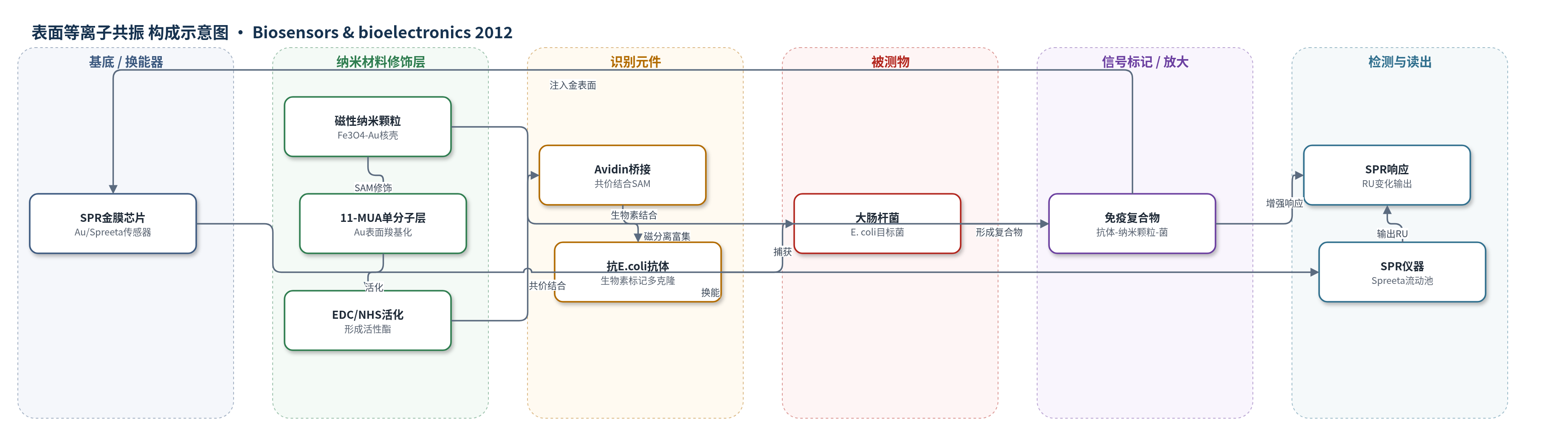
点击图片查看大图 · 依据论文自动绘制
传感器类型
表面等离子共振(SPR)生物传感器
检测对象
大肠杆菌(Escherichia coli, E. coli);样品基质:PBS菌悬液、湖水、河水、水洼水、加标自来水
检测原理
金包覆Fe3O4磁性纳米颗粒表面先形成11-MUA自组装单分子层,经EDC/NHS活化后共价结合avidin,再通过avidin–biotin相互作用固定生物素标记抗E. coli抗体。样品中的E. coli与抗体结合,经磁分离和PBST/PBS洗涤后形成抗体–纳米颗粒–细菌复合物并富集。复合物注入SPR金膜流路时,细菌和Au纳米颗粒靠近金表面,改变界面折射率和局域电磁场;Au壳层进一步放大SPR响应。E. coli浓度越高,捕获复合物越多,RU变化越大,从而实现无标记定量。磁分离富集与Au纳米颗粒增强共同提高灵敏度,总分析时间小于70 min。
检测灵敏度
最佳金包覆磁性纳米颗粒-SPR法:LOD: 3 cfu/ml;线性范围: 30–3.0 × 10^4 cfu/ml;R^2 = 0.997;斜率: 202.0(正文 y=202.0x+23.5),Table 1 报告 209.1。
效应效果
选择性方面,5×10^3 cfu/ml的Enterobacter aerogenes和6.7×10^3 cfu/ml的Enterobacter dissolvens仅产生61 RU和83 RU,低于检出限响应;3×10^3 cfu/ml E. coli产生734 RU。实际水样中,湖水和水洼低于检出限,平板计数无粪大肠菌群;河水SPR为27 cfu/ml,平板为30 cfu/ml。加标自来水(4×10^1、4×10^2、4×10^3 cfu/ml)测得6.5×10^1、3.4×10^2、4.4×10^3 cfu/ml,与平板计数无显著差异(p<0.05)。捕获效率约55%,总分析时间<70 min,未报告RSD。作者认为可用于病原菌快速无标记定量。
传感器的构成
- SPR换能基底:Spreeta传感器芯片/500 Å Au玻璃片,提供金膜SPR检测界面与3通道流路
- 磁性纳米颗粒核:Fe3O4磁性核心,用于免疫磁分离、富集和浓缩E. coli
- 金包覆增强层:Au壳层包覆Fe3O4,增强SPR响应并作为SAM成核表面
- 自组装单分子层:11-巯基十一酸(11-MUA)在Au表面形成-COOH功能化SAM
- 交联活化层:EDC/NHS活化11-MUA羧基,形成可共价结合avidin的活性酯
- 桥接蛋白层:avidin共价结合到活化SAM,提供生物素结合位点
- 识别元件:生物素标记兔抗E. coli多克隆抗体,通过avidin-biotin结合捕获目标菌
- 读出与再生:PBS流动下SPR RU变化读出,0.1 M NaOH/1% Triton X-100再生表面
中文摘要
本研究针对生物防御、食品安全、医学诊断和制药领域对微生物快速敏感检测的需求,比较了四种基于表面等离子共振(SPR)的大肠杆菌(Escherichia coli, E. coli)传感策略,旨在确定最合适的生物活性表面制备方法。以E. coli为模型菌,分别测试了抗体非特异性吸附、通过avidin–biotin相互作用特异性吸附、基于自组装单分子层(SAM)固定抗体,以及结合免疫磁分离与金包覆磁性纳米颗粒的SPR新方法。结果表明,金包覆磁性纳米颗粒策略最有效,可特异性分离E. coli并在无标记条件下快速定量。该方法线性范围为30–3.0×10^4 cfu/ml,检出限为3 cfu/ml;对Enterobacter aerogenes和Enterobacter dissolvens无显著响应。实际水样检测结果与平板计数法比较无显著差异(p<0.05),说明其可用于真实水样中E. coli的快速定量。
英文摘要
Rapid and sensitive detections of microorganisms are very important for biodefence, food safety, medical diagnosis and pharmaceutics. The present study aims to find out the most proper bioactive surface preparation method to develop rapid, sensitive and selective bacteria biosensor, based on surface plasmon resonance (SPR) spectroscopy. Escherichia coli (E. coli) was used as a model bacterium and four sensing strategies in SPR were tested. Three of these strategies are antibody immobilization methods that are non-specific adsorption, specific adsorption via the avidin-biotin interaction, and immobilization of antibodies via self-assembled monolayer formation. The fourth strategy is a novel method for bacteria enumeration based on the combination of the SPR spectroscopy and immunomagnetic separation with using gold-coated magnetic nanoparticles. According to results, the most efficient SPR method is the one based on gold-coated magnetic nanoparticles. This method allows to specifically separate E. coli from the environment and to quantify rapidly without any labeling procedure. The developed method has a linear range between 30 and 3.0 × 10(4)cfu/ml, and a detection limit of 3 cfu/ml. The selectivity of the method was examined with Enterobacter aerogenes and Enterobacter dissolvens, which did not produce any significant response. The usefulness of the method to detect E. coli in real water samples was also investigated, and the results were compared with the results from plate-counting method. There was no significant difference between the methods (p>0.05).