组成图示
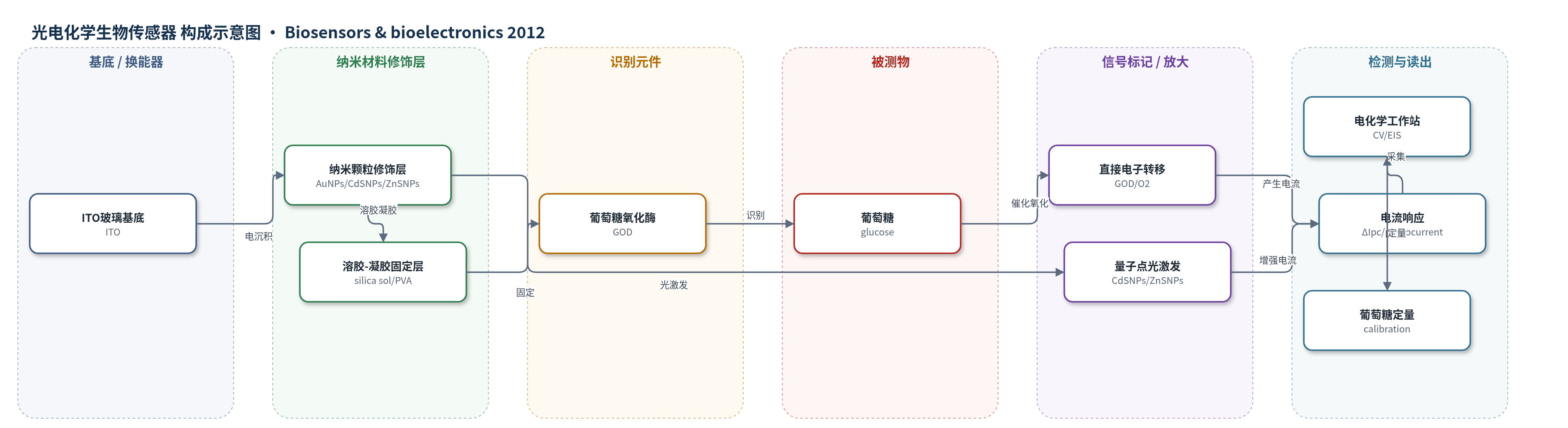
点击图片查看大图 · 依据论文自动绘制
传感器类型
光电化学生物传感器
检测对象
葡萄糖(glucose);样品基质:磷酸盐缓冲溶液(PBS)、人血清(human serum)
检测原理
葡萄糖氧化酶(GOD)通过溶胶-凝胶法固定在 Au、CdS 或 ZnS 纳米颗粒修饰的 ITO 电极上。纳米颗粒增大界面并促进 GOD 活性中心与电极间的直接电子转移。在氧饱和缓冲液中,GOD 还原态可电催化溶解氧还原,使阴极峰电流升高;加入葡萄糖后,GOD 催化葡萄糖氧化并消耗其氧化态,导致阴极峰电流下降,电流变化量 ΔIpc 随葡萄糖浓度增加而增大,从而实现定量。CdS/ZnS 量子点在氙灯照射下产生光电流,光伏效应可增强 GOD 催化响应,使灵敏度提高约30%。
检测灵敏度
灵敏度: 0.29 μA/mM(GOD/AuNPs/ITO)、0.35 μA/mM(GOD/CdSNPs/ITO)、0.54 μA/mM(GOD/ZnSNPs/ITO)
效应效果
三种 GOD/纳米颗粒/ITO 电极对 0.5 mM 葡萄糖连续六次检测的重复性 RSD 分别为 3.3%、5.2% 和 2.8%,独立制备六支电极的批间重现性 RSD 分别为 4.7%、5.9% 和 4.1%。连续循环伏安扫描 30 圈后 GOD 峰电流无明显下降,表明在缓冲液中稳定。人血清加标回收率为 96% 和 102%,结果与医院比色法一致。ZnS 纳米颗粒体系灵敏度最高,且 ZnS 对人体和环境无毒,作者认为其比 CdS 更适合构建新型电化学和光电化学生物传感器。
传感器的构成
- 基底/换能器电极:氧化铟锡(ITO)玻璃,导电透明工作电极。
- 纳米材料修饰层:金纳米颗粒(AuNPs)、硫化镉纳米颗粒(CdSNPs)或硫化锌纳米颗粒(ZnSNPs),电沉积于 ITO 表面,增大界面并促进 GOD 直接电子转移。
- 识别/催化元件:葡萄糖氧化酶(GOD),催化葡萄糖氧化并介导直接电子转移。
- 固定基质:硅溶胶(silica sol)与聚乙烯醇(PVA)溶胶-凝胶层,包埋固定 GOD。
- 信号转换元件:GOD 活性中心/O2 还原体系,将葡萄糖浓度转换为阴极峰电流变化。
- 光电化学激发元件:CdSNPs/ZnSNPs 量子点,在氙灯照射下产生光电流并增强 GOD 催化响应。
中文摘要
本文比较了基于金(Au)、硫化镉(CdS)和硫化锌(ZnS)纳米颗粒-葡萄糖氧化酶(GOD)体系的三种生物传感器的电化学与光电化学行为。所有纳米颗粒均通过电沉积法沉积在氧化铟锡(ITO)薄膜玻璃表面,随后采用溶胶-凝胶法将 GOD 固定在纳米颗粒修饰电极表面。利用扫描电子显微镜、紫外-可见光谱和电化学阻抗谱对 ITO 电极上沉积的纳米颗粒进行表征。比较了 GOD 的直接电化学行为、葡萄糖校准曲线以及酶反应动力学参数。此外,量子点-GOD 体系生物传感器在光照后电流响应增强。基于 ZnS 纳米结构的电化学和光电化学生物传感器表现出比 Au 或 CdS 纳米结构更高的灵敏度。考虑到 ZnS 对人体和环境无毒,结果表明 ZnS 纳米颗粒-GOD 体系有望成为构建新型电化学和光电化学生物传感器的平台。
英文摘要
A comparison of the electrochemical and photoelectrochemical behaviors of three biosensors, based on the use of Au, CdS, and ZnS nanoparticles-glucose oxidase (GOD) system, is discussed. All the nanoparticles were electrodeposited onto the indium tin oxide (ITO) thin film coated glass surface. GOD was then immobilized on the nanoparticles-modified electrodes surface with the sol-gel technique. The deposited nanoparticles on ITO electrodes were characterized by scanning electron microscopy, UV-vis spectroscopy and electrochemical impedance spectra. The direct electrochemistry of GOD, analytical performance of glucose calibration curves and the kinetic parameters of the enzyme reaction were compared for all the electrochemical biosensors. Furthermore, the current response of the quantum dots-GOD system biosensor can be increased after illumination. The electrochemical and photoelectrochemical biosensors based on ZnS nanostructures exhibited higher sensitivity than that of Au or CdS nanostructures. Considering ZnS is nontoxic to human and environment, the results suggest that ZnS nanoparticles-GOD system seems to be a promising platform for fabrication of novel electrochemical and photoelectrochemical biosensors.