组成图示
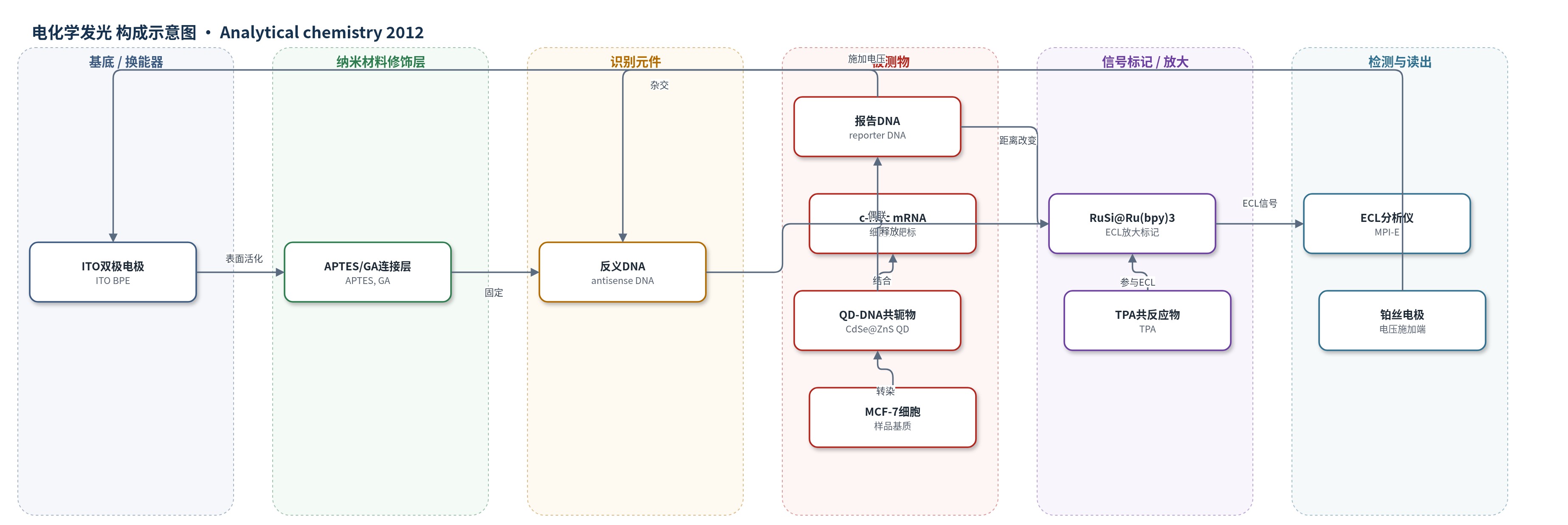
点击图片查看大图 · 依据论文自动绘制
传感器类型
电化学发光(ECL)生物传感器
检测对象
c-Myc mRNA(c-Myc mRNA,MCF-7乳腺癌细胞/LO2细胞裂解液);报告DNA(reporter DNA,细胞裂解液)
检测原理
CdSe@ZnS QD偶联反义DNA与报告DNA形成双链共轭物并转染细胞;细胞内c-Myc mRNA与反义DNA杂交,使报告DNA从QD释放,释放量正比于c-Myc mRNA。细胞裂解后,报告DNA与固定在ITO BPE阳极极的反义DNA杂交,形成刚性双链DNA,使RuSi@Ru(bpy)3^2+标记远离电极表面,降低ECL强度。BPE两端施加电压,阳极极Ru(bpy)3^2+与TPA发生氧化还原反应产生ECL,阴极极还原O2;RuSi@Ru(bpy)3^2+因高载量Ru(bpy)3^2+提供约24倍信号放大。ECL下降量ΔI随报告DNA浓度增加而增大,从而间接定量c-Myc mRNA。
检测灵敏度
线性范围: 2 × 10⁻¹⁶ to 1 × 10⁻¹¹ M;线性拟合范围: 1 × 10⁻¹⁶ to 1 × 10⁻¹³ M;R^2 = 0.9906
效应效果
该传感器对非特异性干扰具有良好耐受性:在1 nM SSB或1 nM DNase I存在下,报告DNA响应无显著ECL变化,表明纳米颗粒空间位阻和高盐环境可保护DNA。传感器可经超纯水冲洗再生,15个循环后信号恢复率>95%。实际细胞样品中,MCF-7细胞c-Myc mRNA平均拷贝数为2203±256拷贝/细胞,LO2细胞为13±2拷贝/细胞,与文献报道的2907±289拷贝/细胞处于同一水平。RuSi@Ru(bpy)3^2+标记较Ru(bpy)3^2+和RuSi分别增强约24倍和12倍。方法无需纯mRNA校准,利用报告DNA作为内标,适合微型化无线检测和即时检测。
传感器的构成
- 基底/换能器:ITO双极电极(ITO BPE)/U形ITO微电极,嵌于PDMS微通道,作为无线ECL换能器
- 表面连接层:APTES修饰ITO表面引入氨基,戊二醛(GA)交联固定DNA
- 识别元件:反义DNA(antisense DNA)固定于BPE阳极极,与报告DNA杂交以间接识别c-Myc mRNA
- 信号标记/放大:Ru(bpy)3^2+偶联二氧化硅纳米颗粒(RuSi@Ru(bpy)3^2+),通过GA连接至反义DNA,提供ECL发光与放大
- 封闭剂:2% BSA封闭未反应GA位点,降低非特异结合
- 高盐处理液:高盐PBS去除非特异结合RuSi@Ru(bpy)3^2+并降低DNA静电排斥,使标记靠近电极
- 电子供体/共反应物:三丙胺(TPA)在0.1 M PBS(pH 7.4,1 M NaCl)中作为ECL共反应物
- 细胞内递送模块:CdSe@ZnS量子点(QD)-反义DNA/报告DNA共轭物,转染细胞并释放报告DNA
中文摘要
本文报道一种超灵敏无线电化学发光(ECL)方法,用于在聚二甲基硅氧烷(PDMS)微通道中基于氧化铟锡(ITO)双极电极(BPE)检测肿瘤细胞内核酸靶标。该方法在BPE阳极极修饰反义DNA作为识别元件,Ru(bpy)3^2+偶联二氧化硅纳米颗粒(RuSi@Ru(bpy)3^2+)作为信号放大标记,并以报告DNA作为内标。利用杂交引起RuSi@Ru(bpy)3^2+ ECL效率变化,特异性检测从肿瘤细胞释放的报告DNA。ECL检测前,肿瘤细胞转染CdSe@ZnS量子点(QD)-反义DNA/报告DNA共轭物;反义DNA探针与细胞内靶mRNA选择性结合后,报告DNA从QD上释放,其量反映靶mRNA水平。以MCF-7乳腺癌细胞中的原癌基因c-Myc mRNA为模型靶标进行概念验证。该无线ECL生物传感器对报告DNA在2×10^-16至1×10^-11 M范围内呈良好线性,并能准确定量活细胞中c-Myc mRNA拷贝数;估算MCF-7和LO2细胞中c-Myc mRNA分别为2203和13拷贝/细胞。该策略有望用于微型化设备和即时检测。
英文摘要
We report an ultrasensitive wireless electrochemiluminescence (ECL) protocol for the detection of a nucleic acid target in tumor cells on an indium tin oxide bipolar electrode (BPE) in a poly(dimethylsiloxane) microchannel. The approach is based on the modification of the anodic pole of the BPE with antisense DNA as the recognition element, Ru(bpy)(3)(2+)-conjugated silica nanoparticles (RuSi@Ru(bpy)(3)(2+)) as the signal amplification tag, and reporter DNA as a reference standard. It employs the hybridization-induced changes of RuSi@Ru(bpy)(3)(2+) ECL efficiency for the specific detection of reporter DNA released from tumor cells. Prior to ECL detection, tumor cells are transfected with CdSe@ZnS quantum dot (QD)-antisense DNA/reporter DNA conjugates. Upon the selective binding of antisense DNA probes to intracellular target mRNA, reporter DNA will be released from the QDs, which indicates the amount of the target mRNA. The proof of concept is demonstrated using a proto-oncogene c-Myc mRNA in MCF-7 cells (breast cancer cell line) as a model target. The wireless ECL biosensor exhibited excellent ECL signals which showed a good linear range over 2 × 10(-16) to 1 × 10(-11) M toward the reporter DNA detection and could accurately quantify c-Myc mRNA copy numbers in living cells. C-Myc mRNA in each MCF-7 cell and LO2 cell was estimated to be 2203 and 13 copies, respectively. This wireless ECL strategy provides great promise in a miniaturized device and may facilitate the achievement of point of care testing.