组成图示
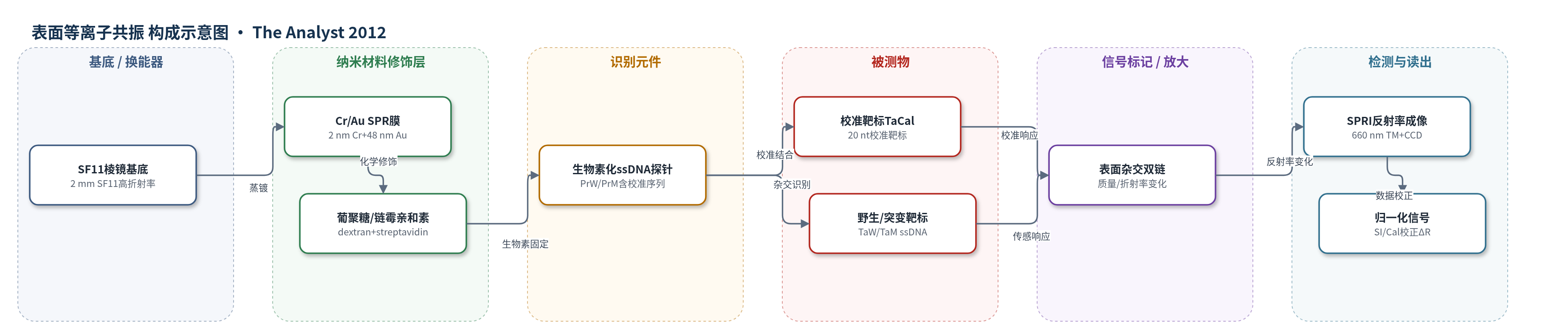
点击图片查看大图 · 依据论文自动绘制
传感器类型
表面等离子共振(SPR)生物传感器
检测对象
CFTR M470V 单核苷酸多态性(SNP)相关野生型/突变型单链 DNA 靶标(TaW/TaM);样品基质为 PBS 缓冲液(模拟患者基因产物提取液)
检测原理
系统采用 Kretschmann 型表面等离子共振成像(SPRI)。660 nm TM 偏振光经 SF11 棱镜激发金膜表面等离子体,当靶标 ssDNA 与芯片上探针杂交时,表面生物膜厚度和局部折射率改变,导致反射率发生空间分辨变化,由 CCD 记录为 ΔR(t)。探针为多功能设计:传感序列识别 CFTR M470V 野生/突变靶标,共同校准序列与 TaCal 杂交。先注入 PBS 1.25× 产生折射率阶跃,校正金膜/功能化层空间灵敏度差异;再注入 TaCal 饱和结合,量化各点有效探针密度。校正后的 ΔR 在低浓度下近似正比于靶标初始结合量,PrW 与 PrM 信号差的正、负或中间趋势分别指示 WT、MT 和 HT 基因型。
检测灵敏度
原文未报告 LOD、线性范围、灵敏度斜率或相关系数;仅描述典型灵敏度为每纳米平均生物膜厚度约百分之几的反射率变化。
效应效果
校准循环重复 6 次,run 0 的 ΔR(Cal) 平均 1.08%、中位 1.16%、标准差 0.39%;同一斑点连续靶标注入标准差仅 0.07%,说明时间重现性优于空间斑点重复至少 5 倍。校正前各次校准信号标准差为 0.61%、0.33%、0.26%、0.32%、0.36%,校正后降至 0.08%、0.10%、0.10%、0.10%、0.10%。在 144 个子矩阵 SNP 基因分型中,未校正时最佳区分度约 1σ(约 68% 正确),校正后提高至 3σ(>99% 正确),并可实现 100% 正确基因分型,单芯片分析少于 10 分钟。作者认为该方法降低芯片制作要求,适用于动态读取系统的常规分子诊断。
传感器的构成
- 基底/换能器:SF11 高折射率棱镜(2 mm):承载金膜并用于 Kretschmann 型 SPR 光耦合。
- 过渡层:2 nm Cr:增强金膜与基底附着。
- SPR 金属层:48 nm Au:激发表面等离子体,反射率随表面生物膜厚度/折射率变化。
- 功能化层:dextran 化学层 + streptavidin:提供生物素结合位点,稳定固定探针并支持再生。
- 识别元件:biotinylated ssDNA probes PrW/PrM:含 15 nt 传感序列,识别 CFTR M470V 野生/突变靶标。
- 校准元件:共同校准序列 5′-GACCGGTATGCG-3′:与 TaCal 杂交,量化各点有效探针密度。
- 间隔序列:10-base poly-T spacer:分隔传感序列与校准序列,降低空间位阻。
- 连接基团:biotin linker:将探针高亲和固定至链霉亲和素层。
中文摘要
本文利用探针功能化稳定的生物芯片和可实时测量的检测系统,证明在同一探针斑点上进行连续靶标注射所获得的探针–靶标相互作用数据,比在单次平行靶标注射中使用多个探针斑点重复所获得的数据在时间上更具重现性。为提高生物芯片数据精度,作者开发了一种无需复杂数据后处理即可量化并校正表面异质性的归一化方法。该方法简单有效,其核心是在所有探针中加入共同反应基团,并通过测量生物芯片对校准靶标的响应来量化生物传感器响应性的空间异质性。作者以 DNA–DNA 相互作用为模型,采用表面等离子共振成像系统作为动态读取器,验证了该方法的普适性。生物芯片基于经链霉亲和素生化功能化的金膜,其上点样与囊性纤维化基因分型相关的生物素化单链 DNA 探针。该归一化方法显著提高数据精度,使单核苷酸多态性基因分型能够明确区分杂合子与两种纯合子。
英文摘要
Using a biochip with stable probe functionalization and a detection system capable of real time measurements, it is demonstrated that acquired probe-target interaction data are more reproducible in time--on a given probe spot using sequential target runs--than in space, using many probe spot replicates on the biochip in one single parallel target run. To increase the biochip data precision, a normalization method that quantifies and corrects the surface inhomogeneity without the use of complex data post-processing has been developed. This simple and effective method is based on adding a common reactive group to all probes and quantifying the biochip response to a calibration target, thus quantifying the spatial heterogeneity in the biosensor responsiveness. The usefulness of such methodology, which can be easily generalized, is demonstrated in the model case of DNA:DNA interactions, using a surface plasmon resonance imaging system as the dynamical reader. The biochips are based on streptavidin biochemically functionalized gold films onto which biotinylated ssDNA probe sequences, related to cystic fibrosis genotyping, are spotted. This normalization method provides high gain in data precision and allows, in this example, unambiguous genotyping of SNP, including discrimination of the heterozygote case from the two homozygote cases.