组成图示
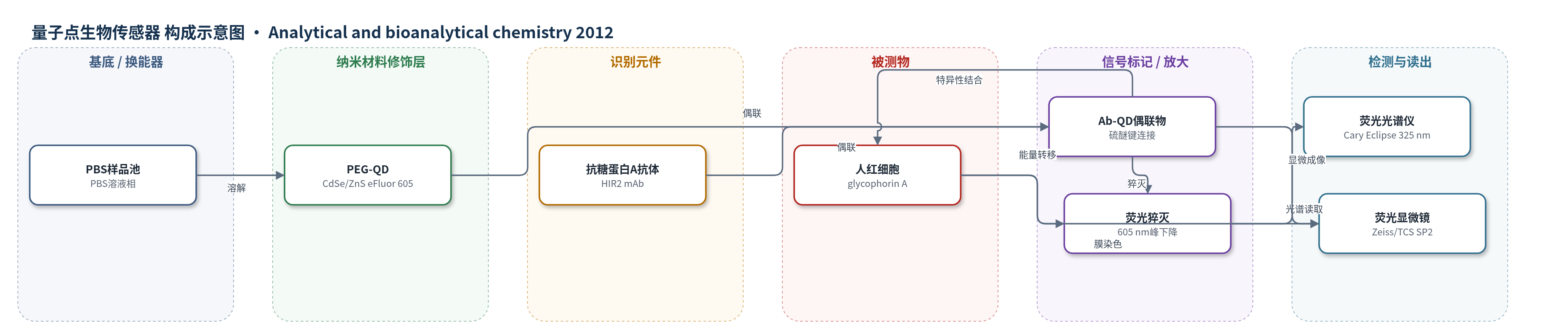
点击图片查看大图 · 依据论文自动绘制
传感器类型
量子点生物传感器
检测对象
人血/人红细胞(human blood / human erythrocytes);样品基质:全血(whole blood,EDTA抗凝)、血涂片(blood smears)
检测原理
抗糖蛋白A抗体通过硫醇化学偶联到PEG修饰的CdSe/ZnS量子点(QDs)上,形成Ab–QD偶联物。Ab–QD在PBS中发射605 nm荧光。加入人全血后,抗体特异性结合红细胞膜上的糖蛋白A,使QD靠近细胞膜及抗原微环境,发生能量转移或荧光猝灭,导致605 nm峰强度显著下降。猝灭程度随血样稀释度、红细胞数量和抗原数量增加而增强,呈浓度依赖关系。未偶联QD缺乏该特异性结合,其荧光强度随浓度增加而升高。检测时通过荧光光谱仪读取605 nm峰强度变化,或通过荧光显微镜观察红细胞膜染色,从而判断人血存在。
检测灵敏度
未报告LOD、线性范围、灵敏度斜率或相关系数。
效应效果
该Ab–QD传感器对人血具有明显特异性:与全血孵育后605 nm荧光峰猝灭92.26%(t=113.04,p<0.001),血浆460 nm峰下降52.58%(t=21.45,p=0.001);精液和唾液未出现类似猝灭。未偶联QD在血中峰强度随浓度增加,而Ab–QD无显著变化,说明猝灭依赖抗体识别。DNA分型显示处理样品与对照均扩增22/22等位基因,DNA量分别为2.46、2.53、4.11 ng/μL和4.21、3.1、3.7 ng/μL,对照为2.28和3.08 ng/μL,未观察到抑制。作者认为方法快速、简便、人源特异且可保留DNA,适用于法医体液鉴定。
传感器的构成
- 基底/样品池:PBS溶液相(无固体电极基底),作为溶液相检测介质
- 信号标记/换能元件:eFluor 605 纳米晶量子点(CdSe/ZnS QDs,PEG表面功能化),提供605 nm荧光并因结合靶标猝灭
- 识别元件:抗人糖蛋白A单克隆抗体(anti-human glycophorin A mAb, HIR2),特异性结合红细胞膜糖蛋白A
- 偶联层:硫醇反应偶联试剂(eFluor 605 Nanocrystal Conjugation Kit–Sulfhydryl Reactive),通过硫醚键连接抗体与QD
- 样品基质:人全血/红细胞(human whole blood/erythrocytes),含膜抗原糖蛋白A,作为被测物来源
- 读出装置:荧光光谱仪(Varian Cary Eclipse,325 nm激发,350–620 nm扫描)和荧光显微镜(Zeiss Axioskop 2 MOT plus/TCS SP2),读取605 nm峰强度变化
中文摘要
在犯罪现场识别人血可为调查提供关键信息,并可提供用于DNA分型的核物质来源。本文报道了一种用于识别人血的免疫荧光生物传感器的开发,有望克服现有体液鉴定技术的不足。研究人员将抗人红细胞抗体(anti-glycophorin A)通过硫醇化学偶联到荧光半导体量子点(QDs)上,形成抗体–量子点(Ab–QD)偶联物。偶联产物经琼脂糖凝胶电泳和免疫组织化学验证。将液体血样与偶联纳米晶孵育后,其荧光发射谱呈现浓度依赖性的猝灭;而未偶联QD在血样中表现出不同效应。对经Ab–QD处理后的血样进行DNA分型,可获得完整谱型,表明该方法不干扰DNA分型。据作者所知,这是首个可用于识别人血的混合Ab–QD传感器实例。该研究有望开辟体液检测领域的新研究方向。
英文摘要
The identification of human blood at a crime scene can provide crucial information to an investigation whilst also providing a source of nuclear material which can be targeted for DNA profiling. Here, we report on the development of an immunofluorescent biosensor for the identification of human blood which has the potential to overcome the drawbacks of the current body fluid identification techniques. An antibody (Ab) raised against human erythrocytes was conjugated to fluorescent semiconductor quantum dots (QDs) by sulfhydryl chemistry. The conjugation was verified by agarose gel electrophoresis and immunohistochemistry. Incubation of liquid blood samples with the conjugated nanocrystals was shown to quench the fluorescence emission spectra in a concentration-dependent manner. A different effect was observed with unconjugated QDs incubated in blood. Full profiles were obtained from blood samples previously treated with the Ab-QDs, demonstrating that the method does not interfere with DNA profiling. To our knowledge, this is the first example of a hybrid Ab-QD sensor that has the potential to be employed for the identification of human blood. The results of this study are expected to open up a new research direction in the field of body fluid detection.