组成图示
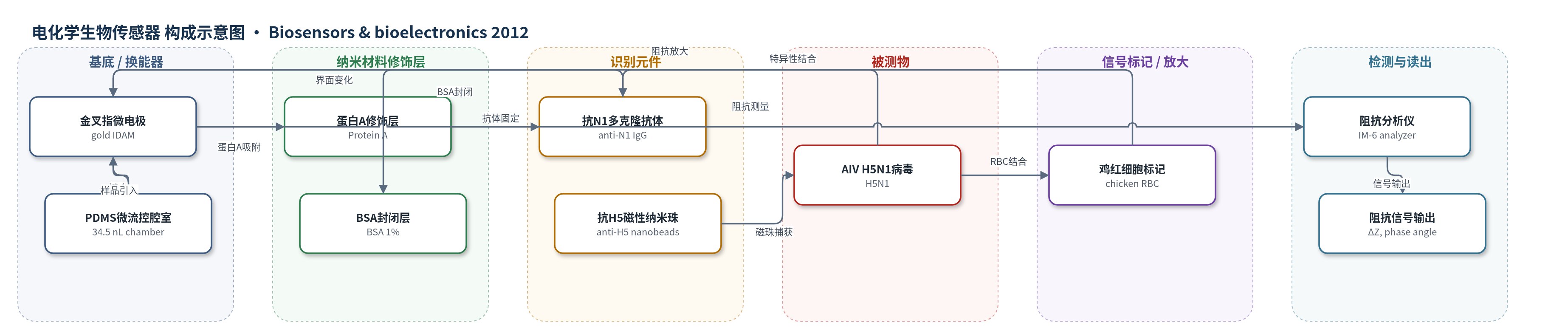
点击图片查看大图 · 依据论文自动绘制
传感器类型
电化学生物传感器
检测对象
禽流感病毒 H5N1(AIV H5N1);样品基质为灭活病毒悬液/病毒样品(经免疫磁分离处理)
检测原理
先用生物素化抗 H5 单克隆抗体修饰的 30 nm 磁性链霉亲和素纳米珠从样品中免疫磁分离并富集 AIV H5N1。微电极表面经 Protein A 固定抗 N1 多克隆抗体,BSA 封闭后,捕获的病毒通过 N1 抗原与电极抗体特异性结合,在电极表面形成蛋白/病毒生物层,阻碍叉指间离子流动,使溶液电阻 Rs 增加,阻抗幅值在 1–50 kHz 升高。随后加入鸡红细胞,病毒血凝素结合红细胞表面唾液酸,RBC 作为大尺寸生物标记进一步增加界面电阻,放大阻抗变化。施加 100 mV 交流信号,IM-6 测量阻抗幅值和相位,ΔZ 或 ΔRs 随病毒浓度增加而增大,RBC 放大后在 10^1–10^5 EID50/mL 呈线性。
检测灵敏度
LOD: 10^3 EID50 ml−1;线性范围: 10^1–10^5 EID50 ml−1;ΔZ=8562.3cvirus – 5212.4;R^2=0.83;无 RBC: LOD 10^5 EID50 ml−1, R^2=0.10;Rs: LOD 10^2 EID50 ml−1, R^2=0.98
效应效果
该传感器在 2 h 内检测 AIV H5N1,LOD 为 10^3 EID50/mL,与先前仅针对 H5 的阻抗传感器相同,但通过抗 H5 磁珠分离和抗 N1 电极抗体实现 HA/NA 双重识别,特异性更高。特异性测试中,5 种非目标禽流感亚型里仅 H5N2 产生显著假阳性,归因于多克隆抗 N1 抗体与 N2 的交叉反应;其余非目标亚型无显著信号。RBC 放大使阻抗变化提高超过 100%,并使校准曲线从无 RBC 时的 R^2=0.10 改善到 R^2=0.83,但 RBC 尺寸较大且单个 RBC 可结合多个病毒,导致标准差较大、线性相关仍有限。作者认为该装置结构简单、成本低、可微型化,适合现场或床边快速筛查禽流感疫情。
传感器的构成
- 基底/换能器电极:金叉指阵列微电极(gold interdigitated array microelectrode, IDAM),嵌入 PDMS 微流控芯片,用于施加交流信号并测量阻抗。
- 微流控腔室:PDMS 微流控通道与椭圆腔室(40 μm 深、100 μm 宽,腔室 34.5 nL),用于样品引入、孵育和洗涤。
- 亲和修饰层:金黄色葡萄球菌蛋白 A(Protein A, S. aureus)直接吸附于金表面,通过 Fc 区结合固定抗体。
- 识别元件:抗 N1 多克隆抗体(polyclonal anti-N1 antibody)固定于电极表面,特异性捕获 AIV H5N1 的 N1 抗原。
- 封闭剂:牛血清白蛋白(BSA, 1%)封闭电极表面非特异结合位点。
- 免疫磁分离层:30 nm 磁性链霉亲和素纳米珠(magnetic streptavidin-coated 30 nm nanobeads)偶联生物素化抗 H5 单克隆抗体(biotinylated anti-H5 monoclonal antibody),用于分离和富集 AIV H5N1。
- 信号标记/放大元件:鸡红细胞(chicken red blood cells, RBC, 0.5% w/v)通过病毒血凝素结合病毒表面唾液酸,作为大尺寸生物标记放大阻抗。
- 测量介质:0.04 M imidazole buffered saline with 0.4% Tween 20(稀释 1:200,000),用于洗涤和阻抗测量。
中文摘要
禽流感病毒(AIV)H5N1 亚型自 1990 年代发现以来,已成为全球大流行和经济损失的潜在来源。当前公认的金标准检测方法病毒培养和 rRT-PCR 耗时、昂贵,且需要专门培训和实验室设施。因此,需要一种快速、灵敏、特异的筛查方法用于现场或床边检测 AIV,以有效实施隔离和药物治疗。本研究旨在提高已用于 AIV H5 筛查的阻抗生物传感器的特异性和灵敏度。所开发传感器的三个主要组成部分是用于分离 AIV 病毒的免疫磁性纳米颗粒、用于样品控制的微流控芯片和用于阻抗测量的叉指微电极。在本研究中,抗 N1 亚型多克隆抗体被固定在微电极表面,以特异性结合 AIV H5N1 并产生更特异的阻抗信号;鸡红细胞(RBC)作为生物标记物结合捕获在微电极上的 AIV H5N1,以放大阻抗信号。RBC 放大显示,与无 RBC 生物标记方案相比,阻抗信号变化提高超过 100%,并且是形成生物传感器线性校准曲线所必需的。使用第二种抗 N1 抗体比先前生物传感器方案提供了更高的特异性和可靠性。该传感器能够在 2 h 内检测低至 10^3 EID50/mL 的 AIV H5N1。
英文摘要
Avian influenza virus (AIV) subtype H5N1 was first discovered in the 1990 s and since then its emergence has become a likely source of a global pandemic and economic loss. Currently accepted gold standard methods of influenza detection, viral culture and rRT-PCR, are time consuming, expensive and require special training and laboratory facilities. A rapid, sensitive, and specific screening method is needed for in-field or bedside testing of AI virus to effectively implement quarantines and medications. Therefore, the objective of this study was to improve the specificity and sensitivity of an impedance biosensor that has been developed for the screening of AIV H5. Three major components of the developed biosensor are immunomagnetic nanoparticles for the separation of AI virus, a microfluidic chip for sample control and an interdigitated microelectrode for impedance measurement. In this study polyclonal antibody against N1 subtype was immobilized on the surface of the microelectrode to specifically bind AIV H5N1 to generate more specific impedance signal and chicken red blood cells (RBC) were used as biolabels to attach to AIV H5N1 captured on the microelectrode to amplify impedance signal. RBC amplification was shown to increase the impedance signal change by more than 100% compared to the protocol without RBC biolabels, and was necessary for forming a linear calibration curve for the biosensor. The use of a second antibody against N1 offered much greater specificity and reliability than the previous biosensor protocol. The biosensor was able to detect AIV H5N1 at concentrations down to 10(3) EID(50)ml(-1) in less than 2h.