组成图示
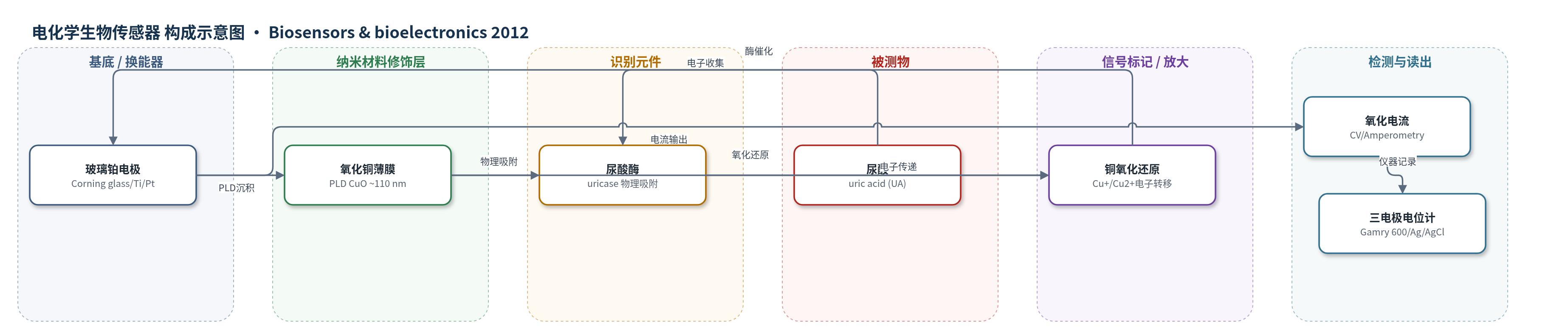
点击图片查看大图 · 依据论文自动绘制
传感器类型
电化学生物传感器
检测对象
尿酸(uric acid, UA);样品基质:PBS缓冲液、人血清
检测原理
尿酸在固定于CuO薄膜表面的尿酸酶催化下被氧化为尿囊素,同时尿酸酶活性中心被还原。p型CuO薄膜具有Cu+/Cu2+氧化还原对,可直接接受还原态尿酸酶活性中心的电子,随后Cu+被重新氧化,将电子传递至Pt电极。该过程无需外部氧化还原介质,CuO自身充当电子转移介质。随着尿酸浓度升高,单位时间内酶催化反应释放的电子数增加,电极氧化峰电流/安培电流线性增大。CuO粗糙多孔表面提高酶负载量,p型高载流子迁移率增强界面电子通信,从而获得较低电位下的快速响应。
检测灵敏度
LOD: 0.14 mM(信噪比=3);线性范围: 0.05 mM–1.0 mM;灵敏度: 2.7 mA/mM;线性回归斜率: 2.701 mA/mM;R^2 = 0.992
效应效果
该传感器对葡萄糖(5 mM)、胆固醇(5 mM)、尿素(1 mM)、抗坏血酸(0.1 mM)和乳酸(0.5 mM)等干扰物在生理浓度下对0.10 mM尿酸响应影响可忽略。4 ℃储存14周后仍保留>90%活性,货架寿命>14周。人血清样品测定RSD为1.2%–3.0%,加标0.5 mM后RSD为1.5%–2.4%,回收率98.6%–102.4%,与商品化分光光度法结果一致。其Km为0.12 mM,95%响应时间4 s,无需外部介质,作者认为可用于无试剂集成植入式尿酸生物传感器。
传感器的构成
- 基底/换能器电极:Corning glass(康宁玻璃)基底,RF溅射 Ti(约10 nm)缓冲层和 Pt(约100 nm)导电层,提供导电基底与电子收集。
- 纳米材料修饰层:PLD 制备 p型 CuO 薄膜(约110 nm),具 Cu+/Cu2+ 氧化还原对和粗糙多孔表面,促进电子转移与酶负载。
- 识别元件:尿酸酶(uricase)通过物理吸附/静电作用固定于 CuO 表面,催化尿酸氧化为尿囊素。
- 电子转移介质:CuO 自身氧化还原对(Cu+/Cu2+),无外部介质,传递尿酸酶活性中心电子至 Pt 电极。
- 电解质:50 mM PBS(pH 7.0,0.9% NaCl),提供离子导电与酶活性环境。
中文摘要
本文报道了一种基于氧化铜(CuO)薄膜的无试剂尿酸生物传感器。作者采用脉冲激光沉积(PLD)技术在镀铂(Pt)康宁玻璃基底上生长p型CuO薄膜,并将尿酸酶(uricase)通过物理吸附固定于CuO表面,构成尿酸酶/CuO/Pt/玻璃生物电极。CuO薄膜具有Cu+/Cu2+氧化还原对,可在无外部氧化还原介质的磷酸盐缓冲液(PBS)中促进尿酸酶活性中心与电极之间的电子传递。循环伏安和光度法结果表明,该生物电极在0.05–1.0 mM尿酸范围内呈良好线性,灵敏度为2.7 mA/mM,米氏常数Km为0.12 mM,表明固定尿酸酶对尿酸具有较高亲和力。生物电极在4 ℃储存14周后仍保持较高活性,作者认为该p型CuO薄膜基质有望用于无试剂、集成化植入式尿酸生物传感器。
英文摘要
An efficient reagentless uric acid biosensor has been realized using a copper oxide (CuO) thin film matrix grown onto platinum (Pt) coated corning glass substrates by pulsed laser deposition (PLD) technique. The p-type CuO matrix successfully introduces redox property in the electrode and provides enhanced electron communication features. Sensing response obtained by the bioelectrocatalytic oxidation of uric acid by uricase/CuO/Pt/glass electrode was studied without any external mediator using cyclic voltammetry (CV) and photometric assay. The studies reveal that the uricase/CuO/Pt/glass bio-electrode exhibits good linearity over a wide range of 0.05 mM to 1.0mM uric acid concentration with enhanced response of 2.7 mA/mM and high shelf life (>14 weeks). A low Michaelis-Menten constant (K(m)) of 0.12 mM, indicate that the immobilized enzyme (uricase) has enhanced affinity towards its analyte (uric acid). The results confirm promising application of the p-type CuO thin film matrix for the realization of a reagentless integrated implantable biosensor.